%20in%20Plain%20Sight_10.jpg)


“Toward a Sentence” at NARS Foundation
Review
John Cage once called Robert Rauschenberg's White Paintings “airports for lights, shadows and particles,” characterizing the painted work not as a window onto a world but rather a living capsule of its creation and a reflection of its environment. German artist Stefan Vogel's first New York solo exhibition, Wish You We, at Sofia Sominiski, presents four minimalist canvases that seem to have been generated by one layer of dust at a time, revealed under torn, plaster-dipped cloth that falls from the ceiling. Sofia Sominiski's street-facing glass frames the space as a fifth canvas that catches whatever passersby, like dust, happen to drift across it. In Wish You We, Vogel asks how our present might look from a distant future and what would survive. His response comes through the paintings’ material composition—dust, wire, dirt, cigarette ends, hair, photocopies, typewritten scraps, kitchen paper, bandage-like fabric. Vogel’s intentional incompleteness invokes the image of a dystopian construction site, where structure arises from the wreckage of the past.
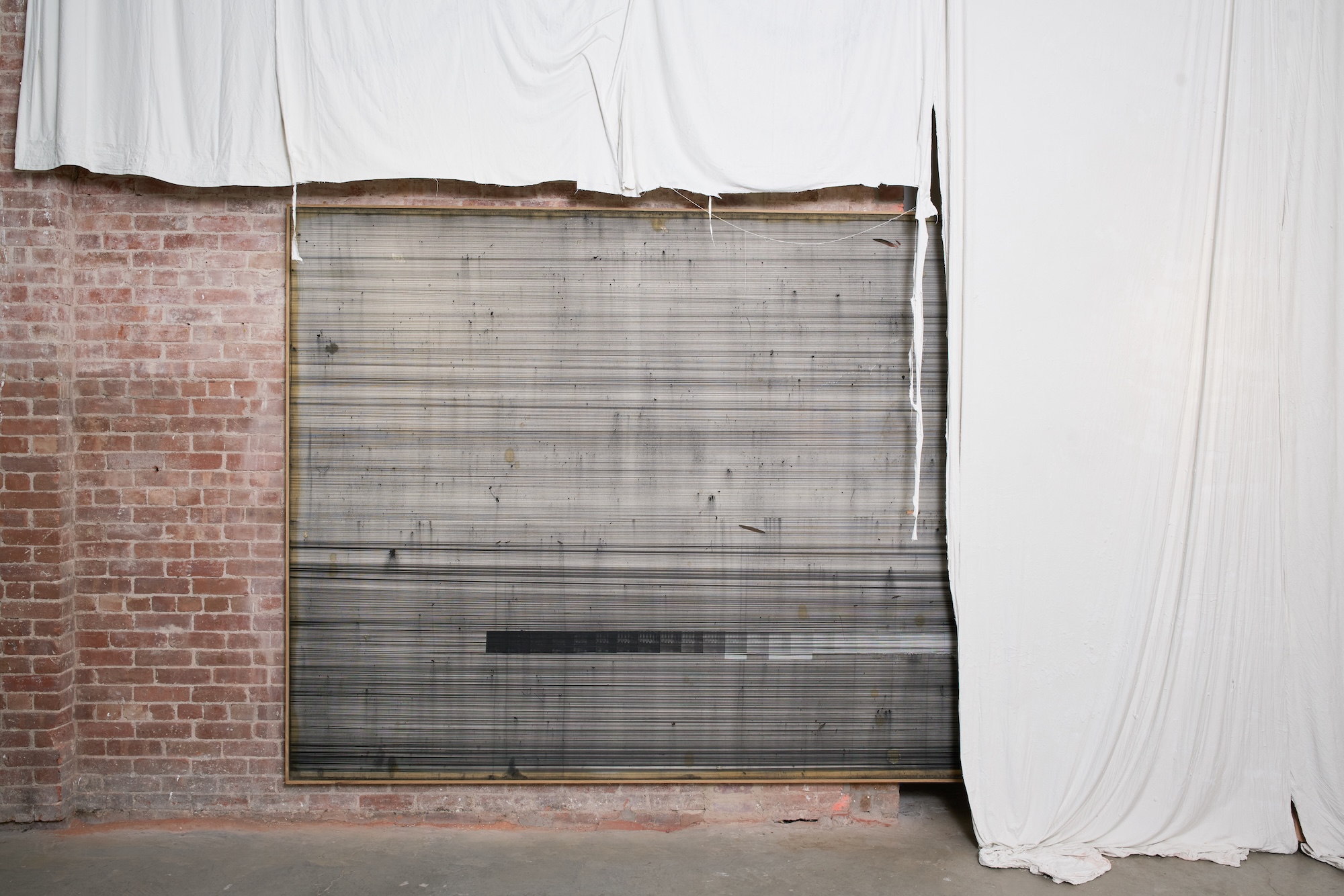
Vogel locates the beginning of his practice, which spans painting, installation, sculpture, and photography, in writing. First, he theorizes the narrative behind a work. Then, he paints, layering in text and photography drawn from his own archive and often reused across pieces, until the canvas fully encapsulates the writing. At first glance, Morgen und Bushaltestelle a/s Karper im Zug (2024) is a 200 cm x 240 cm monochromatic canvas in which detritus and dirt remain suspended on the unprimed, ink-stained surface. A few millimeters above it, a taut black string runs across at equal intervals. From afar, the composition appears like a television screen, perpetually caught between two channels. As the audience navigates the gallery space, their perception of the string's depth changes, like TV static. Similarly, the sun and ever-evolving weather outside the window determine what shadows the curtains and string cast on the surface. In contrast to the almost white surface and the diffusive ink, tears on the canvas surface first read as paint until further inspection (or enough sun) reveals the gallery’s brick wall. At the bottom of Morgen und Bushaltestelle a/s Karper im Zug, the same photograph of a radiator repeats and fades until it dissolves into white. As the composition simultaneously comes into focus and loses resolution in real time, the perpetual flux forces the audience to look at the surface until they become aware of their inability to understand it, a rehearsal of their blindness before the future.
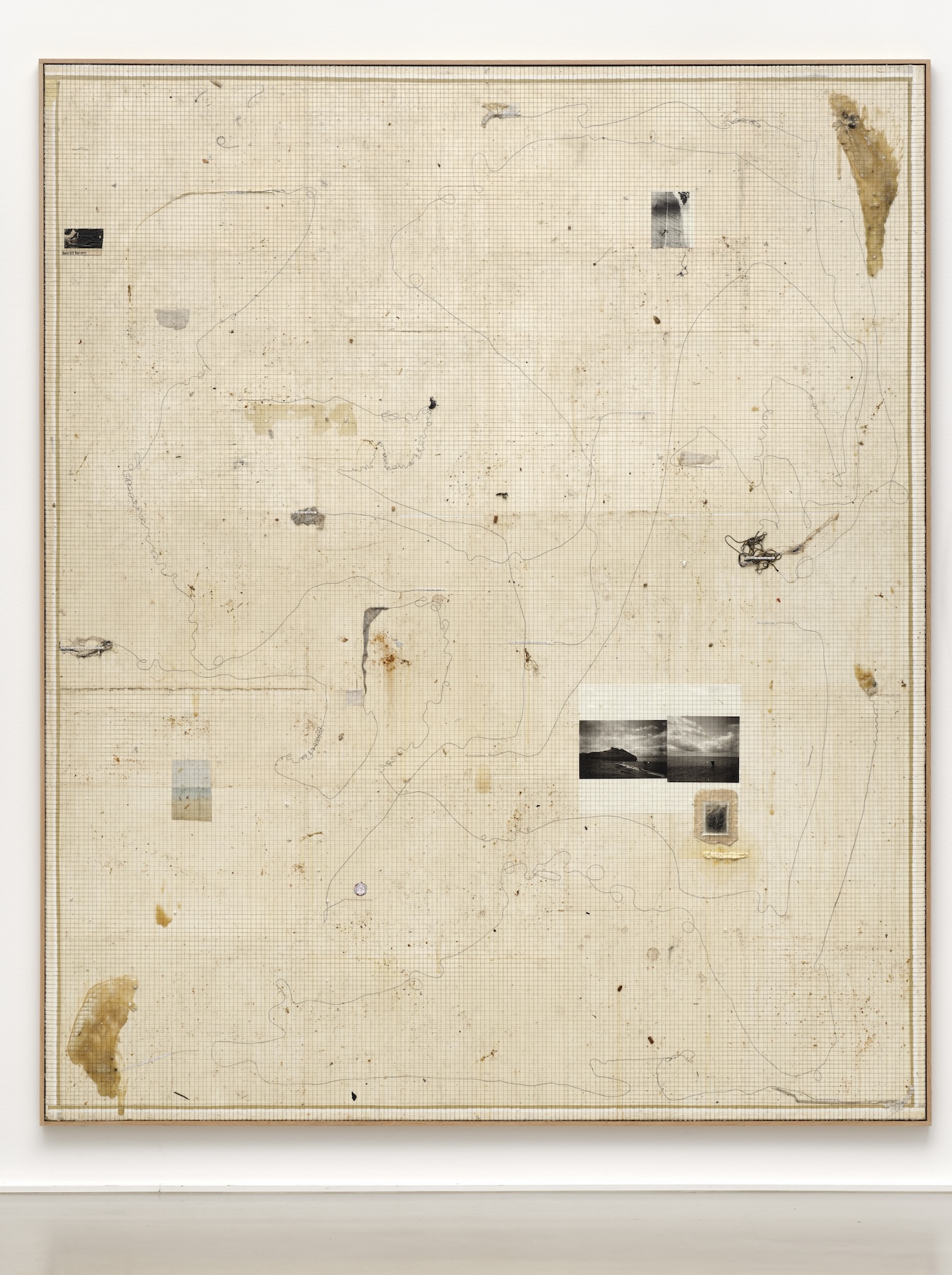
Sand (2023), which resembles a constellation chart from afar, further engages with porousness. Although the grid, emblematic of society, is just a taut string, the canvas surface is a mix of hair, ash, dust, string, paper, photos, and whatever happened to land there while the piece sat in the studio. Black thread, varnished onto the surface, meanders and stitches together fragments of type and photographs of the coastline of Sabaudia, a coastal town built in the 1930s as a showpiece of Fascist Rationalist planning: a cliff seen from above, the same stretch of shore repeated from a slightly different angle—all shot with the same sort of strange perspective that eschews the traditional linear one. Scraps of text run underneath in a register drawn from Vogel’s visit to Sabaudia: fragments about things melting and condensing, about something getting wet and then hard. In Sand, language is as fragmentary and bodily as the materials around it, like a fractured dream that resurrects the long past while creating something new.
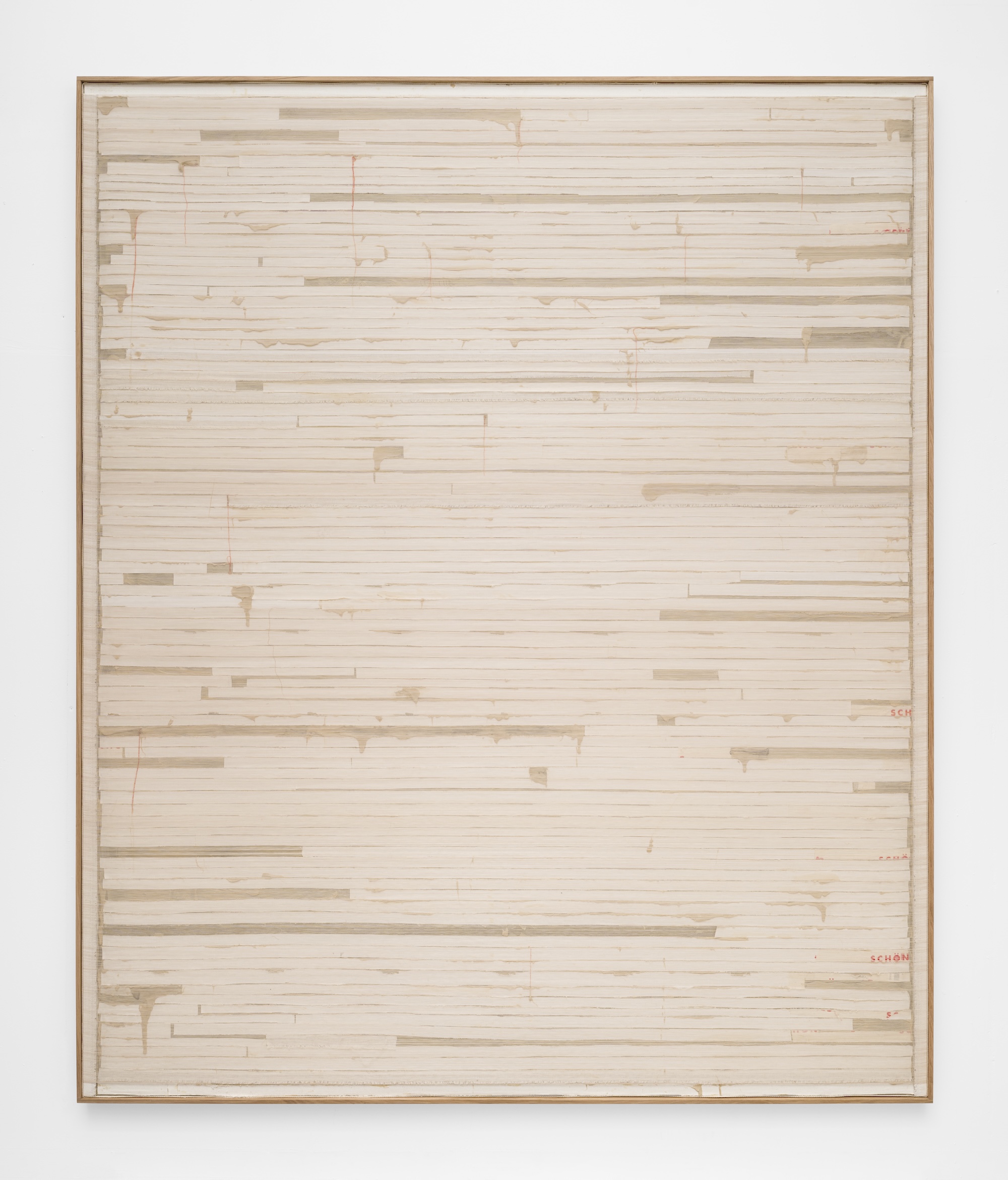
Eigentlich Schön (2025) is the piece whose surface is most visibly under duress. Strips of fabric are pasted across the canvas in a pattern that nods to Frank Stella's bands while connoting a full-body cast. Like gauze, a separate layer of white string is wound over the whole composition, echoing the diagonals of the fabric strips. The brown adhesive holding the strips together drips down, like blood seeping through a bandaged wound. Embalmed between the gauze is the German word schön, stenciled in red, broken apart and repeated as if the canvas is still deciding whether to admit it. Red string picks up that same color elsewhere on the surface. While Eigentlich Schön feels incomplete, patched up to heal the decomposing layers, the effect is its preserved instability, as if scaffolding became a permanent fixture of a building’s facade.
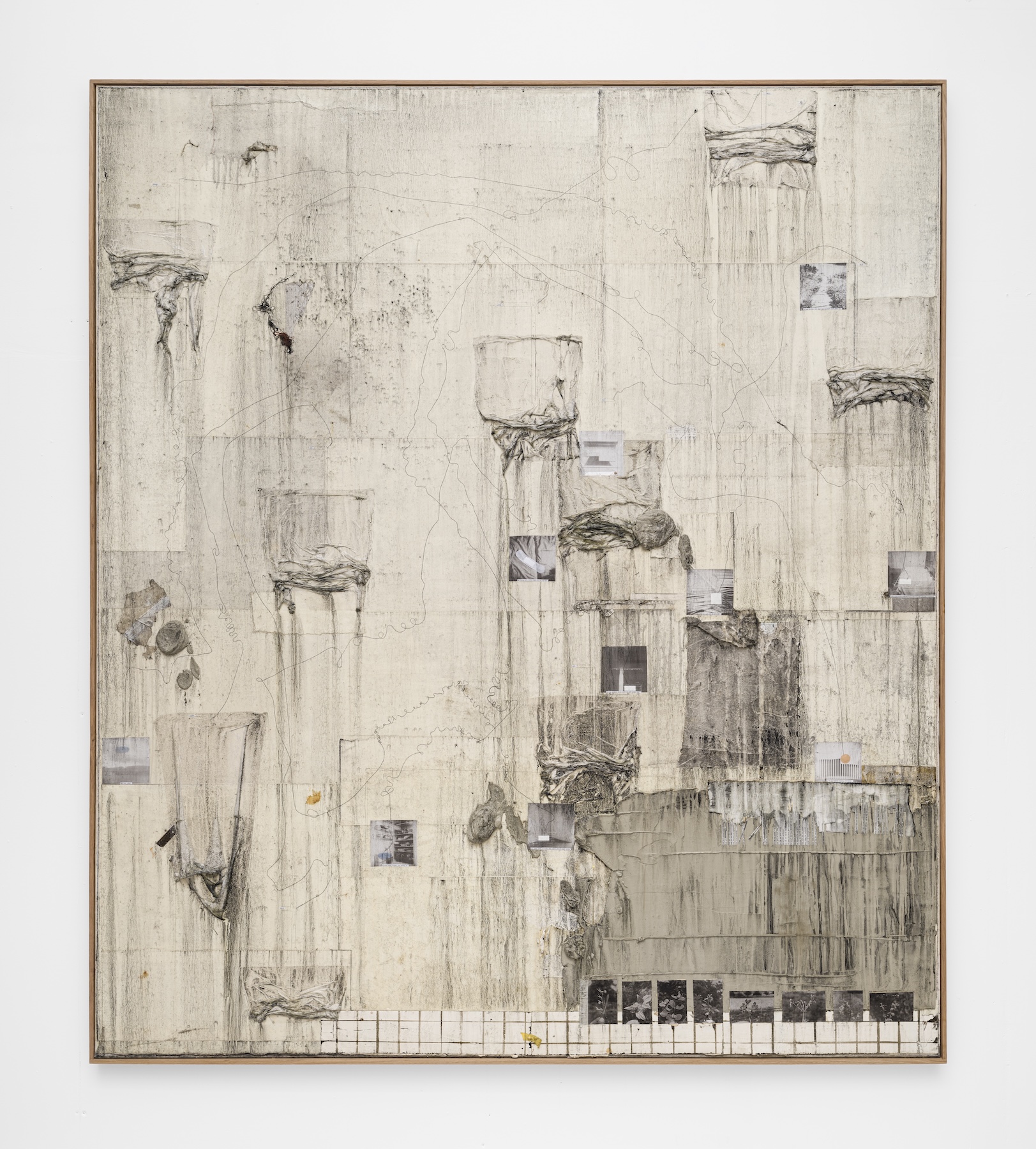
Following the more minimal Eigentlich Schön, eigentlich schon wenn die Sprache nicht wäre und all die Winkel (2024) layers fabric and plaster to infuse the surface with blisters and ridges. Vogel then seals the surface under lacquer and dusts it with charcoal, catching hair and studio debris between the coats. Broken bathroom tiles are embedded along the bottom edge, half-swallowed by the surface, interrupted by small photographs of plants wherever the tile grid breaks. Alongside, black thread loops through the piece almost carelessly, and bandages stitch on images of indiscernible textures—a bookshelf, a bed sheet, a photocopier, and a window blind. Above them, fragments that read like postcard language—notes on weather, on temperature, on a jacket with a zip-off lining—sit beside a help-line phone number, one kind of message mirroring another. Text runs around the work's entire border with no spaces between words, so the sentence itself becomes a kind of wall. Near the bottom, one line survives almost intact, and it might be the closest thing the show has to a thesis statement (roughly translated from German): downward and down and further and further and ever further down below the underneath, at the very bottom, and then, when you... The sentence never finishes, nor does the painting.
In a similar vein to his paintings, the exhibition's title, Wish You We, reads like a postcard phrase with a word missing, "wish you were here," interrupted before it can complete itself. Though the missing phrase is never confirmed, the multitudinous meanings the remaining words suggest speak louder than a single, resolved sentence ever could. The distorted grammar requires the audience to think inside the painting's own broken language and, in doing so, to accept that the future, like the sentence itself, is unknowable and unresolved. As Karl Marx once defined the force of history as “the midwife of every old society pregnant with a new one,” the incompleteness of Stefan Vogel’s grammar and artworks embodies this sort of materialism, where the future lies hidden within the present detritus. In Wish You We, the present operating within the fixed structure of string, ink, nails, and canvas—the past’s creation—becomes defined by the weather of its future.
Stefan Vogel: Wish You We is on view at Sofia Sominiski Gallery from June 26 to August 1, 2026.