.webp)
.jpg)
Tim Kent: “Sojourn” at Hollis Taggart
Review
Niki (2026), a sixteen-by-four-meter adhesive print showing a detail of white jeans, stretches across the floor, past the entrance wall and into the long corridor of Fondazione Sandretto Re Rebaudengo. It is the only one of the ten enigmatic works by June Crespo in Danzante that readily submits to description. For the others, words quickly prove inadequate. One can report their mostly human-scale dimensions; their evocative titles, such as Vascular, The Dancing Column, and Óptico; the way they inhabit the space, resting on the floor or hanging from the ceiling. One can quote the press release, according to which the works “take their formal vocabulary from the iris and the strelitzia (bird of paradise),” or list their materials: aluminium and bronze, cement, garments, straps, ceramic, marble dust, resin, fiberglass, asphalt, plants.
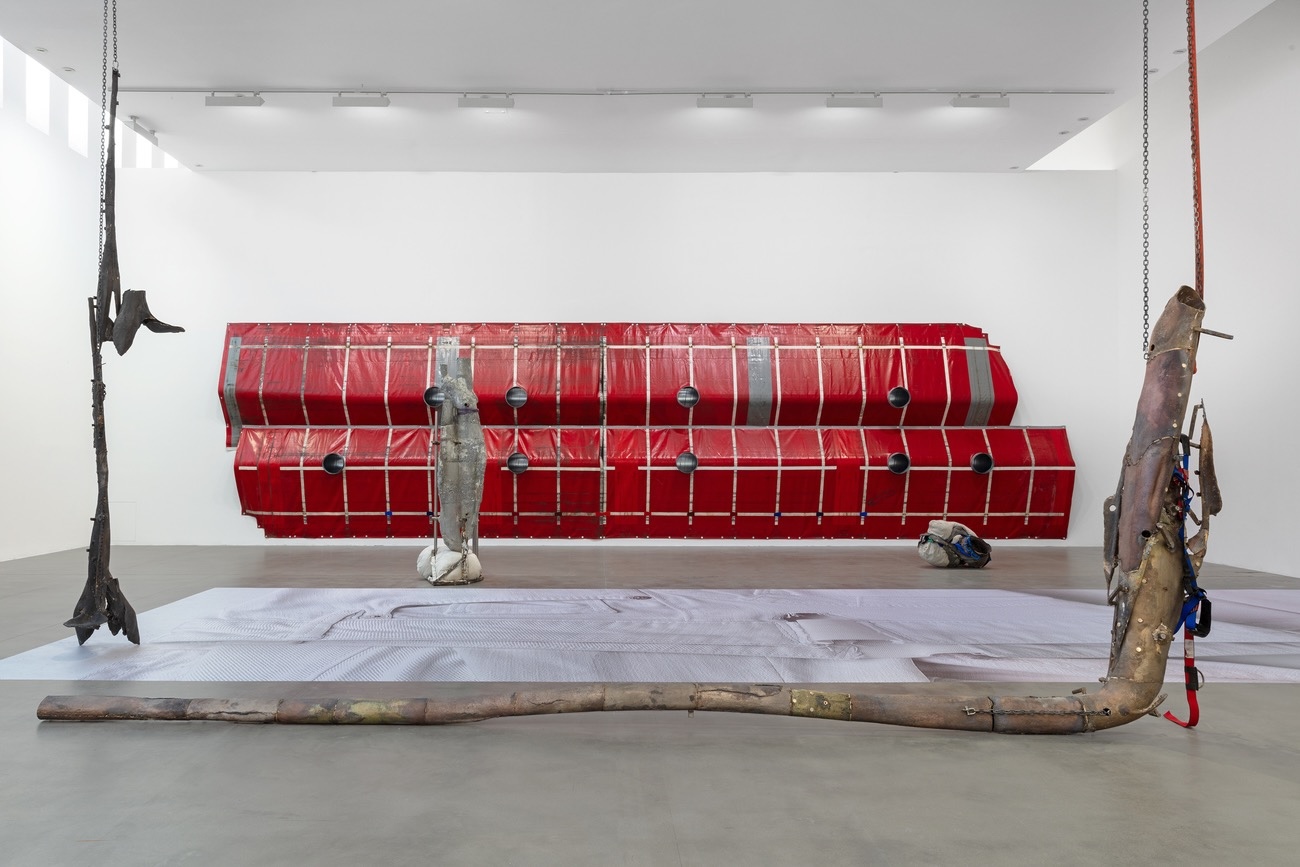
At first, Danzante seems to belong to a recognizable posthuman sculptural vocabulary: semi-figurative, semi-industrial, bodily but without humanity, material but resistant to form, running from Nairy Baghramian to Andra Ursuta, through Giulia Cenci and Hannah Levy. Not by chance, Crespo also took part in the 2022 Venice Biennale, The Milk of Dreams. Much of this recently popular sculpture works, but by now it belongs to a specific and overexposed vocabulary, and rarely unsettles the terms by which we approach it. Crespo does.
All the preparation with which one approaches this kind of sculpture turns against the viewer, as Crespo’s consolidated, if not depleted, vocabulary proves unpredictable. The only anchors are the bodily, architectural, and natural references suggested by the titles, or the spatial directives indicated by the volumes, which rise like plants searching for overhead light, only to bend abruptly, parallel to the floor, in unnatural, mechanical ways, as in The Dancing Column IV (Iris) (2025). Elsewhere, one can glimpse casts of mannequins or identifiable garments. But as soon as these elements become recognizable, the rest counterbalances them with incomprehensible masses, just as the nine sculptures offset the photographic print on the floor.
A sentence by Donald Judd comes to mind: “The parts are always more important than the whole. (But) the whole’s it. The big problem is to maintain the sense of the whole thing.” As soon as it surfaced, the link between Crespo and Judd seemed self-evident. Even before discovering that Crespo herself has said she focuses first on “the relations between the parts and the whole,” because it is “difficult not to establish hierarchies of attention,” I related to the works not as a mixture of references and gestures, but as a self-possessed body of work, marked by an austerity closer to Minimalism. How can something carry the appearance of post-industrial corporeality with Judd’s authority and posture?
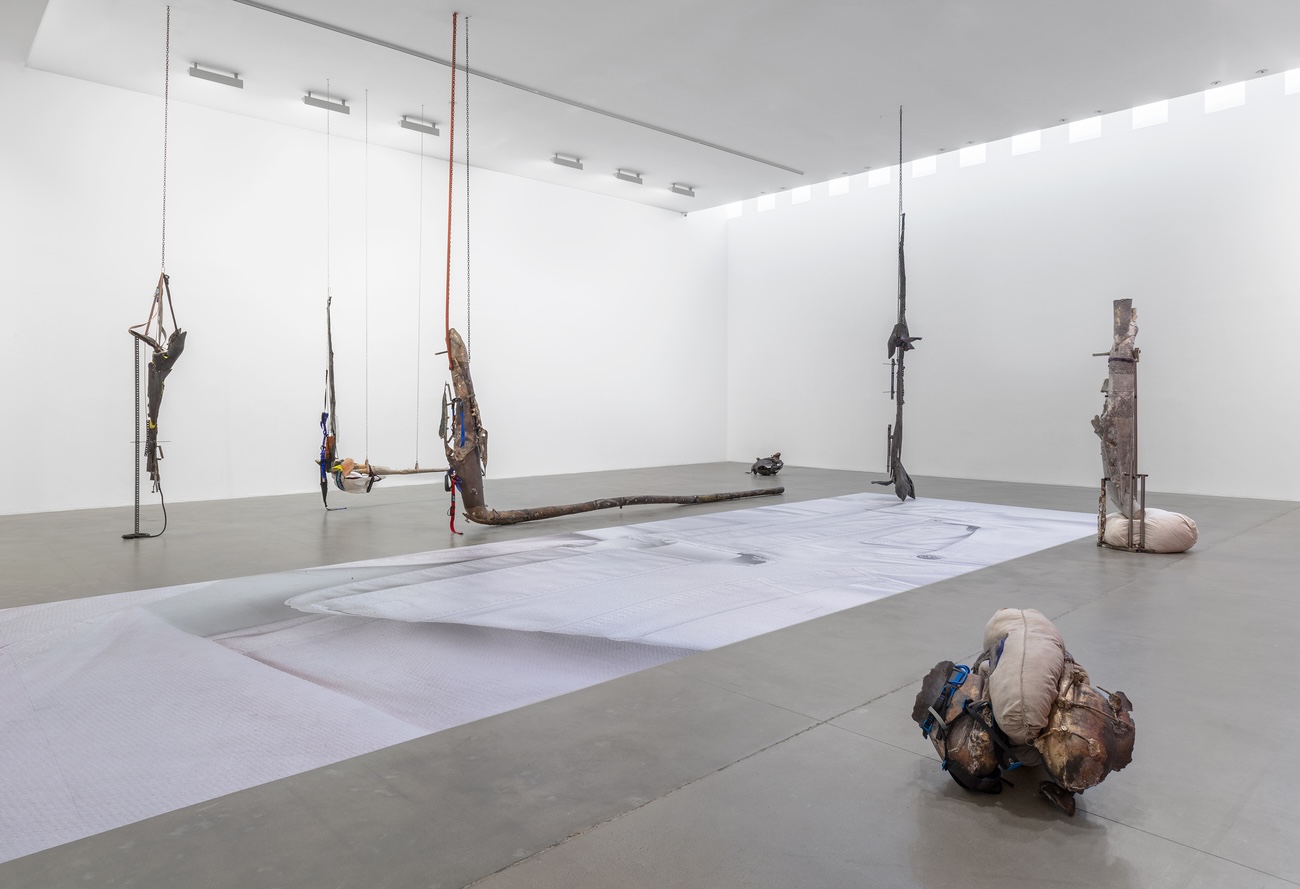
In After Art, David Joselit theorized “the emergent image” as “a dynamic form that arises out of circulation,” requiring “a spatialized form of reception.” Whether or not the reference is direct, it is telling that Crespo speaks of an “emergent thing,” born from her “affective feeling” toward materials, while the exhibition’s press release states that “it is only as we circle around the works that we begin to establish a relationship.”
Through titles and found objects, she allows recognition to begin and then interrupts it. The ease with which she oscillates between elements of figuration and amorphousness lets each register leak into the other. One begins to see mannequins as abstract forms, and abstract forms as body parts. She clearly does not believe in a clean distinction between the two, so it is useless to police it.
The same equivalence applies to the physical bonds within the works: the cushion on which a form rests, the straps binding the parts together, the visible seams. For objects so evidently manipulated, they appear spontaneous, as if pre-existing. They are posed as axioms, with the force of affirmation, but without its presumption.
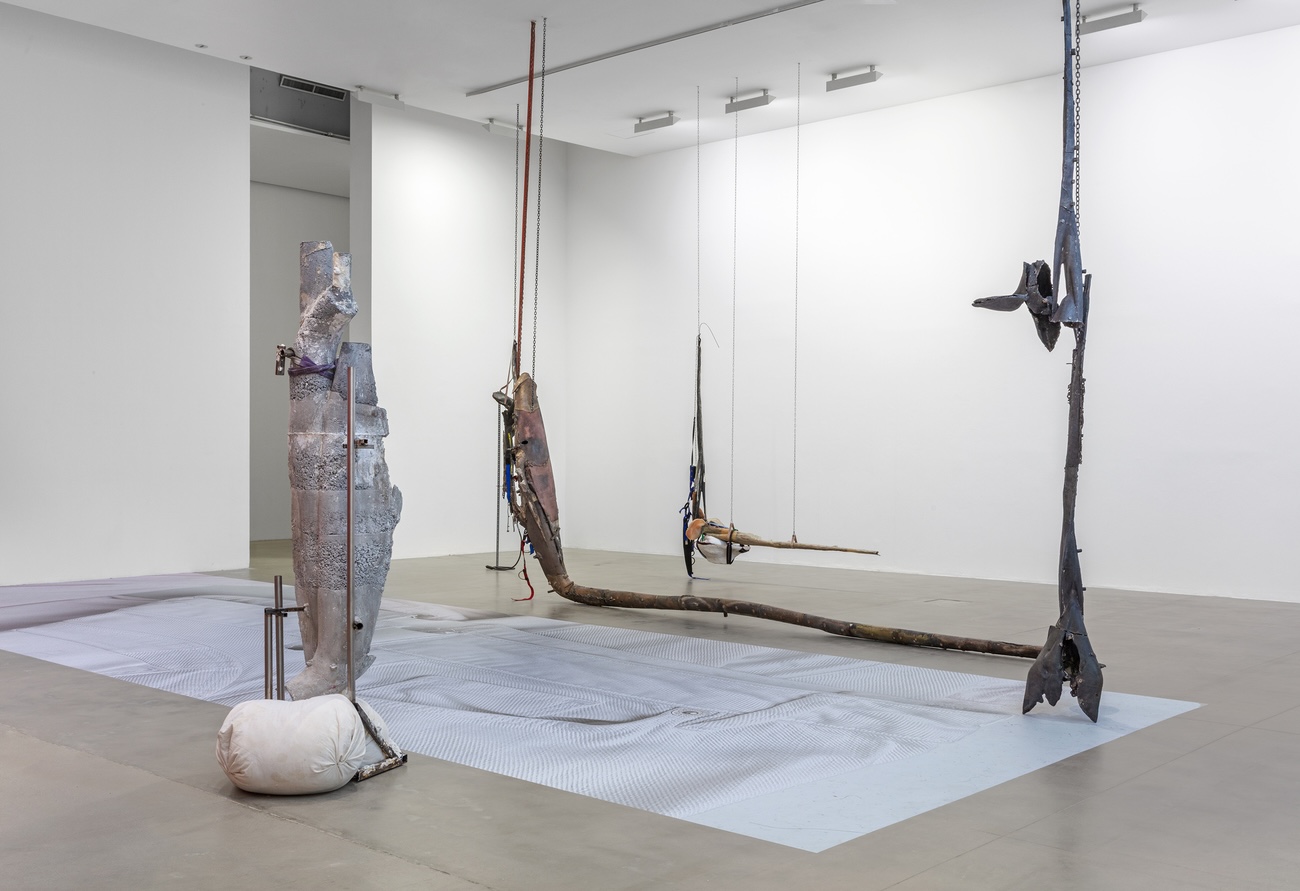
Again, Judd’s words, this time on John Chamberlain’s crushed-car sculptures, with their “worn and accidental appearance and highly developed composition,”1 could apply to Crespo. In her work, too, “the order is not one of control or distillation, but of continual choices.” The objects are so clearly meant to be exactly that way, but for reasons impossible to trace. Closer to the outcome of a natural process than to an artistic one, they can only be studied in their internal coherence, for which we are entirely superfluous. Precisely because of that, we encounter them on more equal terms.
If the artist says that she does not want to “cement an image,” and that “if the works are free, the viewer is freer too,” one could read them as three-dimensional Rorschach tests. I would then see in the damaged garments and images buried within industrial residues the remains of environmental catastrophes. But a post-apocalyptic reading does not do justice to their character: rather than fear, they conjure a primordial tension, akin to being in the presence of a large animal.
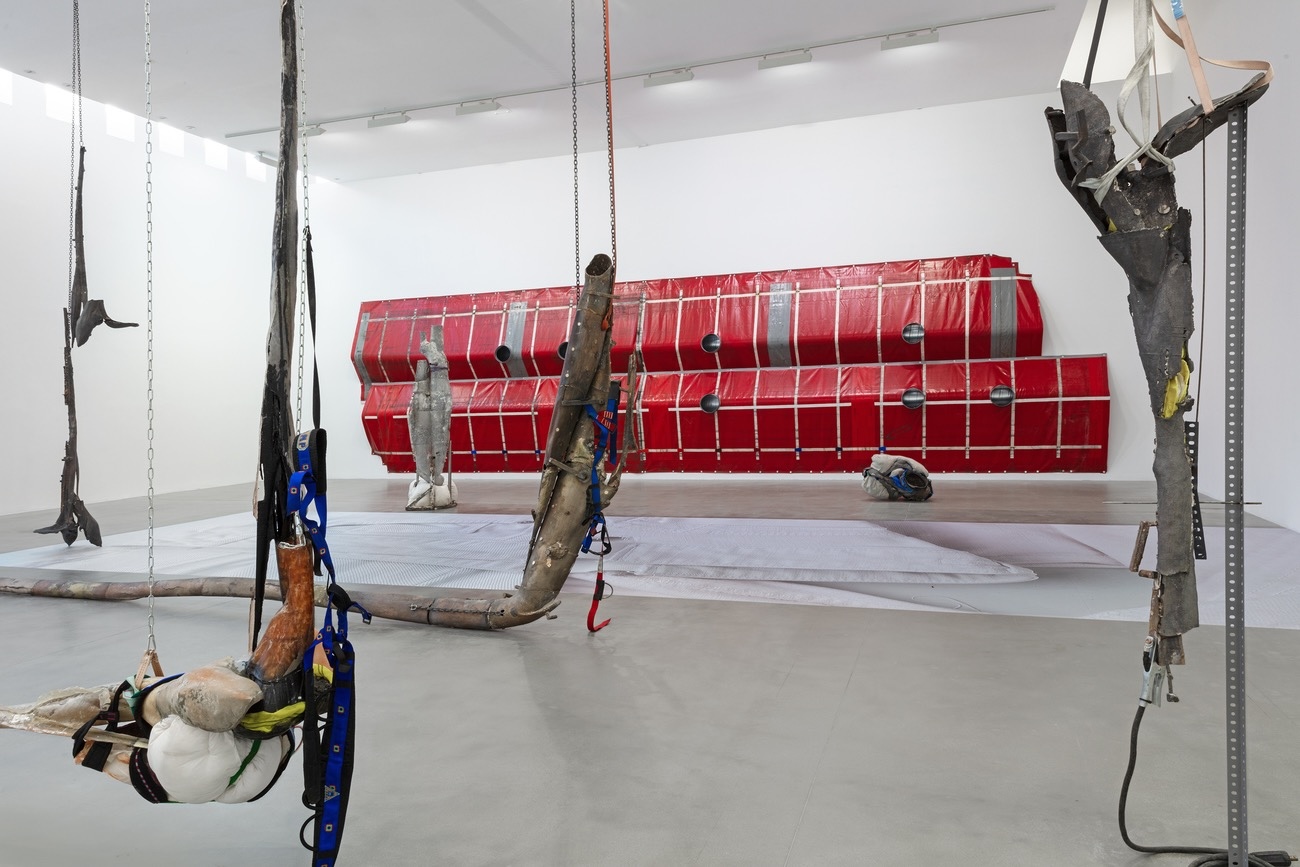
Above all, compared to a Rorschach test, these works add the awareness that they were not made for us. We can see something in them, but they are not at our service. To observe them is like observing a flower; perhaps this is the sense in which they refer to “the iris and the strelitzia.” What’s surprising is that the only way for humans to reach that inexplicable perfection seems to be through rough casts, industrial materials, and used clothes.
Another surprise is that an exhausted contemporary sculptural language might be revitalized through Judd’s anachronistic theory. Or perhaps the opposite is true: Crespo gives renewed meaning to Judd’s blunt ontological confidence. “Things that exist exist, and everything is on their side,”2 he wrote. Unlike Judd, Crespo introduces a certain humility: she is concerned with the viewer, draws inspiration from flowers, describes herself as “not exactly an author but an assistant” to her own work, and jokingly calls her sculptures “bastard objects.” But there is no doubt that they exist first, and only afterwards allow thought to gather around them.
Danzante, curated by Bernardo Follini, is on view at Fondazione Sandretto Re Rebaudengo through October 11, 2026.
1 Donald Judd, “John Chamberlain,” in 7 Sculptors: Anthony Caro, John Chamberlain, Donald Judd, Alexander Liberman, Tina Matkovic, David Smith, Anne Truitt (Institute of Contemporary Art, University of Pennsylvania, 1966), 190.
2 Donald Judd, “Nationwide Reports,” in Donald Judd: Complete Writings 1959–1975 (Nova Scotia College of Art and Design Press, 1975), 117.