

.webp)
.webp)
Lucy Puls: "Righting" at Nicelle Beauchene Gallery
Review
Winters near the Arctic Circle are cloaked in a lasting darkness. Children go to school when the sun has barely risen, while summers feel eternal with sunlight shining through the middle of the night. In fact, Old Norse calendars divided the year into two seasons only: winter and summer. Taking its name from the poetry collection of the late Icelandic writer Sigurður Pálsson, the exhibition Inside Voices, Outside Light, curated by Emily Stoddart on view at Scandinavia House, includes contemporary artists from the Faroe Islands, Greenland, Iceland, and Norway. Nature is at the forefront of many of the works: the shimmering colors in Faroese artist Rannva Kunoy’s painting RAROC (4) (2021) evoke the Northern Lights. Two silver-tinted shades of greens and pinks appear and disappear at differing angles, similar to the fleeting light of the aurora borealis. Norwegian artist Morten Andenæs’s photograph of what appears to be a decomposing dandelion is titled Sol (2025) and is paired near a cloudy photograph of the moon, reflecting the stark contrast between night and day.
.png)
In addition to the seasons, the twenty-one artists included in the exhibition also loom under the shadow of Danish colonization, lost Inuit traditions, melting glaciers due to climate change, and the president of the United States’ desire to “buy” Greenland. One of the first images upon entering the exhibition is a series of photographs by Greenlandic artist Lisbeth Karline Poulsen putting on a beaded necklace in the colors and shape of the American flag. The image immediately brings to mind the idea of being choked or suffocated, an evident response to the current politics surrounding the island. Another Greenlandic artist in the exhibition, Inuuteq Storch, portrays mundane scenes of daily life in Greenland equally relatable, bringing a closeness to a country that feels distant to the average American. In one image, Photograph from “What if You Were My Sabine?” (2025), a woman is wrapped in a sleeping bag, with her phone charging near her hand, perhaps in the aftermath of a party. Storch’s photographs document his friends and family—inhabitants of a land that is viewed as a commercialized good—and make them seem familiar, even universal.

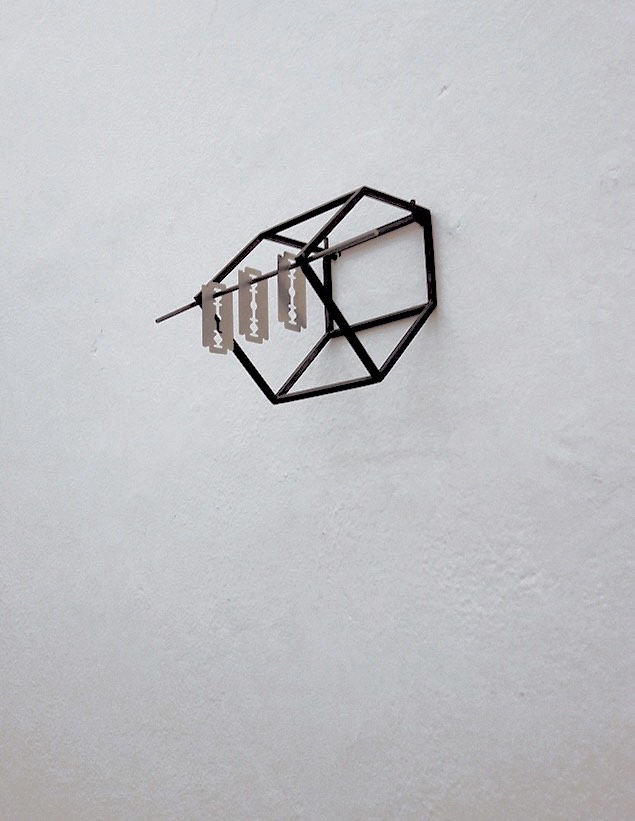
Many of the works exist as fragments, however, and aren’t as evidently interpretable inside this curatorial framework. In Norwegian artist Per Barclay’s Atmosphere (2025), a row of razor blades dangle, threaded through the rod of a simple metal frame. They evoke a quiet violence—but one that isn’t fully contextualized within the exhibition. A sculpture by Ragna Róbertsdóttir, one of the most well-known contemporary artists in Iceland, goes nearly unnoticed. Untitled (1981/2021) is a pyramid-esque structure made of linen, which feels small and enigmatic in the room. In fact, the curatorial motivation of wanting to “reveal new creative visions from a region that might not be well known to many Americans,” as the President of the American-Scandinavian Foundation suggests in the catalog, feels lost when the artists don’t all seem to be trying to visually represent their region. While Róbertsdóttir, for instance, often sources her materials from nature, the connectedness of the Arctic nature surrounding many of these countries genuinely feels disparate in how the works are experienced collectively in the room.
It is significant, though, that the curation includes immigrant artists to these traditionally homogenous countries. Polish-born and Iceland-based photographer Agnieszka Sosnowska reflects the search and feeling of belonging in her black and white self-portraits. She places herself crouched down in a field of grass, with her back to the camera, or in mid-embrace. An antidote to overexplanation, her delicate images offer comfort: the smallness of her photographs and the way she places herself within the frame are akin to a whisper, a secret, a private moment that encourages intimacy and vulnerability from the viewer as well, since one has to be close to the photograph in order to see it. In the catalog for the exhibition, she describes how photographing is akin to capturing a fantasy of belonging that becomes a reality. She explains that, in the split second that the shutter clicks, she “belongs to the moment.” Many of the artists in the exhibition are searching for this belonging and sense of identity through nature, grounding their sense of nationality in their surrounding landscapes.

One of the last works in the exhibition, placed in a dark corner at the back of the room, is Trine Lise Nedreaas’s video Adorn (2023), which records the gradual decoration of a singular spotlighted eye, colorful makeup painted, glittery rhinestones affixed, and fake lashes layered to conceal the skin around it. We adorn ourselves in coats of nationality and identity, yet interior experience often fluctuates from outward appearance. Inside Voices, Outside Light reflects this dichotomy. Amidst a collective experience, there is an individual one. Each voice in the exhibition refracts its own distinct light, and while it might not be a single harmony, collectively it makes space for a selfhood beyond the boundaries of national perception. For a region often only seen for its natural landscapes, the works exhibited move beyond the surface to hone in on what it means to call a country home.

Inside Voices, Outside Light is on view at Scandinavia House from April 18 through June 20, 2025.