
.webp)
Visual Grammar: In Conversation with Bryce Kroll
Interview
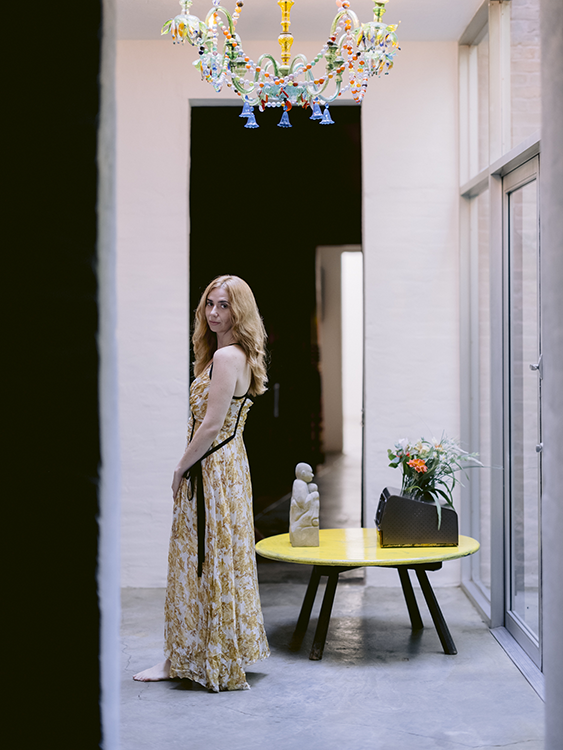
I first encountered Paulina Emilia Aumayr’s paintings in a group show at Galerie Kandlhofer when I was living in Vienna during my Painting Diary residency. Curious, I later visited her studio in Ottakring, the city’s 16th district, to talk in-depth about her work. Our conversation covered topics ranging from tactics of feminist resistance to the politics of visibility, while repeatedly returning to the uneasy territory where intimacy and threat become indistinguishable. Rather than depicting violence outright, her paintings attend to the structures, relationships, and everyday encounters through which they sustain and persist.
Since this interview was conducted, Aumayr has received the 2026 STRABAG Art Award, a fitting recognition of a practice that continues to gain deserved international attention. She will present a solo exhibition at STRABAG Artforum in Vienna in March 2027.
Clare Gemima: Since visiting your studio, I’ve continued returning to something you said that totally struck me. You suggested that your paintings fundamentally ask, “How does one create violence without repeating it?” Can you tell me more about what this means to you?
Paulina Emilia Aumayr: I think there are many ways to think about this. My work always revolves around a fine line between allowing violence to be felt and refusing to reproduce it pictorially. I don’t wish to reiterate stereotypical forms of patriarchal structures—I am not interested in that either. Instead, I try to point to the mechanisms, systems, and environments that make such violence possible, rather than depicting a violent act specifically.
At the same time, I am aware that there is no definitive solution to the question of how to portray violence without repeating it. To know what to paint—as well as what not to paint—in order to avoid reproducing violence, one would have to understand every dimension of it. I approach it from different angles; I either gain a heightened consciousness from recalling situations I have previously been in, or I place myself in situations others may experience—sometimes in Kantian attempts to hypothesize different moral positions—yet I can only ever remain within a partial picture inside of the patriarchy. I will also never experience intersectional dimensions of sexism in ways other women do. What I can do is try to point towards these structures, and oftentimes expose what men believe is morally acceptable.
Cases like Gisèle Pelicot’s have revealed the depths of what Hannah Arendt called die Banalität des Bösen: men who produce disaster, yet remain unable to recognize themselves as doing so, thus sustaining systems of violence without appearing monstrous. I try to let viewers feel the discomfort, often through the way the works enter into dialogue with each other, which produces a larger sense of unease and danger.
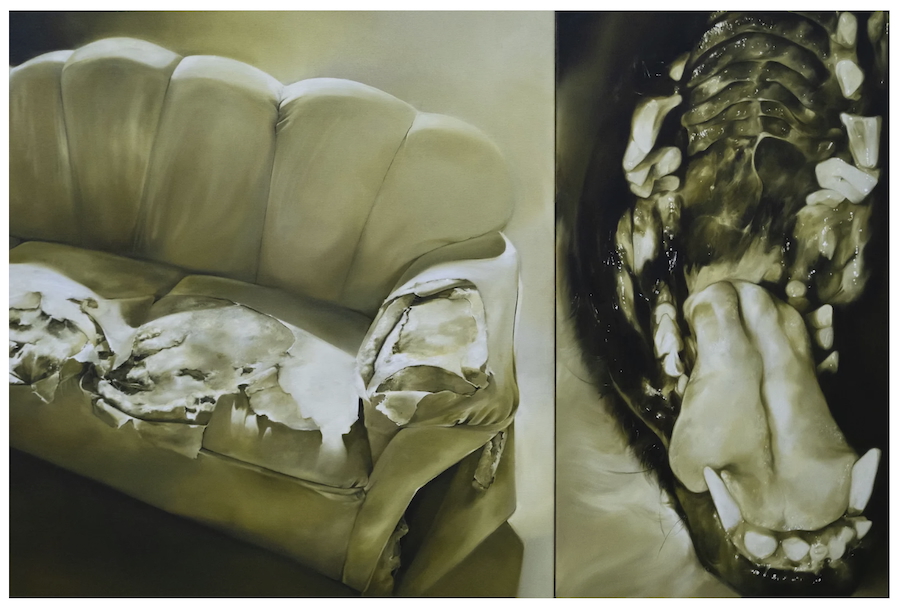
CG: Regarding Arendt’s notion of the banality of evil, does a similar logic inform your choice of motifs? There’s a sense of both aggravation and softness running through your works, often conveyed through bodily elements like animal teeth, jaws, and a recurring fixation on the human neck—an erogenous and highly sensual site acutely vulnerable to violence. Standing face to face with your paintings, there’s an eeriness to them, and a persistent erotic charge that feels difficult to shake. Is that tension something you find yourself consciously stretching?
PEA: I definitely think my choice of motifs is informed by the everyday, which refers to the very space in which the patriarchy operates. This tension, as you mentioned, between images that can easily tilt into something dangerous, or suggest an underlying unwelcome presence, is a very distinct choice I make. They refer to the everyday struggles and realities of FLINTA*s. I think loads of FLINTA*s can relate to this need to be aware of undertones and nuances in everything we experience, always being one step ahead of our surroundings and suspecting danger at all times. It is an attitude that white men simply cannot relate to; there is a kind of parallel society in which we exist, divided by gender. So yes, this tension is something I work with a lot and am particularly interested in. Dogs are the perfect example for this.
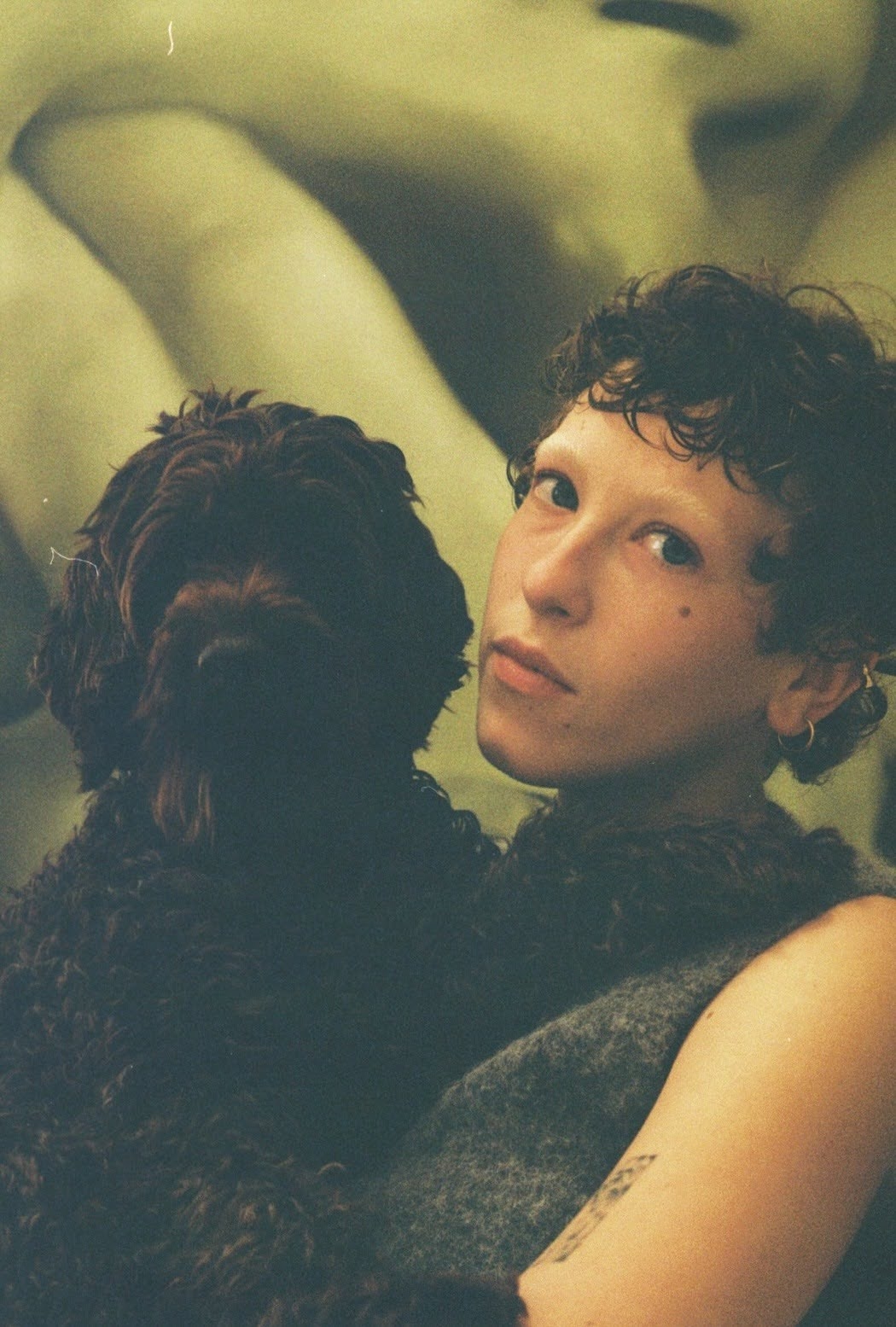
CG: Why the Dalmatians and Greyhounds? In our studio visit, we talked about how strange the human relationship to dogs actually is. The level of interspecies invasion, maintenance, and physical proximity we, like so many other animal parents, normalize despite how unruly, grotesque, and vulgar our beloved pets may be. How has living and working alongside your own beautiful dog, Balu, who felt like a fixture in your studio, informed the way you paint dogs?
PEA: Emotionally speaking, Balu shapes my entire way of living. He is my greatest observer and companion. The relationship I have with him contains an immense amount of care, dependence, and love. In my paintings, I approach dogs in a very different way. I have been using the motif for several years now, and it initially emerged from simply being a dog owner, but over time it developed into a central metaphor. It’s funny, I originally started painting dogs during a sort of crisis, thinking about what to paint at all. A close friend advised me to start with something I love, so naturally, I painted a dog, and from that moment on, a larger idea began to unfold. What interests me about dogs is that they operate on so many psychological and symbolic levels all at once. They can signify loyalty, protection, obedience, dependence, aggression, unpredictability, and threat. They are deeply connected to questions of domestication and behavioral conditioning, and for me this relates to the figure of the aggressor as something multidimensional rather than “fixed.”
The relationship I have with Balu is probably the closest relationship in my life, and I believe there’s something profoundly intimate in the ways humans communicate with their pets nonverbally. I initially felt that I could express types of tensions between intimacy and danger directly through “dog language” much more readily than anything else. With dogs, emotions—fear, excitement, submission, and trust—are immediately physical. I can sense Balu’s mood within seconds, and I think my hypersensitivity to his signals strongly influences the emotional register of my paintings. The dogs in my work never function as simple symbols. They exist somewhere between companion and threat, affection and violence, and vulnerability and control.
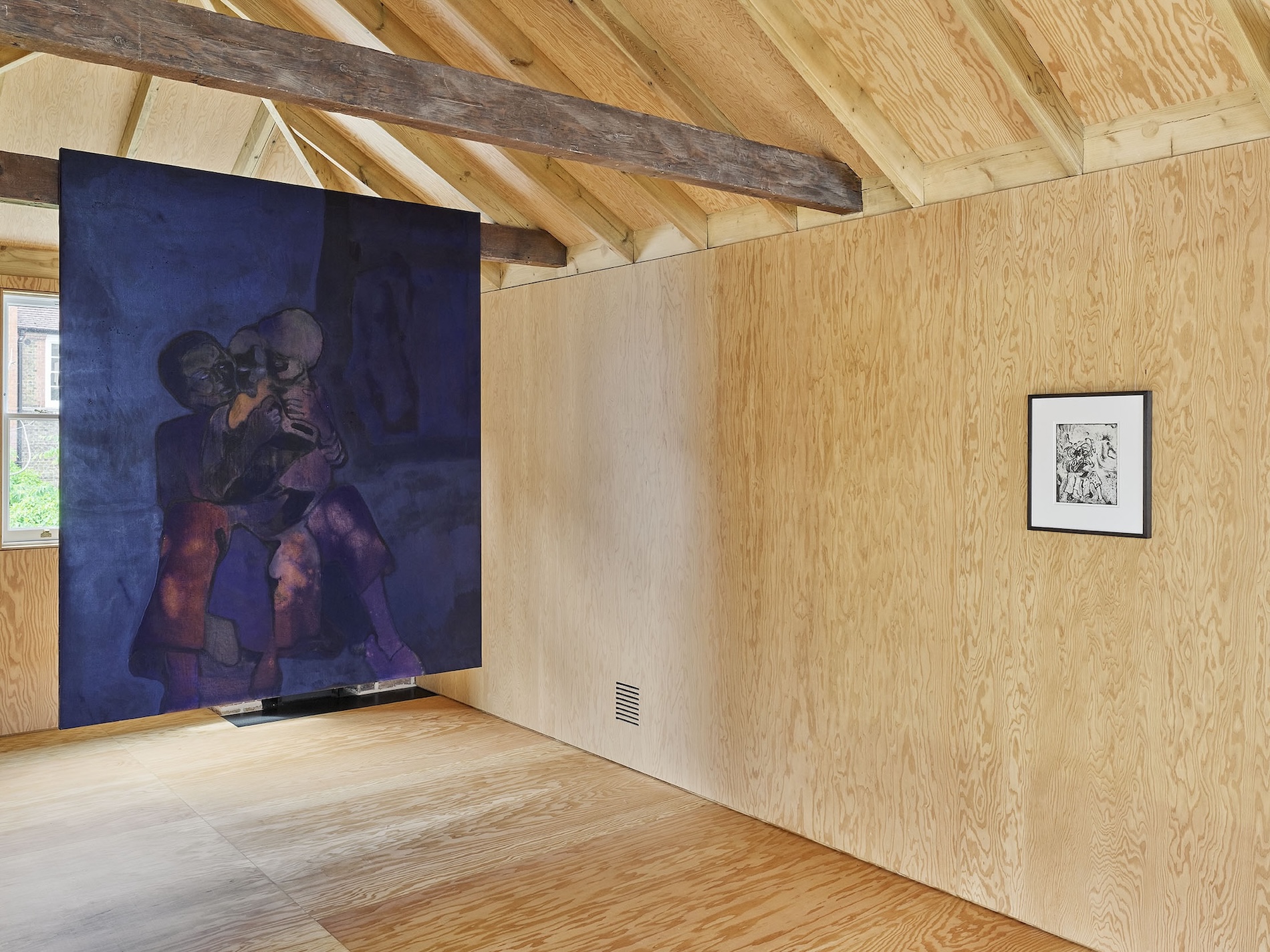
CG: I first encountered your work in Systems of Subversion at Galerie Kandlhofer, which also included works by Allen-Golder Carpenter and Thomas Supper. Rather than being united by a single theme, the works shared a sense of psychological and corporeal unease. Earlier, you mentioned wanting viewers to feel a level of discomfort that often occurred through the way your paintings entered into dialogue with one another, but what happens when your paintings are placed into dialogue with the works of others?
PEA: I was extremely happy to exhibit with Allen and Thomas and deeply admire both of their practices. We installed the exhibition in a very organic way, and there were many happy accidents during the setup period. Allen’s work speaks to racial violence, surveillance, cultural identity, and the systems racism operates within—experiences and structures I cannot speak from myself, but that are essential when talking about feminism and power. White feminism has historically silenced women of color and continues to do so in many ways. I am aware that I am listened to differently because I am white, and that this visibility needs to acknowledge those asymmetries, especially with the rise of right-wing parties in Europe.
Thomas’s works deal with erosion, reduction, and disappearance; they almost seem to document the slow exhaustion of form itself. In this exhibition, I touched on Sara Ahmed’s concept of affective exhaustion within feminist resistance, so I feel like his work resonated with mine within the space perfectly.
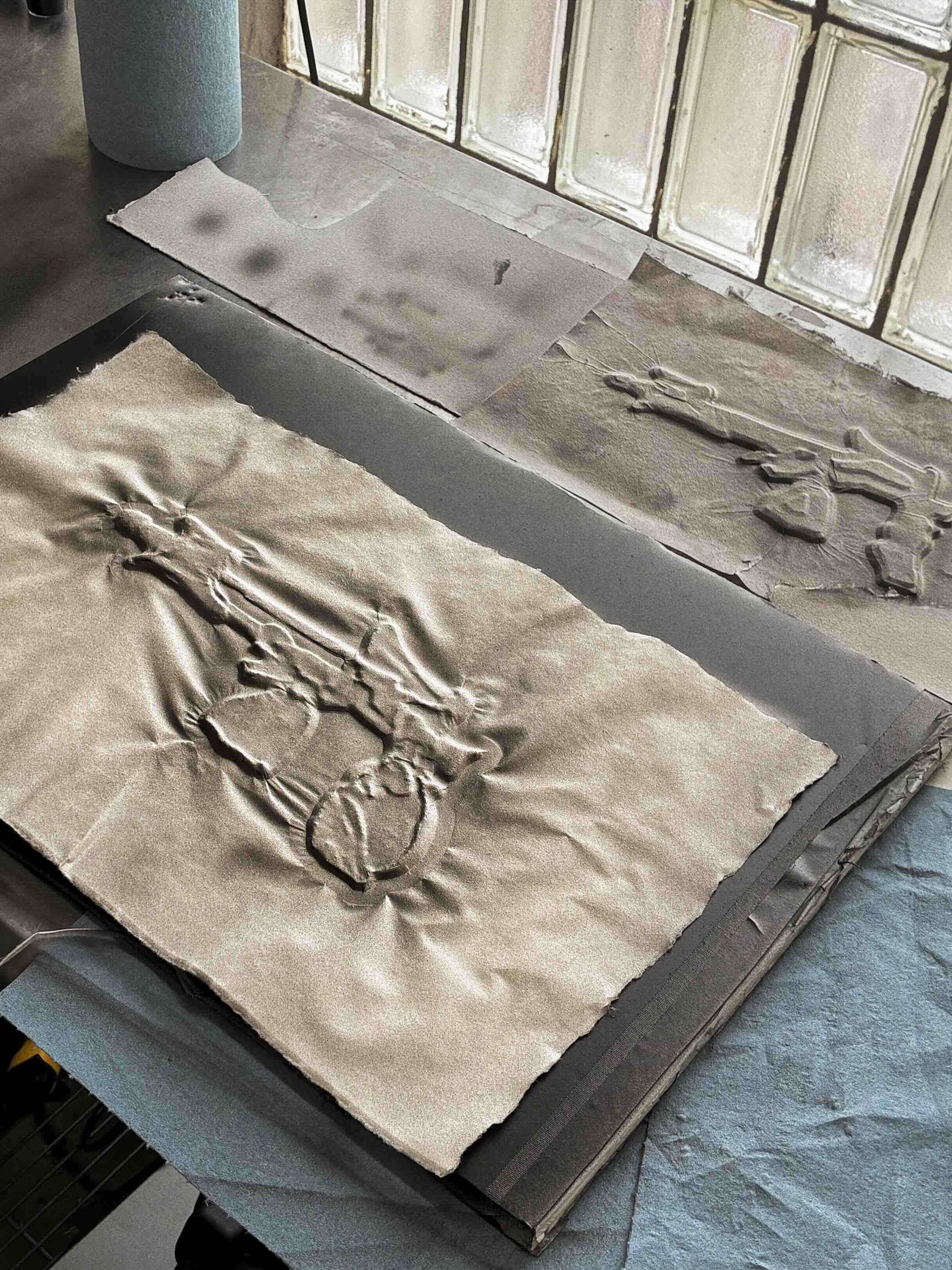
CG: Seeing the exhibition in person, one became increasingly aware of how the installation itself intensified this effect: works suspended, hung extremely high overhead, and shifting material textures all seemed to destabilize the viewer physically and psychologically. Did the spatial construction of the exhibition introduce new possibilities for the work, whether emotionally or narratively?
PEA: Yes, with the installation of Der Geschmack von Metall. Erstick daran it was quite interesting because I had initially exhibited it as a complete bed installation, with the mattress on the floor and the blanket and pillow draped across it. At Galerie Kandlhofer, we knew we wanted to display it differently, and metaphorically it felt like a very significant gesture to suspend the installation from the ceiling. It gave these otherwise intimate objects much more visibility and exposure. The bed lost its function but became something much more confrontational, and I think this enhanced the urgency of the issues I am addressing in the work.
At the same time, I am always looking for ways to partially hide works within an exhibition, especially smaller paintings. I search for corners, niches, or areas that are not immediately visible at first glance. Hanging works unusually high or placing them in less accessible spaces changes the intimacy of the encounter and alters the viewer’s physical relationship to the work. This contradiction between hypervisibility and ignorance is something that directly runs through my practice. Violence and discomfort often exist in this strange condition of being constantly present and simultaneously overlooked.
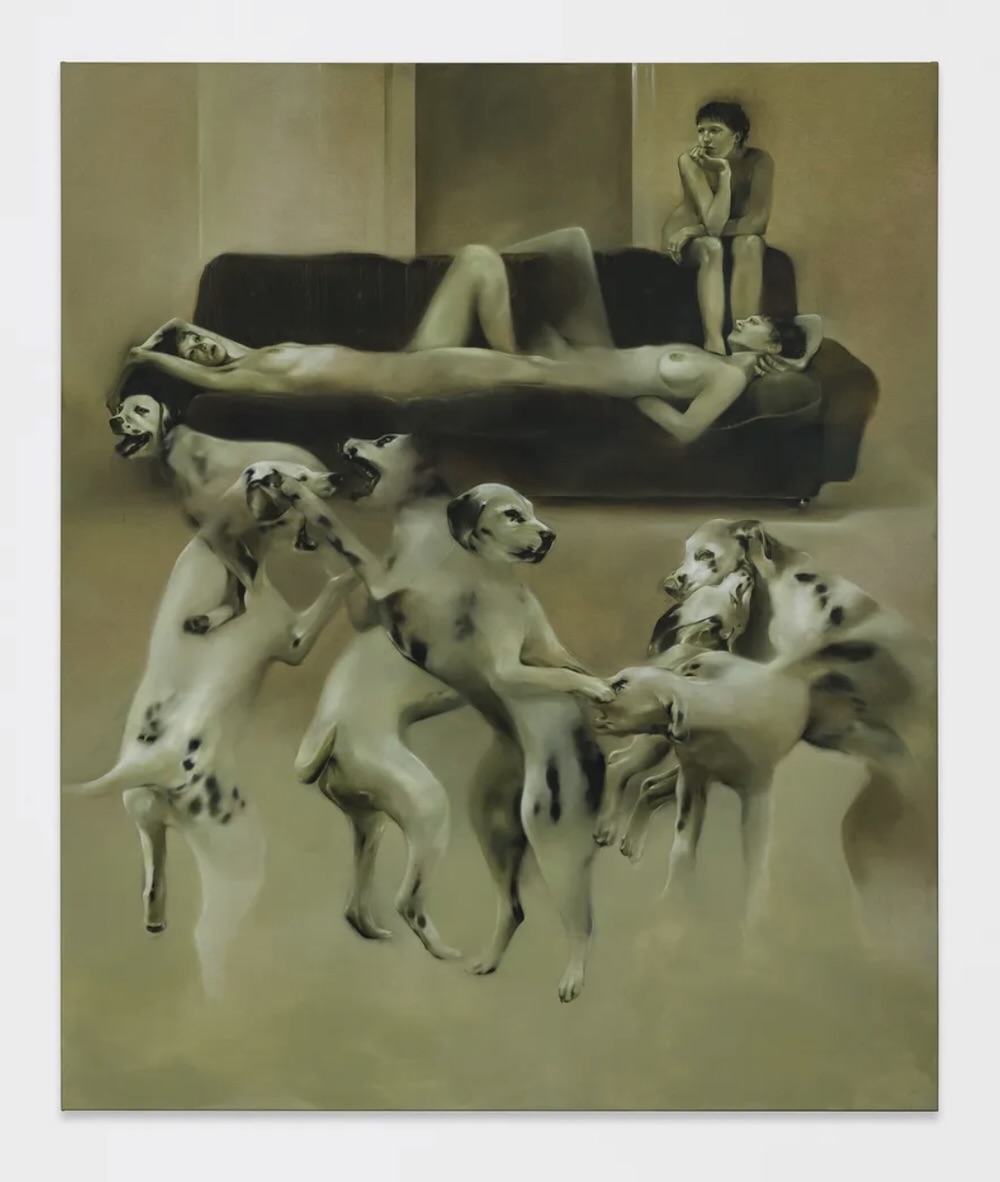
CG: Your paintings often feel as though figures, symbols, and subliminal forms seep into one another before they fully resolve as images, as if meaning itself is constantly migrating across the surface. Does painting become a way of staging this instability, where images are allowed to blur together before settling into recognition?
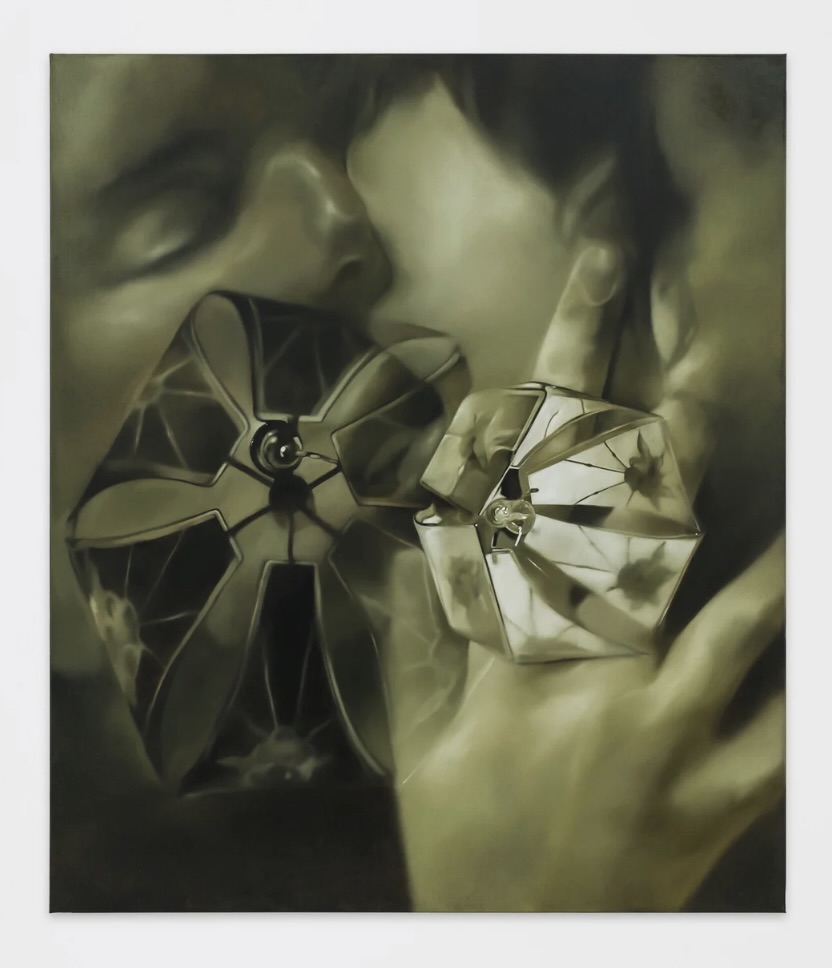
PEA: Painting allows me to make spontaneous decisions, like where to let an image dissolve and where to let it begin again. The blurring of these images and moments in which the motifs meet on the canvas are the most honest things I can do. It is where the tension of the issue builds up and touches on what I talked about before—the underlying presence of patriarchy in all aspects of our lives, alongside a distinctly FLINTA* experience of doubting one’s own judgment. It often takes the form of an internal dialogue of self-surveillance and self-blame: Did he just look at me like that because of my dress? Would this have happened if I had worn something else? Maybe I didn't say no loudly enough. I shouldn't have let him buy me a drink. These types of thoughts often emerge afterward, when violence or discomfort has already entered the body, and they blur responsibility, memory, and self-perception. My painting operates in a similar way, either by blurring images on one canvas or letting different motifs create a dialogue between different canvases. They resist clarity within that dialogue. I work on the back side of primed cotton canvas, which you could say is an emphasis on the visibility aspect of my work, but of course it is also just something that has developed in my work out of an aesthetic need.
CG: How did you arrive at this limited palette of acidic greens and dense blacks, a kind of nightmarish tonality that feels suspended somewhere between nostalgia, deteriorating film stock, and the strange atmosphere of old montage imagery?
PEA: The palette I work with developed sort of naturally; I only work with Lamp Black, Cadmium Yellow, and Titanium White. The deteriorated film stock you mentioned resonates with what I try to do quite neatly. I like to play with the factuality of the issue. We perceive photography as fact and evidence, but then there is also a need to transfer the emotions that come with it. My strange palette evokes a sense of uncertainty and the uncanny, as though the image were being recalled rather than directly observed.
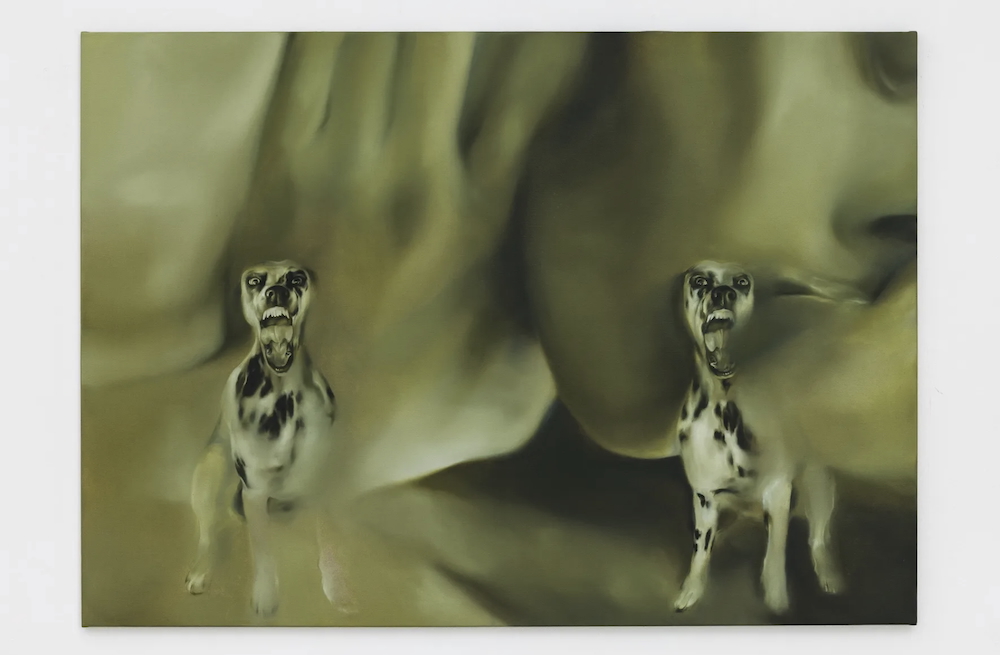
CG: We touched briefly on Marlene Dumas, particularly in her ability to let violence and eroticism co-exist and permeate across her works, a state she conveys both atmospherically and illustratively. Who are other artists or writers that have shaped how you think about representation, withholding, or the politics of visibility, and where do the more mythological or nightmarish elements in your work sit within that?
PEA: I always have a hard time pinpointing exact identities. Marlene Dumas was one of the first artists I felt a deep connection with, and she definitely caught me in a moment of despair as a teenager when my perception shifted.
I also think being exposed to Austrian artists while growing up in Vienna was a very special and formative experience. Being surrounded by the work of Valie Export, Maria Lassnig, and Renate Bertlmann, just to name a few, from a very young age on—the attitude of Wiener Aktionismus (Viennese Actionism), alongside its problematic aspects—and a very culturally dense city overall, just shapes you. Gottfried Helnwein’s works were also very prominent in my teenage years, and as I am listing these personas, I realize I think there is a very politically driven discourse towards injustice they all have in common. Growing up as a child of two academics who, regardless of having nothing at all to do with art, still considered it well mannered to have a certain interest in culture, I was very lucky to have access to museums, theatres, cinema, and books.
As of now, I mostly draw from literature and am driven by the never-ending flood of news revealing more and more ways in which the patriarchy operates. Recent cases like Collien Fernande’s leave me with nothing but astonishment and anger. Being able to handle these harrowing and violent issues through an academic and theoretical lens makes them more graspable for me, and allows me to better wrap my head around them. The writings of Sara Ahmed, Nicola Gavey, Judith Butler, Claire Dederer, and Manon Garcia have also been very important for my work recently.
This interview was edited for length and clarity.
Paulina Emilia Aumayr (b. 2002, Vienna) is an artist working in painting and text. Her practice navigates the intersections of intimacy and violence, addressing the subtle, structural forces of patriarchal power. Paulina Emilia Aumayr lives and works in Vienna. She studies at the Academy of Fine Arts Vienna in Daniel Richter’s class and has shown her work at Galerie Krinzinger, VinVin Galerie, Galerie Michael Bella, and the Parallel Art Fair.