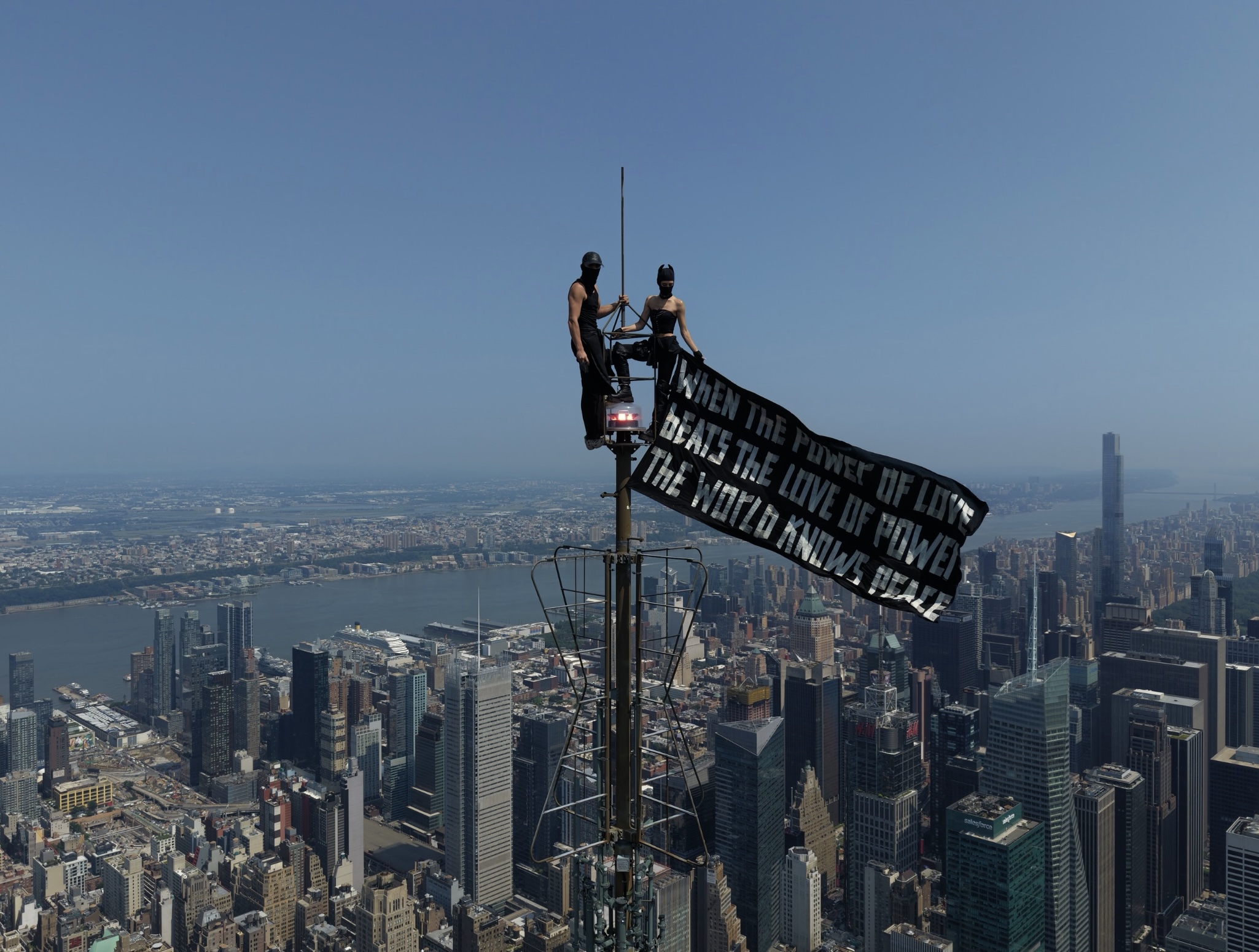
.webp)

Unsympathetic Clock: In Conversation with TJ Shin
Interview
Mary Ellen Carroll once raised, rotated, and unbuilt a midcentury modern house, live-streaming the process before live-streaming was really a thing (prototype 180, 1999–ongoing). They activated unused radio-frequencies to provide far-reaching, high-speed wireless broadband access to underserved communities—programming an open, non-hegemonic electronic space akin to twenty-first-century land art (PUBLIC UTILITY 2.0, 2008–ongoing).1 They produced a twenty-four-hour film of the Federal Building in Los Angeles, inverting the structure of surveillance and illuminating the “reciprocity between container and contained” (FEDERAL, 2005).2 Their Doppelgänger series (1983–ongoing)—a performative gesamtkunstwerk—breaks boundaries between self and other, fact and fiction. They were artist Judi Werthein in a panel discussion for a conference at The Cooper Union (Judi, Judi, Judi, 2007),3 and art historian David Joselit delivering the opening address for a symposium at The University of Chicago (Being David Joselit, 2009).4 Carroll’s doubling goes both ways—they also cast an actress to “be them” in Vienna for the opening of their solo show at Galerie Hubert Winter.5
Over the past four decades, Carroll has inventively and humorously engaged policy as material, infrastructure as agent of social change, and technology as purveyor of “informational justice.”6 We met at their New York studio in early June to talk about their major retrospective exhibition How To Talk Dirty and Influence People, curated by Rebecca Matalon at the Contemporary Art Museum Houston (CAMH).
Rebecca Rose Cuomo: Your work is expansive, and there’s something about it that feels evasive.
Mary Ellen Carroll: As I’ve stated a number of times, I’m against metaphor and the use of phenomenology, biography, and psychology to frame an artist’s work.
RRC: I wrote something for you that I’d like to read, if you’ll allow . . .
MEC: Of course. That’s so generous.
RRC: I am Mary Ellen Carroll, and I’m usually dressed in black. I have brown hair that I’ve never dyed, and some gray strands are starting to appear. I like the grays because they’re silvery and add dimension, but in the future I may cease liking them and choose to start dyeing my hair. I say things like “I’m really glad we spoke!” when I’m ready to end a phone call. I get irritated when people stop right after exiting a trafficked door. I think I follow the codes of conduct and social etiquette I expect from others, but maybe not. I’d be a better person if I were more calm and forgiving and had less of an ego. I believe in animism and think this worldview has powerful epistemological potential. I cook most of what I eat and frequently (inadvertently) burn myself doing so. I laugh freely and loudly. I require glasses or contact lenses to see properly, but sometimes I don’t wear them to soften the outside world. I have a heightened auditory sensitivity and can easily get distracted by sounds. I’m a chronic overthinker. I drink lots of water. I feel comfortable living in a world of mystery and unknowability. You are Mary Ellen Carroll—and I can be, too.
MEC: You understood the instruction. And you also read Kathryn Scanlan.7 She’s a great writer. Do you know her work?
RRC: I didn’t before I read your exhibition catalogue for How To Talk Dirty and Influence People.
MEC: She’s phenomenal. Read Kick the Latch.8 I want to go back to your use of the word "evasive," because I’m not at all. I’m very direct about things.
RRC: You are.
MEC: The work sees things as they are. As we were talking to people about their contributions for the catalogue, I didn’t want it to be over-determined. I think what may happen is they see the freedom in how and what I do, which provides license. On my part, it’s by design and by choice. It’s intentional. There’s a clear pathway. At CAMH, I don’t know if it’s apparent in terms of going from point A to point B, but it’s there—with an organizational structure framing the work in a comprehensible manner for viewers. We worked very hard for nearly seven years to achieve this legibility. I’m fascinated by what you picked up on and how you detailed it.
RRC: I was aware of the Doppelgänger series (1983–ongoing) and its many manifestations. I didn’t know who Kathryn’s text was about: you or her? And is it true? It’s a reminder that Being is performance. I adored it. I wasn’t invited to be a doppelgänger, but maybe because of that inherent sense of freedom your work has, I took the liberty . . .
MEC: What’s incredible about the results of the book and the exhibition is that the book designer, Teo Schifferli, and exhibition designer, Juliana Zeibel, didn’t attempt to mirror one another. It happened in parallel, and they really complement one another. Schifferli’s use of the grid and uncut folios create structural elements that have doubling effects.
RRC: Brilliant. It allows a spatial experience of the book, which is not as explored as it could be. And the exhibition design at CAMH is unique.
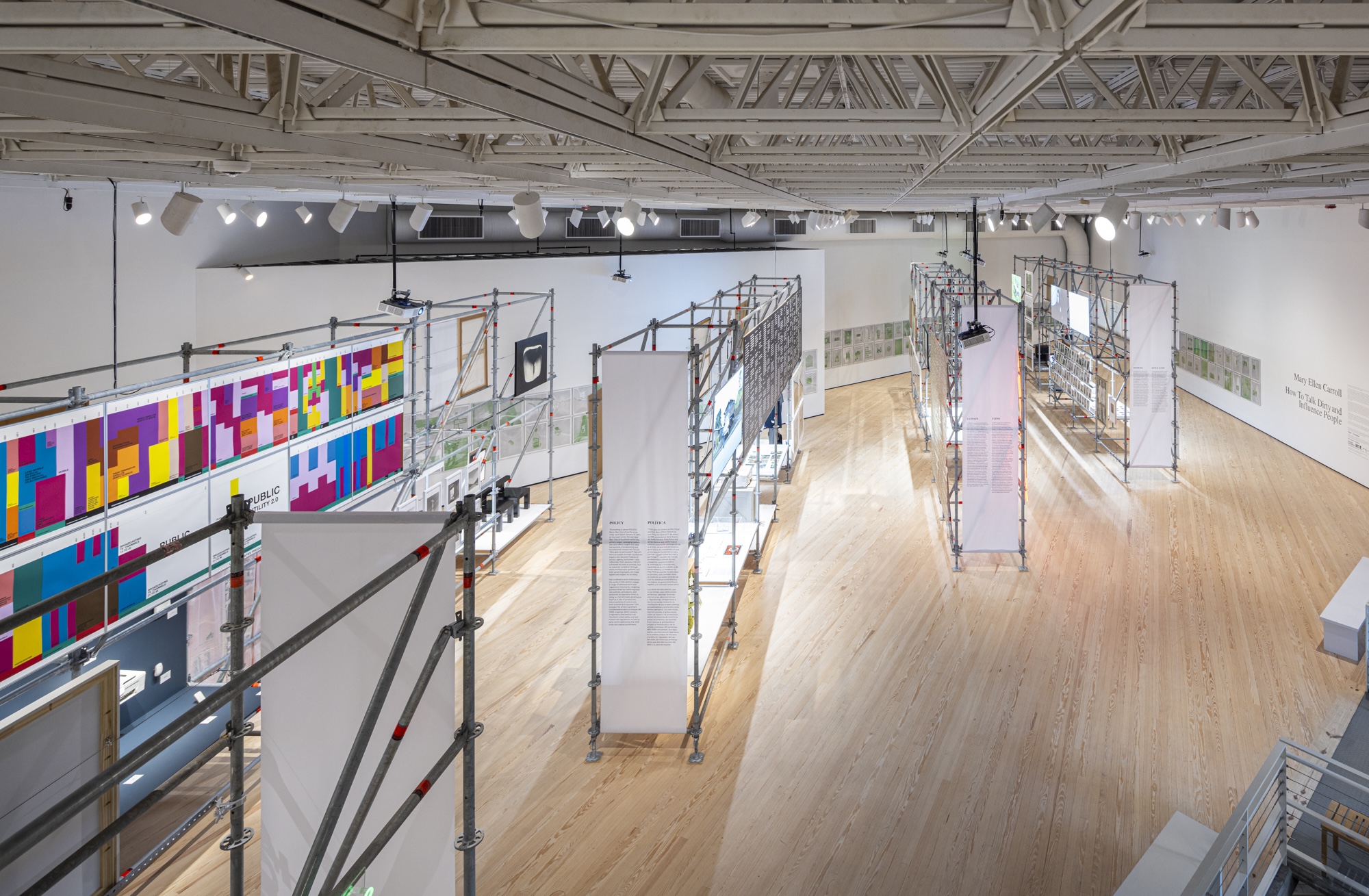
MEC: The architecture is a parallelogram designed by Gunnar Birkerts, a clear span with twenty-two-foot ceilings. We wanted to use the entire volume of the space. When we talked about how to arrange the show, I said, "Imagine library stacks meet Costco Warehouses meet Ken Isaacs," who created this modular system of Living Structures.9 We decided from the beginning to work with an exhibition designer. My friend, Isa [Isabella Rjeille, Curator at Museu de Arte de São Paulo] introduced me to Juliana, who developed the system for Layher’s scaffolding. In presenting the schematics, she’d put up a word followed by her proposed design. Her third proposal was the word "italic," and all the forms were italicized. It was so simple—a brilliant, clear idea that was complex, not complicated. Many people had a hand in making this a reality. Jeff Shore, head preparator, was a key figure along with the rest of the team at CAMH. It would’ve been impossible to do by oneself.
RRC: Was it on the occasion of your show that the museum transitioned to sustainable energy sources, or was that already in place?
MEC: We initiated the process and identified the path for it. About five months ago, I sent Rebecca a text saying, "I want to blanket the museum in solar panels and completely generate our own energy." The next morning I called my friend Joey Romano, a significant person in the energy sector, to find a pragmatic approach.10 Due to utility contracts, equipment, and our limited timeframe, the best solution was carbon offsets. We installed a smart-meter at the museum, charting its usage to the ERCOT [Electronic Reliability Council of Texas] dashboard, which manages the state’s energy flow. CAMH’s offsets will be wind, solar, or battery. We’ll show the museum’s usage alongside renewables on the dashboard in real time, which is part of the visibility. Again, seeing things as they are and when they’re happening.
RRC: I’m ignorant about this technology, so I’m astonished we have the capacity to switch based on what would be most effective, without overloading any particular system.
MEC: It’s utilizing infrastructure, tools of dissemination and distribution. You choose what you put into the system—how, where, and who it goes to. It’s not fixed. Nothing is. There’s always the possibility for change, of finding alternatives and maneuverability within existing structures and channels.
RRC: You asked what I meant about the work feeling evasive, because it’s true you are very precise in explaining what it is. A better way of describing it might be open, unfixed. There are manifold connective threads between different projects, and the projects themselves are multidimensional. For example, one can’t talk about prototype 180 (1999–ongoing) in any singular way—not as architecture nor performance nor broadcast. It’s all of those things. Your work has diverse points of entry and connection. It responds differently in time, and depending on what observers bring to their encounter with it.
MEC: How we gain knowledge is through a dialectic process—accumulation, interrogation, and I’m most interested in maieutics. We see a work, we project onto it. We have our knowledge and systems through which to compare and locate it. We investigate to understand. It makes us aware of our own existence. It either validates what we’re thinking or raises questions about something. That’s what a work of art can do. It’s time to think about building without the idea of permanence. prototype 180 migrates from what’s below the ground, to policy on the ground, then in the airwaves.
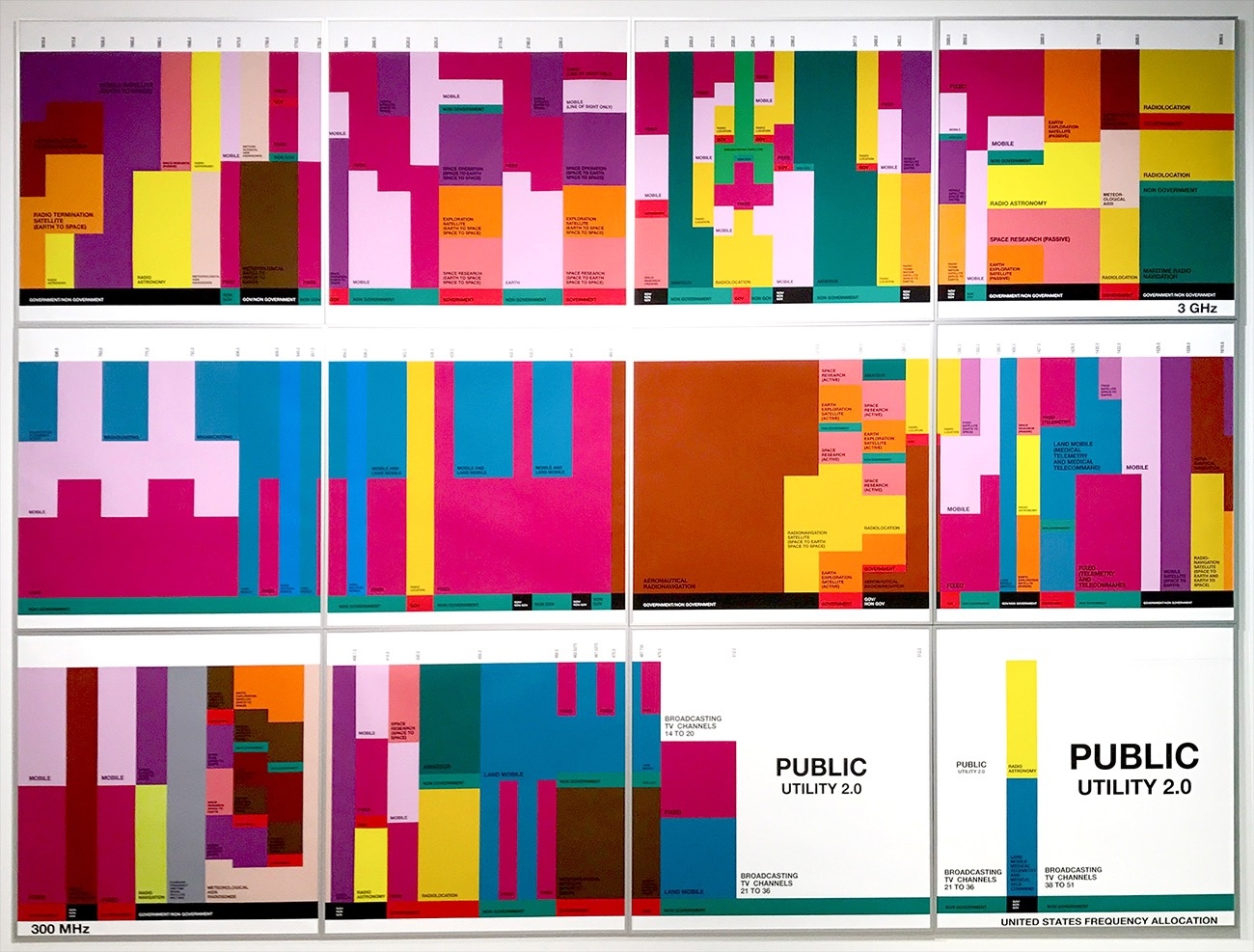
RRC: That vertical strata of materiality is something you intelligently engage across many series. PUBLIC UTILITY 2.0 (2008–ongoing) comes to mind, in which you provide wireless access to broadband and frequencies such as FM and shortwave to underserved communities.
MEC: PUBLIC UTILITY 2.0 evolved from exploring new technologies and using radio-frequency as a twenty-first-century form of land art. “Underserved” means inaccessible, as in remote locations, and “airlining,” the equivalent of redlining in terms of socioeconomic access, where service providers won’t develop infrastructure. It’s also creating content or materials to go through that infrastructure. I worked with my colleague at Rice [University], Dr. Edward Knightly, who’s a brilliant electrical and computer engineer—the wireless guru—to develop Super Wi-Fi.11 Radio-frequencies are real estate, and most are occupied. Some frequencies became available when TV went digital, and as we increasingly migrate to digital transmission, there will be even more.12
Just because a certain technology materially exists doesn’t mean it can be accessed and utilized—it’s also policy play. I got very involved with the FCC and equivalent agencies in other countries. Policy on the ground is inseparable from policy in the air. What are infrastructure’s material possibilities? How can you use it? What can you put there? Nam June Paik coined the term “electronic superhighway.”13 He said it was going to be far more valuable than going to the moon. He understood it as material, as space. PUBLIC UTILITY 2.0 programs a space where people can architect the airwaves.
RRC: The way you address politics in your work doesn’t seem to impart judgment or try to bring people to certain conclusions, although it may be clear what you think by virtue of engagement. With PUBLIC UTILITY 2.0, simply the fact of providing internet to reconnect a dispersed, predominantly Black community in New Orleans that was traumatized by Robert Moses and Interstate 10 . . .
MEC: It was destroyed.
RRC: Which was part of a larger national movement.14 One can deduce your opinions, and although history is embedded in the work, it isn’t really about that. It’s an inclusive space. You’re finding and utilizing infrastructures that exist, understanding how to occupy them in ways that are different from what’s currently there. Then letting people interact as they will.
MEC: It’s really important to see things as they are. The history is always there. It too is material.
RRC: I often think about Sigmar Polke’s work from his retrospective at MoMA: Die Dinge sehen wie sie sind (1991).15 It’s aspirational. It’s a choice.
MEC: It should be a universal imperative, and to maintain equanimity for the unavoidable. Both he and Duchamp were doing exactly that. If I say "This is a glass of water," you can say, "No, it’s not. I see a bookshelf through it." But that’s your subjective framing of the condition. There are always added layers, inclusion or exclusion. What Kathryn did in the book was to make the subject the object, which is what you did in your writing that mirrored theirs.16 Within that maneuvering, how far or how close do you position yourself? Where is the consensus of meaning? I made an early work about New York City and how to represent being in the city—Without Intent (1996).
RRC: Yes, walking on Broadway from Harlem to Battery Park and taking photos at the intersections.
MEC: Without looking. The camera was mounted on my back, and I was shooting from behind, making a documentary about NYC with still images. It was soon followed by photo critics saying the images were not very good in the Henri Cartier-Bresson, straight documentary sense.
RRC: But that wasn’t the point . . .
MEC: It wasn’t about building a linear narrative or distilling a still life. The experience of the city is the experience of moving through it. Recall that Stan Brakhage and experimental film are part of my early background.
RRC: When a critique of Without Intent is "these aren’t good images," it’s because they’re not being seen as they are. They’re seen through the lens of how one expects photography to behave, what landscape is, and how it’s represented. Without Intent—as well as what you were saying about inverting subject/object—complicates perceptions of otherness.
MEC: Exactly. And the question of being, Dasein, and the autonomy of the work of art. An artwork only has to be itself, nothing else. It has no other utility.
RRC: Dasein, the relationality of existence, recalls prototype 180 and the emergence of ethnobotany after the house was uprooted and revolved 180°. Why were native species thriving there during drought years, whereas adjacent plots were botanically desolate?
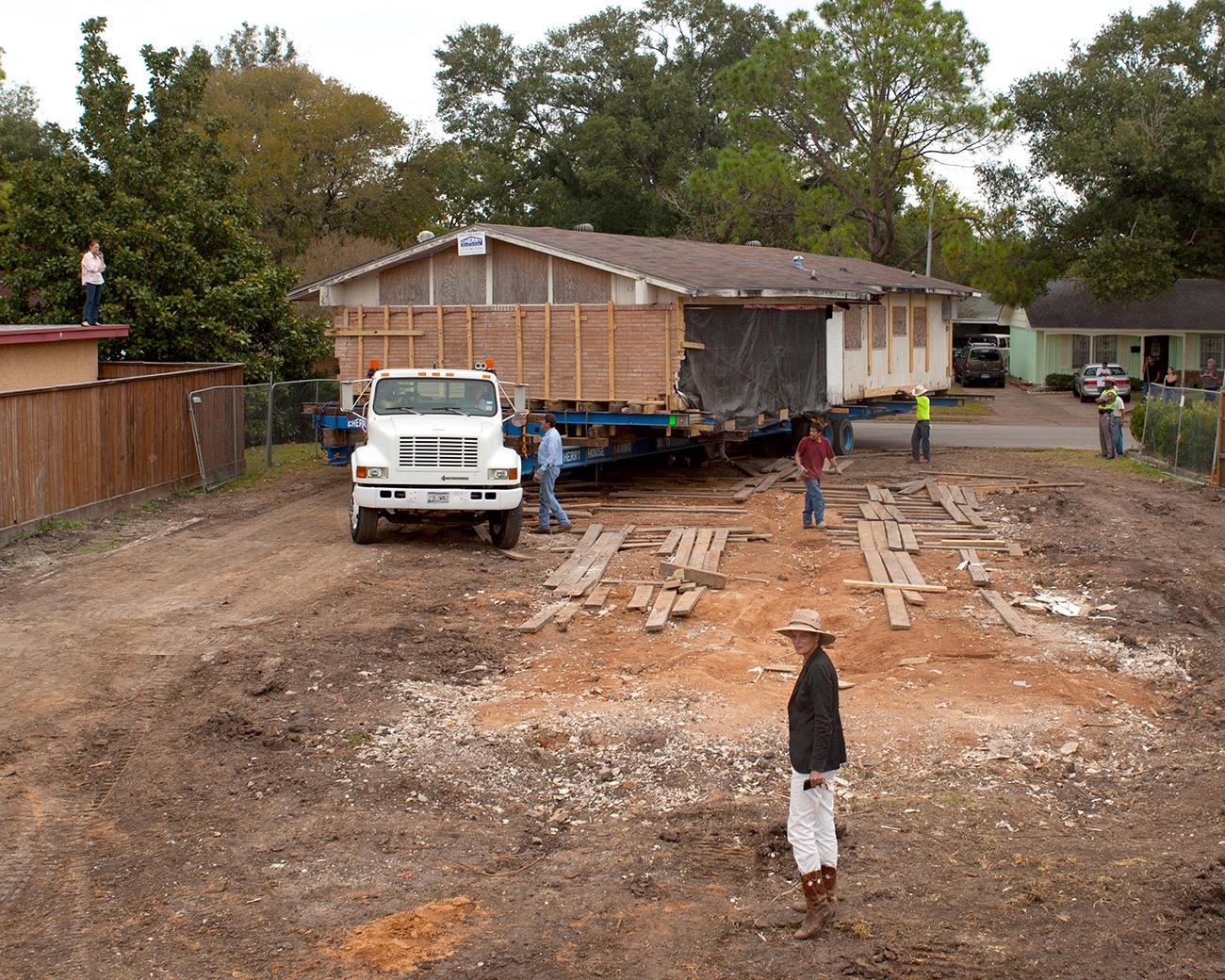
MEC: prototype 180 is my opus. When the revolution happened, the land was moved and flora began to appear. I had botanists classify the growth. During the drought in 2011-2012, nothing was growing on neighboring properties. Their lawns were scorched earth, whereas there was an ethnobotanic prairie growing at prototype 180. It’s either the expression of agricultural pioneers such as birds or insects, the wind, or it was so submerged in the strata of clay beneath the thin topsoil that it came closer to the surface trying to get water and sunlight to photosynthesize, until it eventually did. Most properties in Houston are manicured and homogeneous due to deed restrictions. Sharpstown [the neighborhood where prototype 180 is located] is one of the most diverse areas, developed in the 1950s. It’s not a suburb—it’s in the city proper, 10 minutes from downtown. There’s also a geological link underground to the energy sector and fossil fuels. When OPEC [Organization of the Petroleum Exporting Countries] was formed in the ’60s, Houston was decimated. The price of oil dropped from $30 to $10 per barrel, and it took time to remedy. There was fossil fuel flight. Many properties were abandoned and foreclosed. Eventually, when the price of oil increased, jobs and people started returning to the city, including immigrants.17 All that history is still there.
RRC: The bureaucracy in your work is fascinating. Was forming an LLC or 501(c)(3) a necessary part of the work? Or is it a collateral action for operational possibilities or insurances?
MEC: It is a part of the work. prototype 180 was originally titled OFPC, which stands for “Out for a Pack of Cigarettes.” You’re going out and not coming back. Initially it was an LLC. Not because it was some venture capital, but to say, "This is a material entity, and we can use this model to raise capital and test business interest." The art world functions in this strange place between profit and nonprofit. I wanted to see how far I could go with that. Lars [Lerup, former Dean of Rice Architecture] founded The Rice Building Institute and was interested in prototype 180, especially because he wanted things that were making architecture but not necessarily making architecture.
When Lars retired, the next dean closed the Institute. It had nothing to do with prototype, except then we didn’t have institutional association. At that juncture, I wasn’t interested in shopping it elsewhere. I had to rethink it as a legal entity, and I decided to turn it into a 501(c)(3)—under the IRS’s condition that the property was the entity.18 We’re about to start Phase III of the rebuilding, with the debris of the original house from the unbuilding.
RRC: There’s something about invisible strata with the LLCs, 501(c)(3)s, and all the stories they contain. You were talking about how the work finds possibilities in existing spaces then occupies them. It’s a cosmology in and of itself. That openness and expansiveness may also pose challenges for curators or critics to frame what the thing is, and in relation to other things. It’s a challenge with tremendous potential, making the work incredibly exciting. How did Rebecca Matalon negotiate that for the exhibition?
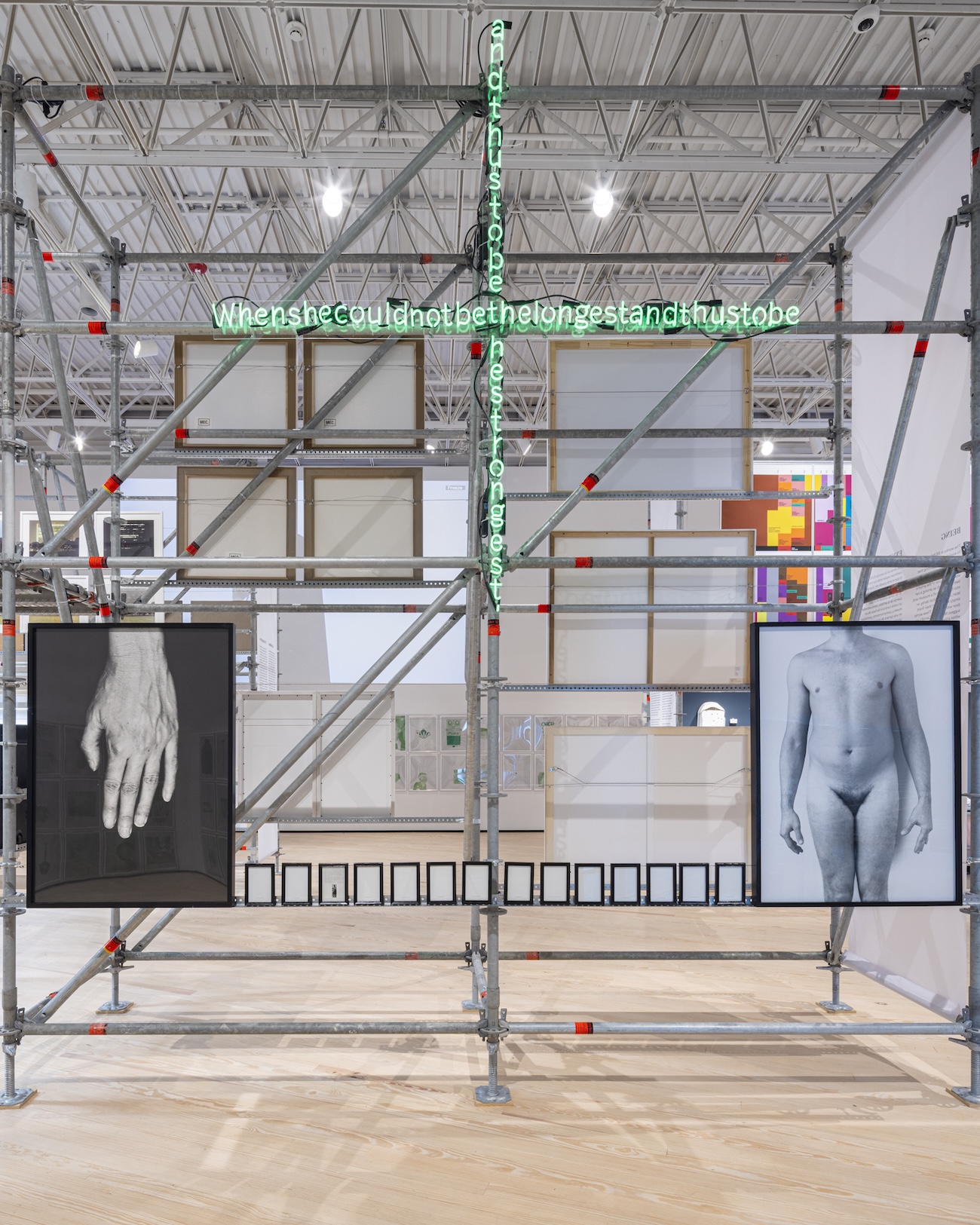
MEC: People frame things relative to what their interests are. For Rebecca—and you would have to ask her—it was performance, doubling, and the Doppelgänger series, as evidenced in her essay.19 For my graduate thesis project, I realized The Hand of Fatima (1989) on the disappearance of women as they age. I was 26 years old, making work on menopause, the medical biology of HRT, and how that disappearance is fabricated sociologically and pharmacologically. All those things come together as material in both text and images with a kind of doubling in drag of the figure posing as female. The show moves through different areas of the double, the dialectic, the copy—extending from the individual to the collective to society at large, dissolving perceived boundaries. The title, How To Talk Dirty and Influence People, comes from comedian Lenny Bruce. Rebecca suggested it, given my use of his work and interest in comedy. In the conversation I had with her after the opening, David Joselit asked, "What’s the difference between standup and slapstick?’ And I said, ‘Jackson Pollock does slapstick, and Sigmar Polke does standup."
RRC: That’s the perfect response.
MEC: You get it.
This interview was edited for length and clarity.
1 “The architecting of frequency as a twenty-first-century form of Land art is how the art world needs to historicize [PUBLIC UTILITY 2.0].” Mary Ellen Carroll in David Joselit, “A Conversation with Mary Ellen Carroll (Part One),” in Mary Ellen Carroll: How To Talk Dirty and Influence People (Contemporary Arts Museum Houston and Dancing Foxes Press, 2026), 169.
2 Charles Renfro, “Mary Ellen Carroll’s Federal.” Quoted by Pamela M. Lee, “All This Is Solid: Mary Ellen Carroll’s Elemental Media,” in Mary Ellen Carroll: How To Talk Dirty and Influence People (Contemporary Arts Museum Houston and Dancing Foxes Press, 2026), 197.
As part of the public programming for Mary Ellen Carroll: How To Talk Dirty and Influence People at CAMH, a nonstop, 24-hour screening of FEDERAL will take place at the River Oaks Theater in Houstonfrom 9am on August 25 through 9am on August 26, 2026. https://camh.org/event/federal/
3 “The artist Judi Werthein was to be on the panel called ‘Designing Your Social Engagement’ as a part of the conference The Situational Drive, which Joshua Decter, from the Bard College curatorial program, had organized. Judi was complaining to me that she thought the entire thing would be a waste of time. I proposed to her that I take the opportunity to realize a piece in the Doppelgänger series where I would be myself as someone else. Then I waited twenty-four hours for her to think about it, because at a certain point ego always kicks in, and you want to be the one in front of the audience. She agreed, though, and it went as well as expected for the two of us—but Decter did not seem to value his own organizing principle of intervention. Before the talk started, when he saw me, he came up to me and said, ‘Who the fuck are you?’ I said, ‘I’m Judi Werthein.’ He said, ‘No, you are not.’ I said, ‘Yes, I am.’ He told me—meaning Judi—’I knew you were going to fuck with things.’ I told him, ‘Everything will be fine.’ And it was. Judi and I agreed that it was the best solution to the problem of this type of talk, as it did create cultural capital for all parties involved. It would have been just another panel if she was playing herself.” Hamza Walker, “My Death Is Pending: A Conversation with Mary Ellen Carroll,” in Mary Ellen Carroll: How To Talk Dirty and Influence People (Contemporary Arts Museum Houston and Dancing Foxes Press, 2026), 121-124.
4 “The audience for the spectacle or non-spectacle is a considered element in all of Carroll’s work, but particularly in the doppelganger tapes. There was a question of how the audience [...] would react to her being Joselit. Would they be patronizing and soft-pedal the questions or dialogue with the presumption that a conceptual artist would not have the same background or understanding to be able to answer the questions that they would actually ask of David Joselit and were asking David Joselit? Would they ask questions that would refer more to the performativity and her process? Would they be hostile, angry, feel duped, cheated that they were not getting David Joselit but a cover or reenactment? Most would not know Carroll by physical appearance, but would they be able to suspend disbelief as a member of the audience in order to actually hear what she was saying and as the authentic text by Joselit? Would they be willing to engage in the freedom that this suspension provides? Would the process reflect the fundamental philosophical question in all of Carroll's work, what is a work of art?” Mary Ellen Carroll, “No.13 Being David Joselit (You don’t know how to ask a question or perhaps I just don’t know how to answer),” Art Lies 62 (2009): 20, University of North Texas Libraries, The Portal to Texas History. https://texashistory.unt.edu/ark:/67531/metapth228027/m1/22/?q=mary%20ellen%20carroll
5 “There was a call to boycott exhibiting in Austria during the rise of the far-right Freedom Party of Austria (FPÖ) led by Jörg Haider. As John Waters so aptly asked in the video work, ME vs. I, “Wouldn’t you show when Nixon was president?” MEC in correspondence with RRC.
6 David Joselit, “A Conversation with Mary Ellen Carroll (Part One),” in Mary Ellen Carroll: How To Talk Dirty and Influence People (Contemporary Arts Museum Houston and Dancing Foxes Press, 2026), 172.
7 Kathryn Scanlan, “I Am Mary Ellen Carroll,” in Mary Ellen Carroll: How To Talk Dirty and Influence People (Contemporary Arts Museum Houston and Dancing Foxes Press, 2026), 24-29. Scanlan reads an excerpt of her catalogue text in “The New Social Environment #1365: Mary Ellen Carroll and Chloe Stagaman, with Kathryn Scanlan,” The Brooklyn Rail https://www.youtube.com/watch?v=SuX9cK7xLuE
8 Kathryn Scanlan, Kick the Latch (New Directions, 2022).
9 Ken Isaacs, “How to Build your Own Living Structures”
10 Carroll previously worked with Romano “on a decentralized solar farm for prototype 180 in 2008.” MEC in correspondence with RRC.
11 “Remember a few years ago when television went digital and everyone had to get adapters or new TV sets? When that happened, what once were television channels became simply channels, a bulk of empty bandwidth that could host any variety of transmission. The Federal Communications Commission named it Super WiFi.” Nathan C. Martin, “Why Art, Not Google, Could Revolutionize WiFi,” Next City, Dec 22, 2014, https://nextcity.org/features/cities-best-wifi-digital-divide-solution-new-orleans-mary-ellen-carroll-art.
12 ‘“Every single phone and Wi-Fi router near you blasts internet traffic through the air over radio wave, Jon Keegan notes. ‘A carefully regulated radio spectrum is that makes it possible for these signals to get to the right place intact.’” Jon Keegan, “The Beautiful Complexity of the US Radio Spectrum,” MIT Technology Review, August 23, 2023, https://www.technologyreview.com/2023/08/23/1077686/radio-spectrum-visualized. Quoted by Lee, “All This Is Solid: Mary Ellen Carroll’s Elemental Media,” 201.
13 Nam June Paik, “Media Planning for the Post-Industrial Society: The 21st Century Is Now Only 26 Years Away,” report prepared for the Art Program of the Rockefeller Foundation, 1974.
14 “In 1968, the opening of the Claiborne Expressway as part of the I-10 devastated the city’s Tremé neighborhood, a formative crucible of Black life, politics, business, and culture for centuries. Like other highway projects of the postwar era—particularly in Los Angeles, Nashville, and Tulsa—such initiatives redlined and disinvested historic neighborhoods of color. The I-10 ruptured an important Black enclave in New Orleans’s Seventh Ward, setting into even greater motion the conditions of anti-Black inequity and disenfranchisement at the site.” Lee, “All That Is Solid: Mary Ellen Carroll’s Elemental Media,” 201-204.
15 Alibis: Sigmar Polke 1963–2010, April 19–August 3, 2014, the Museum of Modern Art, New York. Organized by Kathy Halbreich, Associate Director, MoMA; with Mark Godfrey, Curator of International Art, Tate Modern; and Lanka Tattersall, Curatorial Assistant, Department of Painting and Sculpture, MoMA. https://www.moma.org/calendar/exhibitions/1374
16 “Karl Oye Knausgaard did this in his autofiction opus. My Struggle: A Noun Acting Like a JPEG (2014) is the title of the work I realized at [Robert] Rauschenberg’s studio. 428 nouns are jpegs as forms of autofiction, albeit in images, and they surround viewers at the exhibition. […] An image is what one sees. What is the equivalent in language as a noun?” MEC in correspondence with RRC.
17 “The apartment complexes that were built and surrounded the homes in Sharpstown created an aspirational wall to move one from an apartment to a home. All that history is still there and it is part of the reason that the area has not been redeveloped like other surrounding neighborhoods like Bellaire.” MEC in correspondence with RRC.
18 “The irony isn’t lost that they saw the property at 6513 Sharpview Drive [Houston, TX 77074] as protagonist whose condition made it possible to become a 501(c)(3).” MEC in correspondence with RRC.
19 Rebecca Matalon, “How Do You Solve a Problem like Mary Ellen Carroll?” in Mary Ellen Carroll: How To Talk Dirty and Influence People (Contemporary Arts Museum Houston and Dancing Foxes Press, 2026), 32-48.