In Conversation with Yvonne Shortt
Interview
The Venice Biennale is perhaps the most anticipated and venerated international art fair, and this year’s iteration was certainly one for the books. In the weeks leading up to, and even days of, the Biennale, the art world witnessed a wave of political actions unfold among some of the industry’s biggest names. Controversy sparked amid Russia and Israel’s participation in the Biennale, culminating in the resignation of the entire jury. On May 6, performance art group Pussy Riot staged a protest outside the Russian Pavilion. On May 8, a protest for Palestine was organized on Via Garibaldi, right near the Arsenale. Furthermore, multiple pavilions, including France, Belgium, Korea, and the Netherlands, closed in solidarity with the strike. So far, fifty-two artists participating in the Biennale have declined to be considered for a Golden Lion. Considering this art world political saga, one asks: where does the United States pavilion stand?
Months before the Biennale’s official opening, the US Pavilion was already under intense scrutiny after the Trump administration released a statement calling for a pavilion that represents “American exceptionalism and diplomacy.” Many curators backed away, not wanting to align themselves with the current administration, but Jeffrey Uslip, who has previously worked with the Malta Pavillion in 2022 and CAM St. Louis, took on the commission, selecting Alma Allen, the Utah-born, Tepoztlán-based artist known for his biomorphic sculptures. In the days immediately after the exhibition’s opening, Uslip and Allen received an onslaught of criticism from the press, which called Call Me the Breeze “boring,” “meaningless,” and “apolitical.” In the aftermath of the outpour of negative press, IMULPSE Magazine sat down with Uslip for a one-on-one interview to understand where he stands following the first few days of the Pavilion's opening and what he hopes for as it opens to the public.
Annika Wolanczyk: Why, for you, was Alma Allen the right artist for the US Pavilion this year?
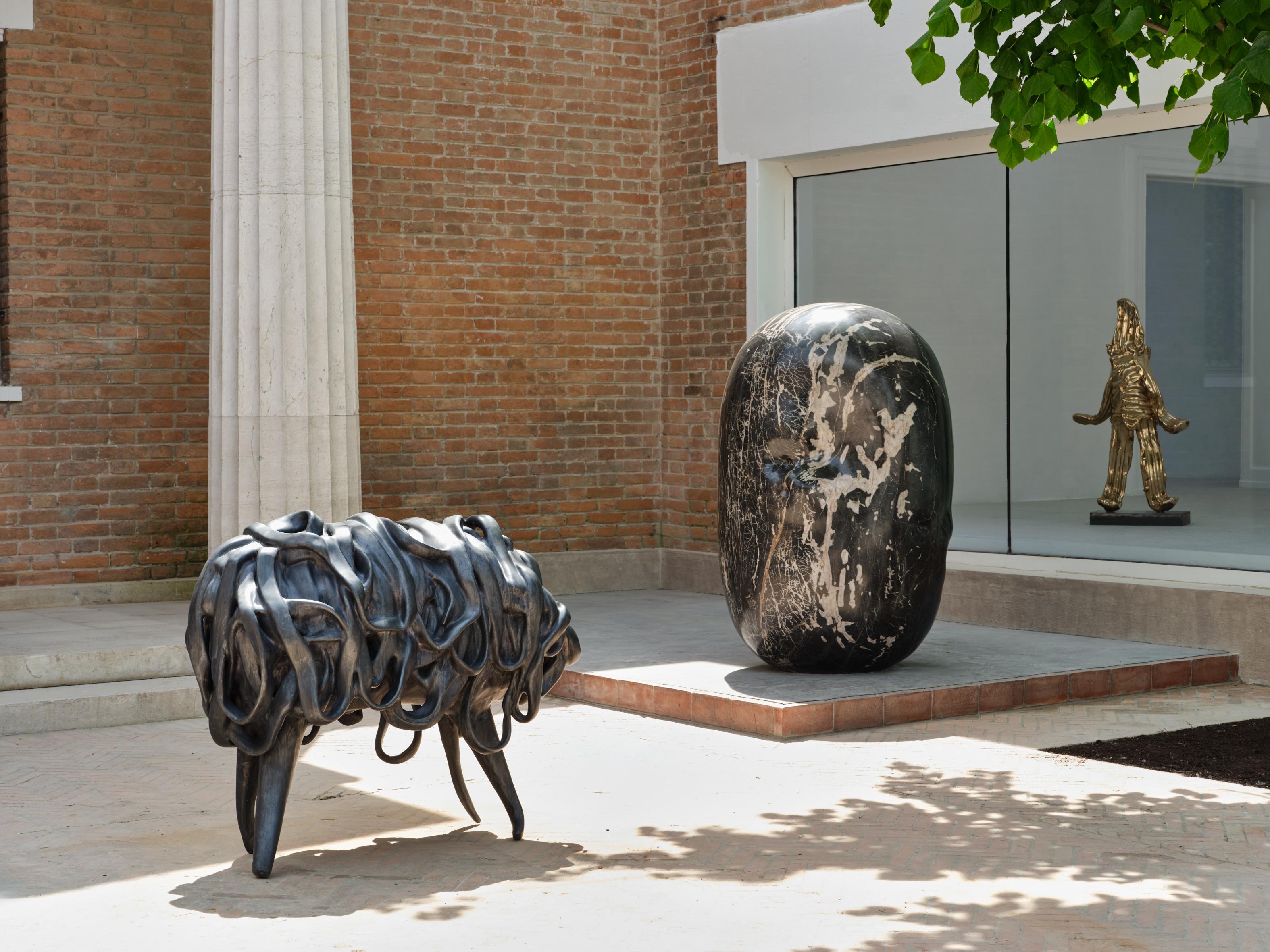
Jeffrey Uslip: I think it starts with thinking through what types of art operate now as we approach the 250th anniversary of the signing of the Declaration of Independence. What do we want for the country? The Pavilion could have gone in many, many different ways. The American bench is deep, and several artists would have put forth an incredibly compelling, innovative, and signature presentation.
For me, I was thinking about three guiding criteria. One, how do we be our future selves in the present? Two, how do we create a unifying position? Three, how do we lean into a first-person narrative, a way of being in the world, one person's lived reality versus a third-person critique of where we are? So, for me, a few artists came to mind, but Alma was the one who rose to the top, because the landscape has a way of putting things into perspective, recalibrating scale, allowing what's important to one's life and the lives of others to come to the fore.
It was also a way to think through the larger Americas and a way to look at the history of biomorphic art from an American position, from Noguchi to Martin Puryear. Alma made sense to me for all these reasons at the same time. And I wanted to put forth work that would be accessible and have multiple entry points, not only nationally, but internationally. I wanted viewers to see a very particular point of view on where we are in the world right now. If you want to call that politics, so be it. I call it politics. But it's a different kind of politics—it's not an instrumentalized or didactic politics, it's a politics that I consider sphinx and chimera. It's a politics that thinks through the relationship of material and form as it pertains to an artist's point of view, lived reality, and a way of being in the world.
AW: What does it mean to curate a national pavilion today?
JU: Well, it's a moment of great pride, and I think it's also a trap. Any nation, but emblematically, the United States, is a nation of diverse perspectives. The “American experiment,” by nature of America itself, encompasses a multiplicity of voices, imperatives, and initiatives. So while it is a great honor, it's also a trap, because I don't believe we can ever think that one pavilion will present the one exhibition that speaks to, or for, everyone. There are some people who have the notion that world's fairs and national pavilions don't have agency anymore, but I disagree. I think they can have agency if you lean into what makes your pavilion particularly unique to your country. I think we were trying to do something different, and it showed.
AW: How would you describe your curatorial practice? How would you define your role as a curator in this exhibition?
JU: I'm "artist-first." I believe the role of the curator is to bridge an artist's practice with the public, and I believe the best curators guide the viewer through an exhibition, through the relationships of work together—which I think our exhibition does—and then disappear. You shouldn't see the hand of a curator, but you should feel it. The viewer should have an individual and unique encounter with the work of art. It should unfold over time, and your role as a curator is to guide the beholder or the public through the multiple registers or layers of what an artist is trying to do with their work.
AW: How does the spatial layout guide interpretation?
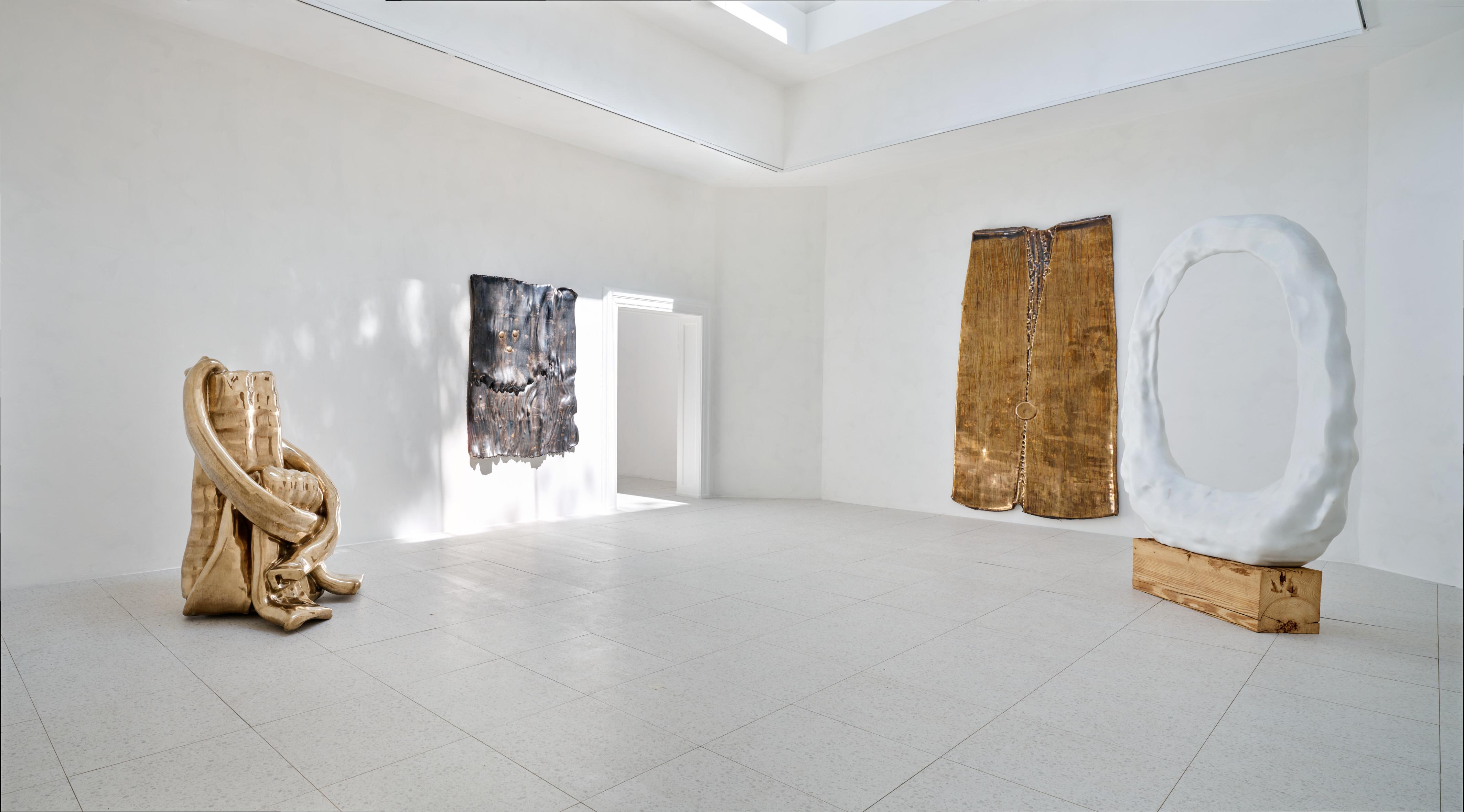
JU: It's everything. Do you start in the middle? Do you start at the beginning? Do you start at the end? I mean that both metaphorically and literally. Certain exhibitions start in the middle—the pavilion’s forecourt started in the middle, in the present. Then, we went to the artist’s autobiographical beginning, and then we looked at an archaeological construct of the first civilizations. Then, we looked at truth, beauty, and freedom. Then we thought about a metaphysical position. And in the end, we brought people back to the landscape.
In what I would consider the “metaphysical gallery” [the third room in the pavilion], we offered viewers the choice between an open portal [Not Yet Titled (2014)] and a closed door. That work recalls institutionalism with the use of Yule Marble, which was a material used to create some of our nation's most iconic monuments, the Lincoln Memorial and the Tomb of the Unknown Soldier. There was also the bronze wall relief [Not Yet Titled (2020)]. That one, to be honest, I never liked and didn't want to include. But this work was something Allen insisted on—he said, “It's important, because for me, this is the conspiracy room.” The bronze work had these three orbs that were in the sky, or, if not the sky, in the upper register. And he told me, “Jeffrey, you know, when the Air Malaysia flight disappeared, these three orbs were circling the plane, and, you know, this is a conspiracy theory [ . . . ] I have this feeling that after the show opens, the government's going to release all these UFO documents, and we'll see pictures of all the UFOs right after the show opens.” And I said, “Okay, let’s do it.” And that's exactly what happened. I've looked at the archive of released UFO images, and they look exactly like Alma’s bronze wall relief. When you say you’re “artist first,” you have to mean it. You have to do it, and I did it. As I said, this was a work I neither liked nor wanted in that room. But now I see the incredible importance of that decision, because if I say I want my show to hold a mirror up to its contemporary imaginary, you've got to walk the walk.
AW: Where does the exhibition take its greatest risk?
JU: The exhibition takes its greatest risk by existing in the first place. The majority of the art world wanted the pavilion closed as a protest against Trump, rather than recognizing that this pavilion is a nonpartisan entity. Art matters, art has agency, and I believe in its promise and possibility. That's where the exhibition takes its greatest risk. We continue to believe in art. This exhibition is not about any government or administration; it's about a nation. It's about culture, it's about artists, and that cannot be corrupted, instrumentalized, or weaponized by any political party.
AW: Allen’s work is recognized for its focus on material and form. In your mind, what is the significance of focusing on abstraction in a hyper-discursive art world?
JU: Well, I think abstraction can be hyper-discursive. The question is whether non-representational art, or non-objective art, can be political or discursive, and it can, as evidenced by a long line of artists in America and throughout the world.
AW: You have said that we are at a critical moment in culture. Can you expand on what you mean by that? How do you feel that Allen’s work speaks to the moment that we are in?
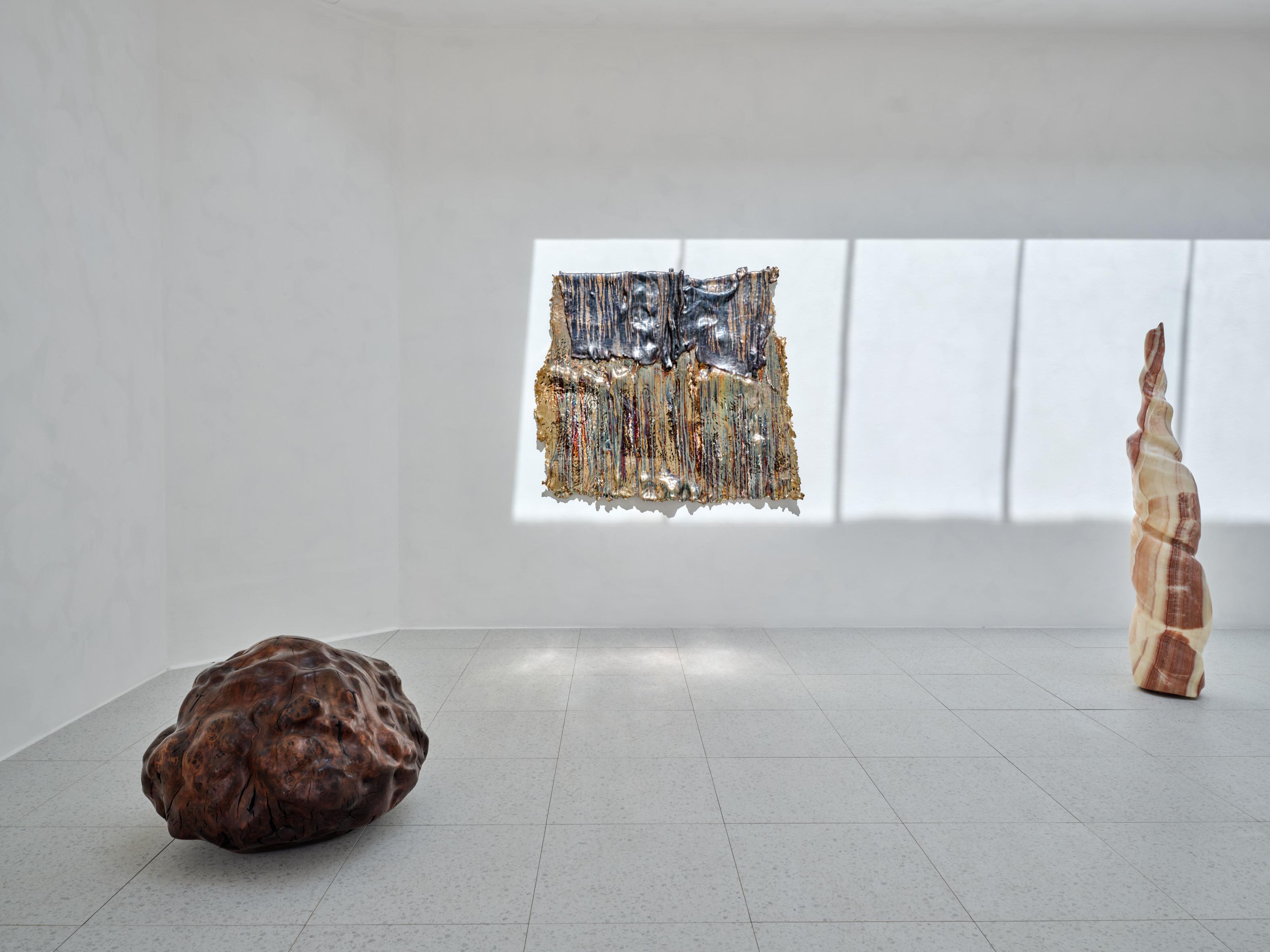
JU: Well, if people look [at the exhibition], they see that materials make meaning. There's a reason why the exhibition contains Mexican onyx, Mexican marble, Guatemalan green quartzite, and Colorado Yule marble. And yes, as I said, the exhibition is chimeric, and if people look at material and form, as it pertains to where we are right now, in this very combative and instrumentalized, weaponized, and divisive time, they would immediately see that this exhibition is meant to undo that.
AW: If the exhibition is misunderstood, where do you think that misunderstanding will happen?
JU: This exhibition is not misunderstood. That's the whole point. It's very much understood. The issue is that the people who are writing about the exhibition do not consider it as mattering or being important, or worth anything. They know it's just the opposite. They know this work means something. And they are intentionally saying the opposite to make sure people misunderstand. They, I believe, don't want the center to hold. Anyone, no matter what political party you are in, practicing any form of this kind of media malpractice, or attack on truth, or attack on art, is no better than the others.
This interview has been edited for clarity and length.