
Samuel Alexander Forest: “A Bag of Tricks” at Ortega y Gasset Projects
Review
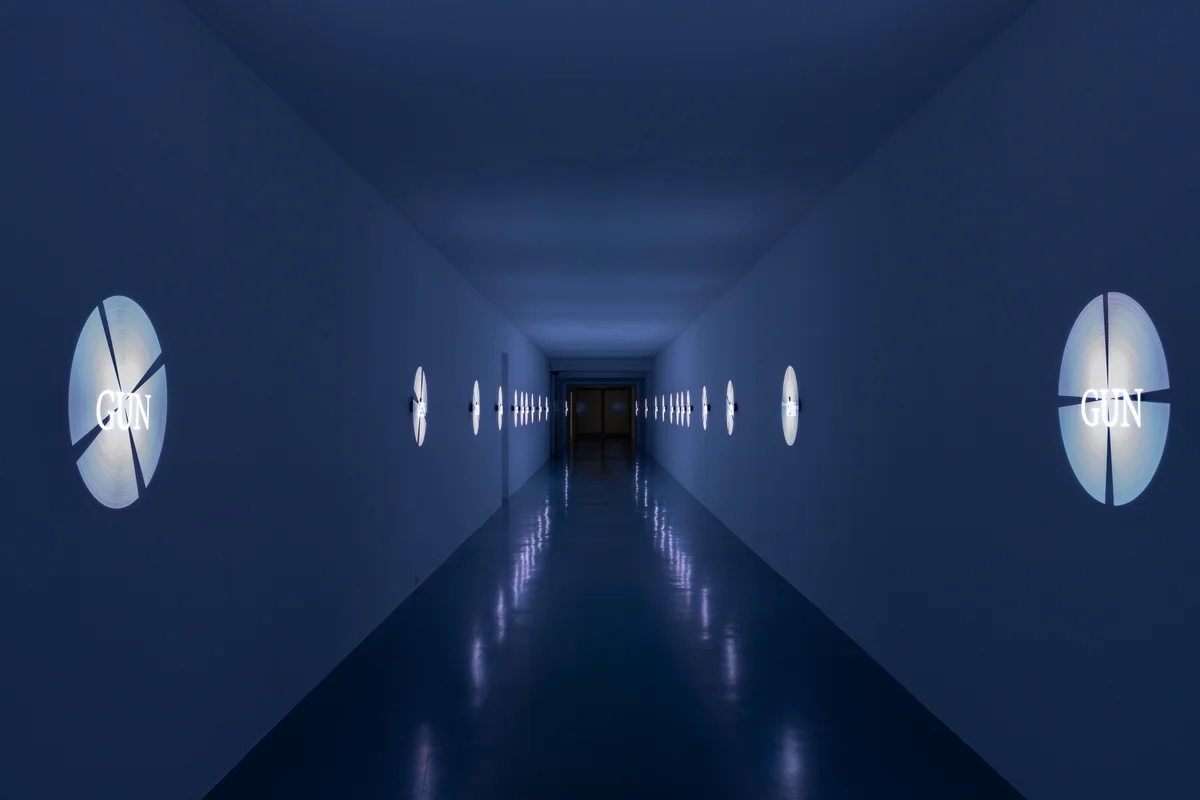
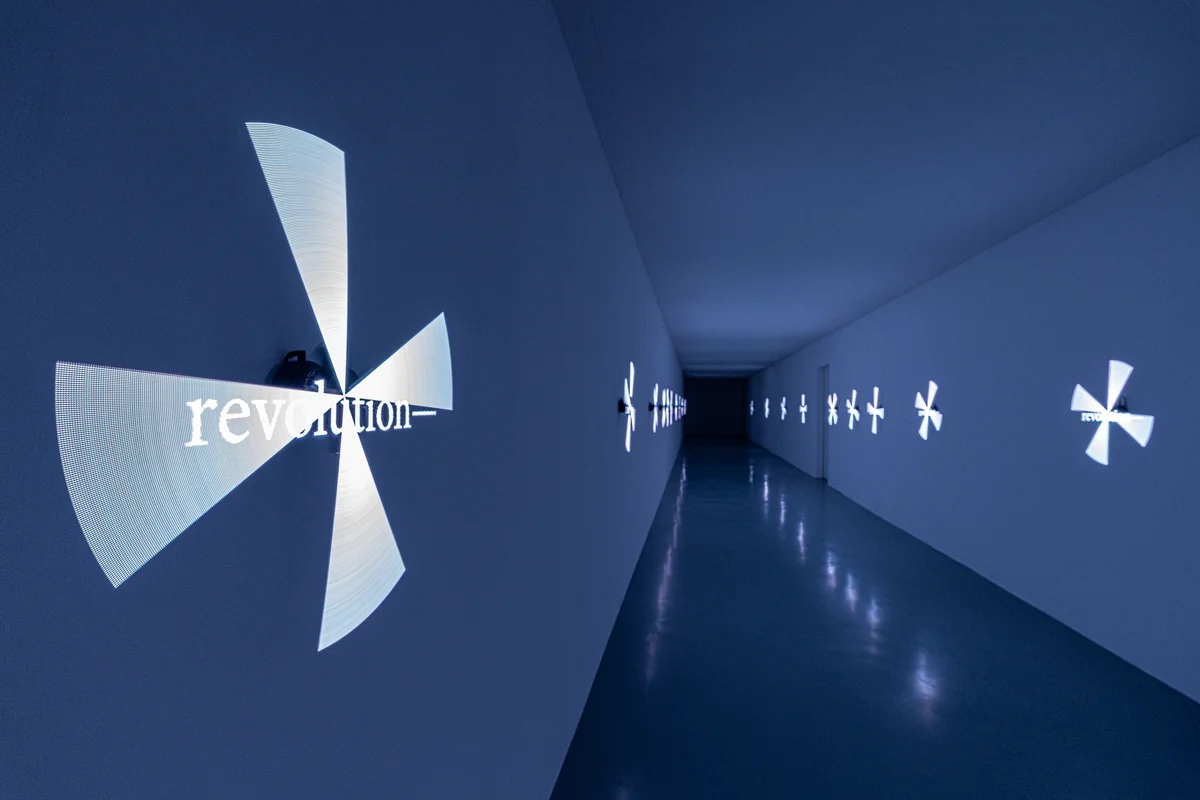
P. Staff’s solo exhibition at the Bonner Kunstverein, Durchdringung, starts with Minimum World (2025). Twenty-four spinning, holographic fans stretch down a narrow hallway. As they whir, words surface in a shocking blue-white reminiscent of lightning. Reading this fleeting poetry requires a constant refocusing of the eyes, triggering a subtle nausea that settles in the gut. By the time one reaches the end of the first gallery, a mild sense of vertigo has begun to set in. P.’s work has made its way through the eyes, into the stomach, and deep into the body’s musculature. This installation evokes the guttural, somatic reckoning that the artist’s work can induce.
P. Staff appeared on the screen of our video call with a cheery greeting from sunny Los Angeles. With a soft lilt to their voice, they speak about the way their life has oscillated between the United Kingdom and the United States, explaining their practice with free-flowing references and readings. It became evident that the effectiveness of P.’s work stems not only from its harsh colors, scale, and sensory intensity, but also from the artist’s careful attunement to the world around them, searching for entrance points into what we define as the body.
Annalise June Kamegawa: Could you give us the dictionary definition or the translation of Durchdringung and explain what it means in the context of your work?
P. Staff: I grew up in Europe and moved around a bit throughout my life. I like the slipperiness of language that emerges in these kinds of mixed environments. When I had a show at Kunsthalle Basel a few years ago, it was called “in ecstasy,” but we spelled it the German way, In Ekstase. There were a couple of works with French titles as well. It feels promiscuous in a satisfying way.
Durchdringung comes from translating “penetration” into German. And although in German you can say “penetration,” durchdringung has this closer relationship to some of the ways that we might use “penetration” in English, in the sense of how expansive and knotty that can be.
Obviously, in English, it has [a] sexual connotation. And it’s a sexual word that isn't romantic, really, in any way. There's something either forceful or clinical or bureaucratic about that word. In German, “penetration” has that sexual hardness, but it feels less expansive. That’s sort of the primary use of it. Durchdringung seemed like a good way to keep some of the mystery in.
Viktor Neumann, the curator at Bonner Kunstverein, and I had many conversations about how the works in the show were all concerned with things entering the body—ideas, politics, materials—bodies crossing borders, saturation, light moving through material, obfuscations, and transparencies. [The works were] also about what I would call “technologies of the clinic,” like x-rays and MRIs and lasers and this kind of thing.
Having said all of that, to me, English is the perfect summation because it retains the violent, militarized language of it. The medical, bureaucratic, all of that. That’s what I was attracted to.
AJK: I appreciated how in Viktor’s exhibition text, there was a relation made between your work and the local German context of chemical production and what that means for a city like Bonn, which had served as the capital of West Germany.
PS: I have been using fluorescent colors for a number of years now in my shows and the works that I make. It registers on so many different levels. Part of my initial attraction was almost a form of institutional critique because one of the primary mechanisms of the art institution is light. You spend so much time hyper-fixating on light in a space.
The first time I really did this mass neon was at the Serpentine in 2019. I had a show there that was about trying to go for full saturation. I wanted like a flat, almost no shadows, harsh neon. Like sunlight turned up too bright or a kind of jaundice, piss yellow.
I think there are interesting historical connotations in that I totally feel like a child of British post-punk. During the ’80s, there was this moment in the Cold War where, in the UK and other parts of Europe, punk went really neon. You have X-Ray Specs or Nina Hagen or these other people that are suddenly leaving behind this post-fascist imagery of punk and going into this other nuclear, irradiated aesthetic. There’s something embedded in that about counterculture, chemical warfare, nuclear war, and this kind of thing. That's a place I really want to land. Obviously in Germany, it has such a specific history, such a specific context. In general, Viktor and I wanted to make sure that we were constantly drawing attention back to the intense militarization of German culture.
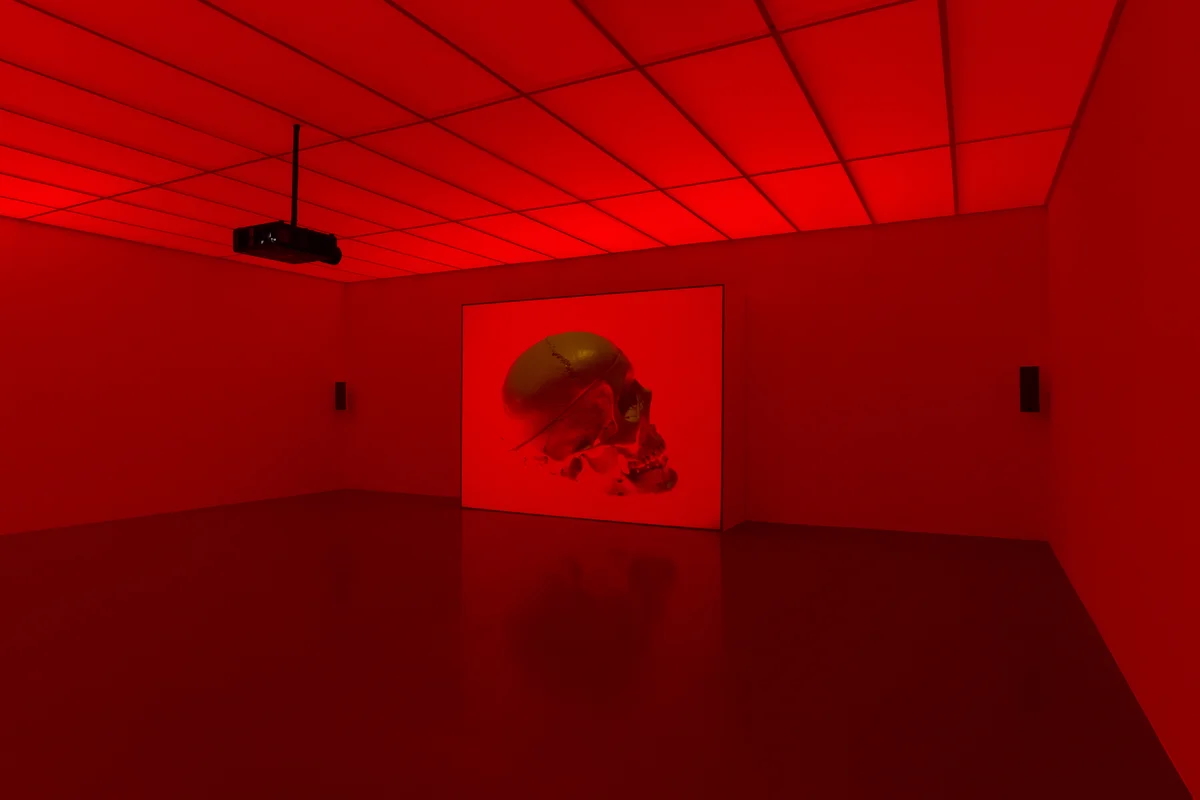
AJK: When I walked into the exhibition, because of the lights and the strobes and everything, it really felt like I was in a club. What kind of environments influence your work and your relationship to light more broadly?
PS: I've never been deeply, deeply in a particular club scene, you know. But I have a million videos of strobing lights on my phone because, if I am out at a party with friends, I can often be caught in the corner filming the lights and trying to understand the effects on the space and the bodies. As a teenager and in my 20s, I was much more into the punk scene, which is not very cinematic. In a way, it’s a little anti-aesthetic. But I love a cold kind of rigor.
Making video work, you’re thinking about light a lot. You know what, there’s maybe an argument to be made about having moved to LA and becoming fixated on light as an aggressor, an antagonistic presence in your life. There are atomic sunsets there, and constant fires. It’s dizzying when you have the most beautiful sky that you’ve ever seen, and it’s because there’s a forest on fire a few miles away. Or the strange beauty of seeing ash rain from the sky. I think my relationship to light is half punk and half apocalyptic.
AJK: I often see people, after they move to LA, describe the sun there as oppressive.
PS: Exactly. It never changes. Like what I was saying before, this idea that light is one of the primary mechanisms of the art institution: it’s generally meant to be not noticeable. In that way, it functions like one of the many disciplining forms of power in an institution. I like to take that and turn the dial up until it’s oppressive.
I think there is some psychological shift about moving somewhere where the sun and light are so agitating. It’s also funny because I come from a very dark country. So yeah, there’s some psychological shit going on there.
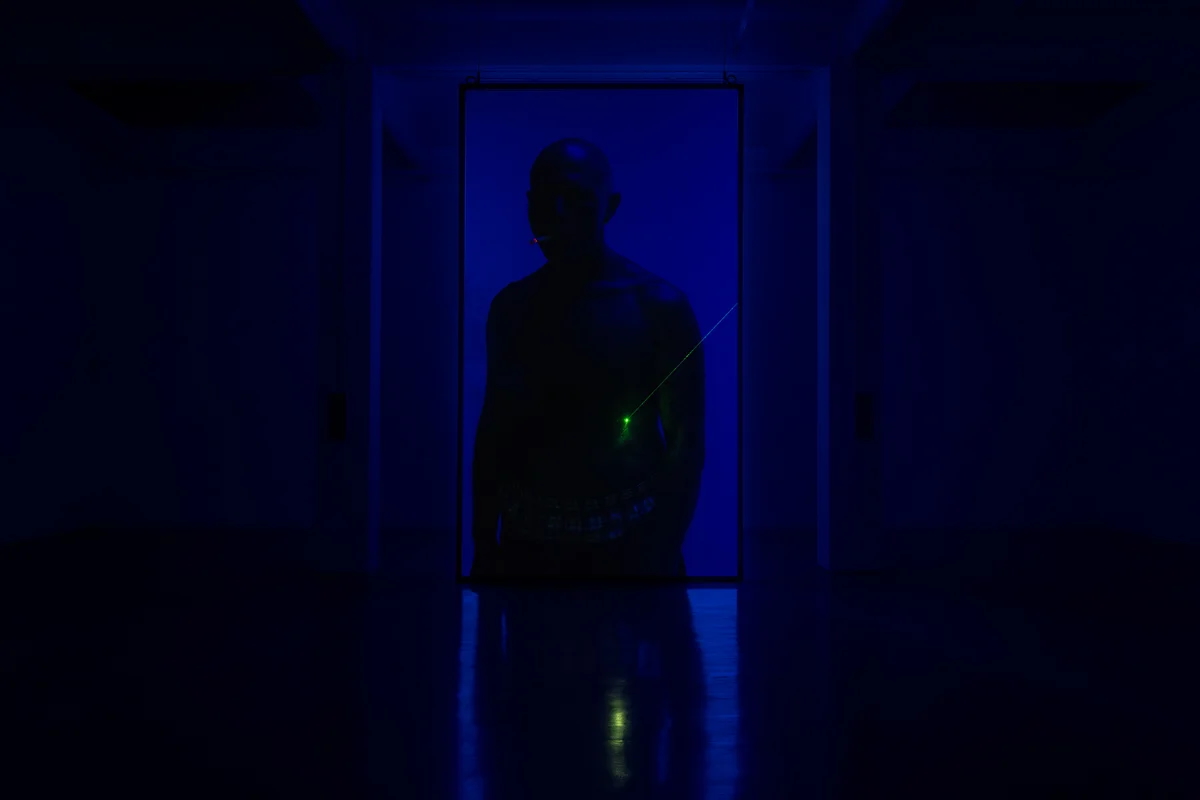
AJK: It’s true that there is this invasiveness about your work. I was thinking about Hormonal Fog, 2025. You can’t close your nose. With Minimum World, even when you close your eyes, there’s still the sense that it’s there.
PS: I’ve always been interested in how different mediums can dissolve that distinction between the artwork, the viewer, and the space. I like works that make you feel touched by it. And not emotionally touched, but changed in some ways; that it’s got inside of your body in some way.
Going back to club aesthetics, there’s nothing I love more than a subwoofer that’s making your chest shake. Feeling the vibration or seeing a speaker that’s rattling. In the first few years after graduating from art school, I was making performances, and a lot of that impulse is still in the work. I wouldn’t say it’s participatory, but I would say it’s inescapable in some way. There’s a little bit of me, and there’s a provocation in that. It’s like, I’m going to make you walk down this fifty-foot corridor that’s strobing, and that’s the price of entry. It’s a dare, a provocation, a challenge to how much you, the viewer, want it or not.
Even if a viewer has to close their eyes, turn away from the work, or if they want to run out of the room as quickly as possible, those are still valuable experiences to me. But I also think a lot about the rhythmic tempo of all the works, on an embodied level as well as emotional. We started Durchdringung with a very energetic, agitating work. Your nervous system spikes. The rest of the show has a slower tempo, but your body is still vibrating somehow. I wanted the final room of the show, where you see the film Penetration towering in the darkness, to be the slowest and the most atmospheric part of the show. But in some ways, you have gone through hell to get there.
It is invasive, and it is about trying to alter your state of being a little bit. These are quite precise maneuvers on my part to invoke a certain affective, emotional and nervous state. Because then I can get the deepest into you with the work, you know?
This interview has been edited for clarity and length.