
Samuel Alexander Forest: “A Bag of Tricks” at Ortega y Gasset Projects
Review
Eli Hill’s recent presentation of eleven paintings, Internal Weather on view at Harkawik, pits photorealistic portraits of queer bodies against often surreal settings of earthly delights and decay. In Hill’s third solo show with the gallery, the artist, a trans athlete, combines the personal with the political to comment on the pressing issue of legislation that beleaguers the autonomy of Hill and his community while also celebrating—and simultaneously catastrophizing—the current state of nature. The issues seem interlocked: the same spiritual decay that threatens the rights of queer people is creeping, in increasingly obvious ways, to destroy the planet’s earthly splendors.
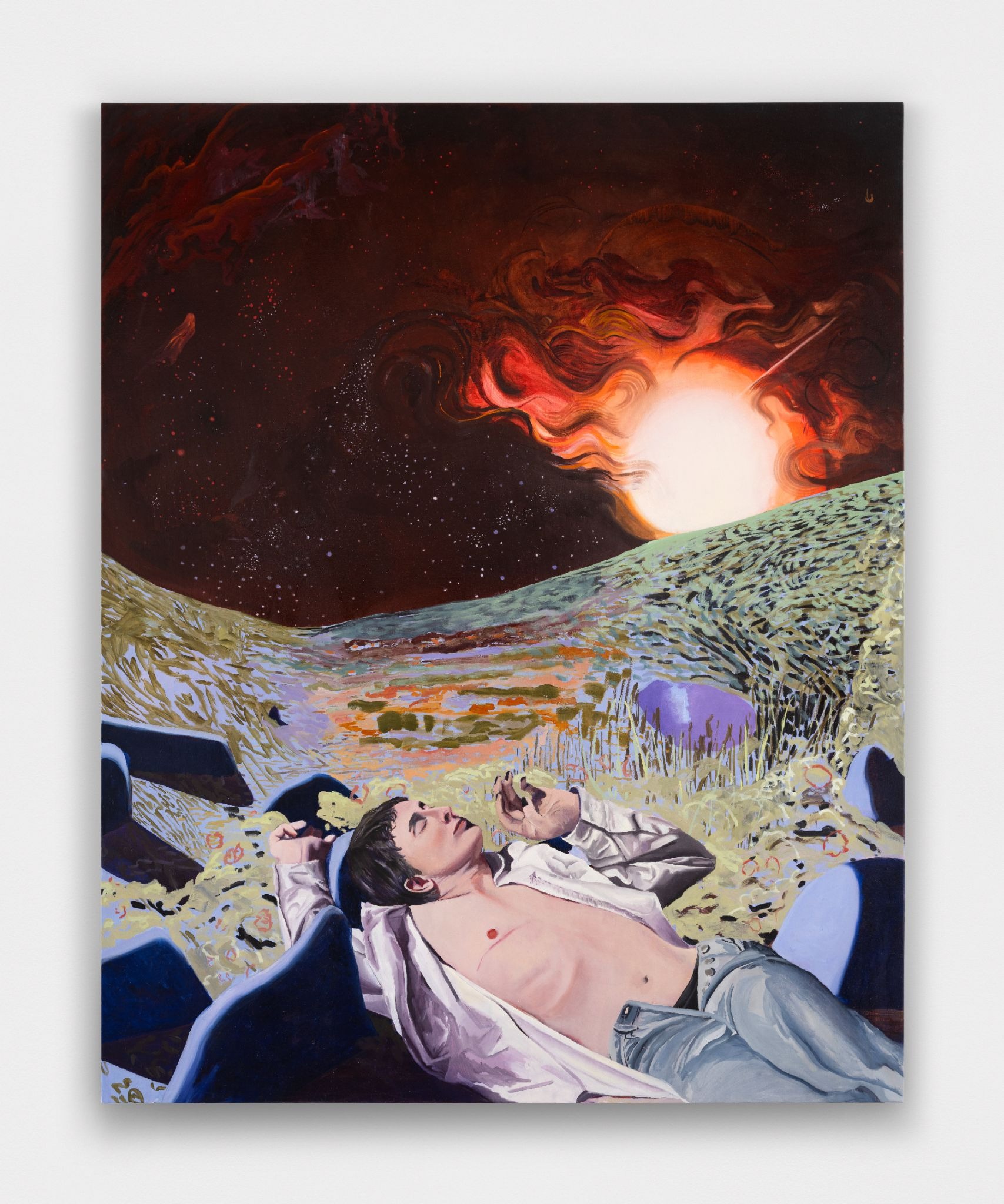
Transgender Billionaire (2025) is the most obvious example of this idea and the show’s standout work. In the painting, Hill lies supine, top surgery scars exposed, on the surface of a grassy, Bonnard-colored world, while in the background, a conflagrant planet—likely Earth—glows, billowing clouds of smoke streaming. Hill’s eyes are closed to the apocalyptic destruction: like the fall of Sodom and Gomorrah, if he looks, he risks a similar fate as Lot’s wife.
Recursive throughout the work is Earth’s Edenic quality: there’s the Fire Island beach scene in Making Something Beautiful (2025) and the enveloping forest surrounding nude figures in Throuple in the Sun (2025). These aren’t just backgrounds to situate the people who populate these paintings; they are part and parcel of the larger image. Not an afterthought, but a case of planning. In this way, Hill is creating a reversal of what Clement Greenberg referred to as the progressive flattening of the pictorial stage, “until its backdrop had become the same as its curtain.”
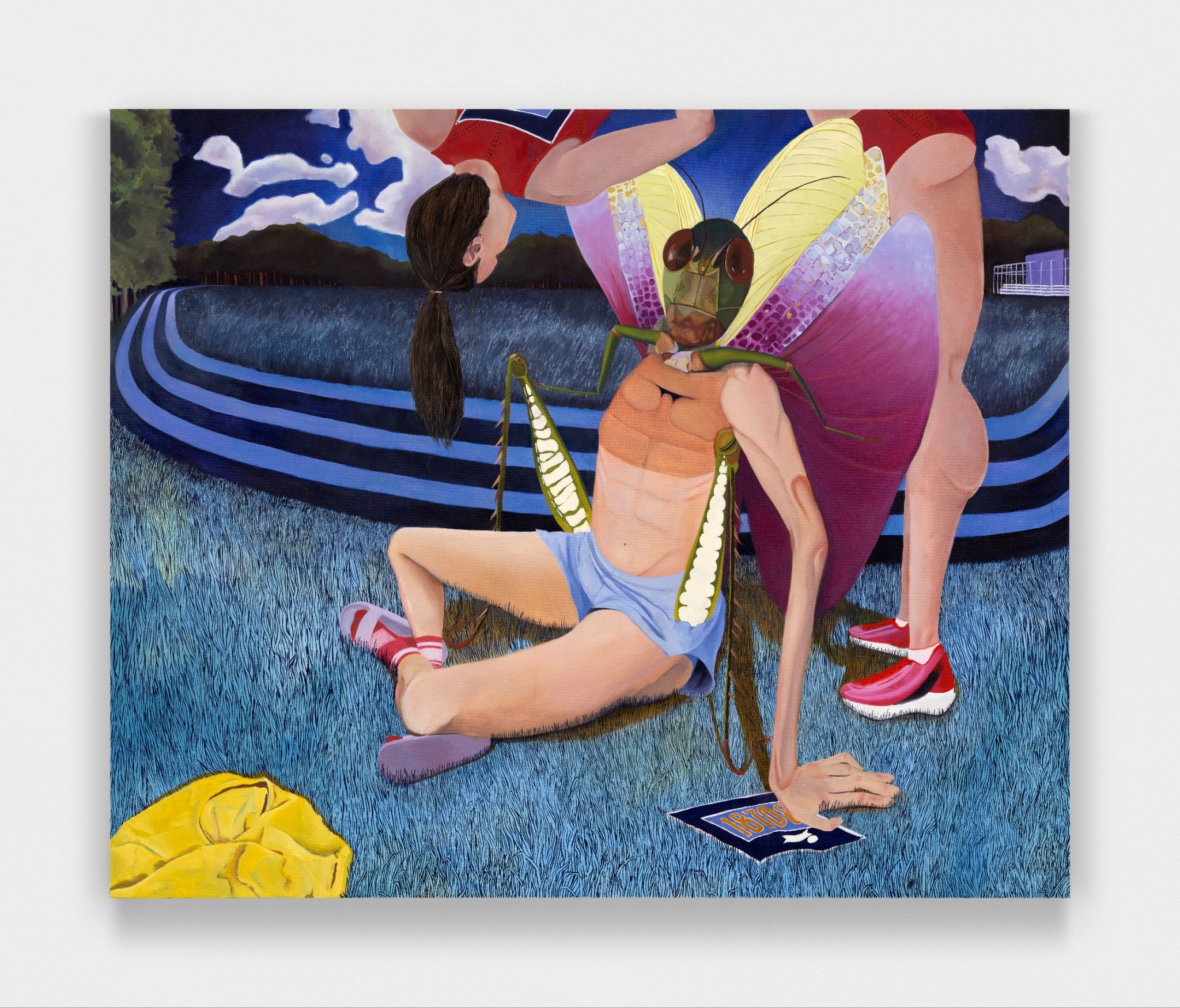
Hill isn’t just an image-maker—he is a storyteller. In Competition (2025), an anonymous athlete stares at a perfect specimen, presumably Hill, who is transformed into an insect. Here, on the track field, we cannot tell if this is the emotion summoned by either athlete, though the female figure is rubbernecking in a way that evokes, at the very least, intrigue. This is an age-old story, from Greek myths to Gogol: the uncanny transmogrification, reflective of a deeper inner turmoil. Tension is introduced into the picture by calling upon the absurd—it is up to the viewer to either resolve that tension or let it ripple through them.
In another track scene, Heat Days (2025), Hill is both lying down and standing up. The sun beams overhead as the landscape warps to meet him, making his figure simultaneously prone and erect. The miasma of heat can be felt, and this time, Hill’s body language belies a sense of despair. As Hill trudges through a swamp in another painting, Sunken Forest (2025), written on his face is an expression of mild annoyance at the fact that his kitchen has mutated into a marsh-like landscape. There is a detachment about the figure’s phlegmatic stance: Hill looks like he just woke up from a nap and was heading for a glass of water, only to find that, as often is the case in these paintings, things are not as simple as they appear. Is Hill, I wonder, unfazed because he’s adjusting to his new surroundings, or have trees been growing in front of the kitchen cabinets for as long as the artist has lived in this hybrid home? If the reader can sense the uncertainty in my reading, it is because Hill’s world is filled with stories, much like Kafka’s three novels, sans ending. Famously, Kafka’s The Castle ends mid-sentence. In Hill’s paintings, a similar feat is enacted; the story is left unfinished.
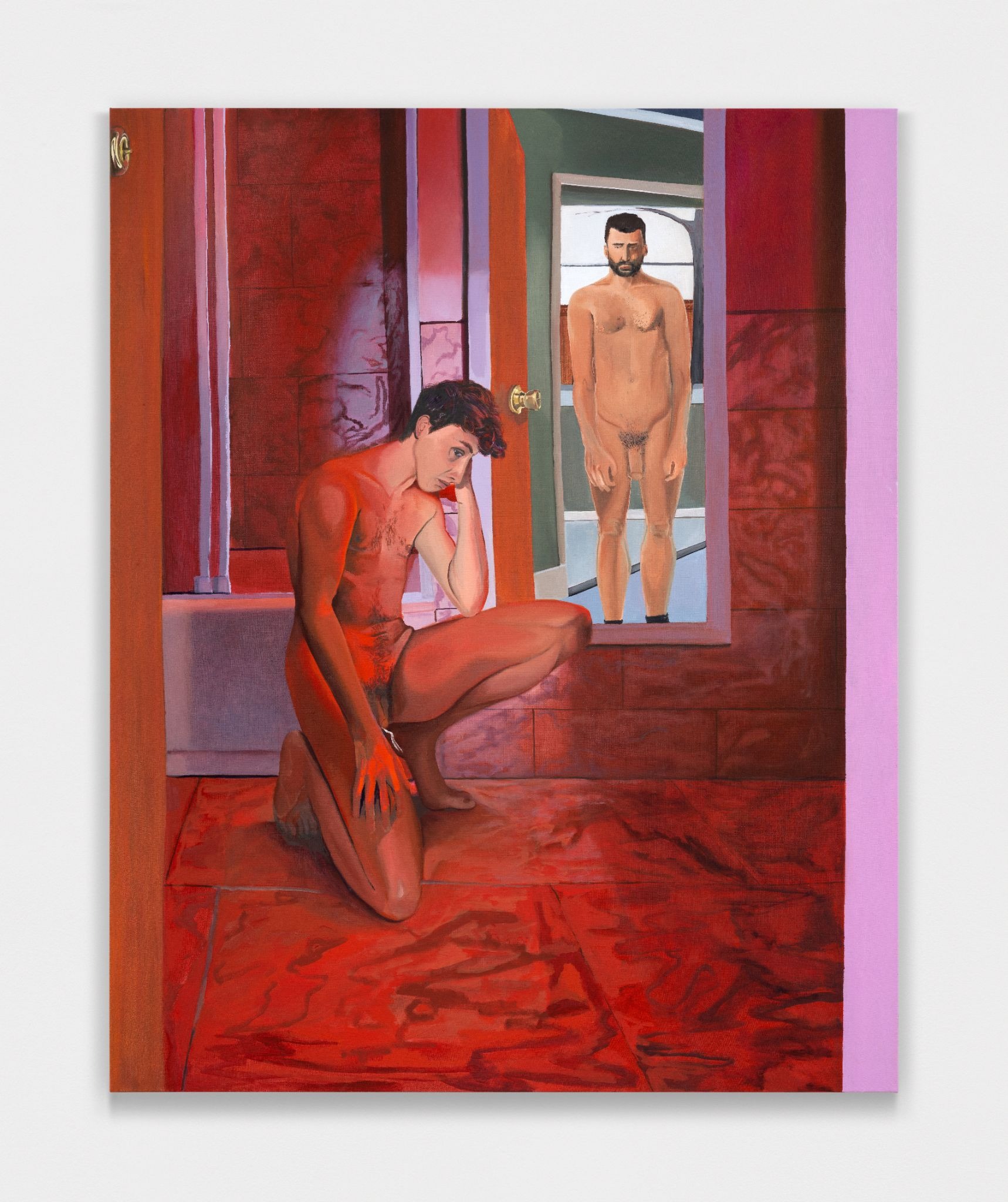
In examining the works that compose the show, I find myself most drawn to the less straightforward paintings, the ones that leave me with more questions than answers. The portraits are stunning, technically flawless, but the paintings that evoke an unsettling off-ness pack the most punch; they ask for a deeper level of engagement because they aren’t so easily resolved. Trans Period (2025) features two male nudes, one of whom is Hill, in a bathroom that opens to a bedroom in a feat of architecture that feels like it’s running with the phantasmagorical theme. Hill is crouching, dismayed, while, in the background, a nude man looks on, also upset about something unexplained. Hill is swathed in moody red light, the shadows perfectly rendered. His penis expels streams of semen, which feels contradictory to the look on Hill’s face. Eschewing mirrors for an easy Lacanian analysis, perhaps it is instead the viewer who recognizes Hill and not the subject in the mirror himself. But why is he ejaculating in this tense moment? My best guess is the man, a voyeur, caught Hill in a private act, at the point of climax, and being unfamiliar, each is abashed. But this is not a fact: as with most works of Internal Weather, Hill disrupts the natural flow of the world with the insertion of a surreal element that forces the viewer to wrestle with uncertain meaning. One askew element sets the propulsive beat of what follows.
Eli Hill: Internal Weather was on view at Harkawik from March 27 through April 25, 2026.