

.webp)

Editors' Selects: October 2026
Review
David Smalling: Elizabethan Collar
TEMPLON | 293 10th Ave, New York
March 26 – April 25, 2026
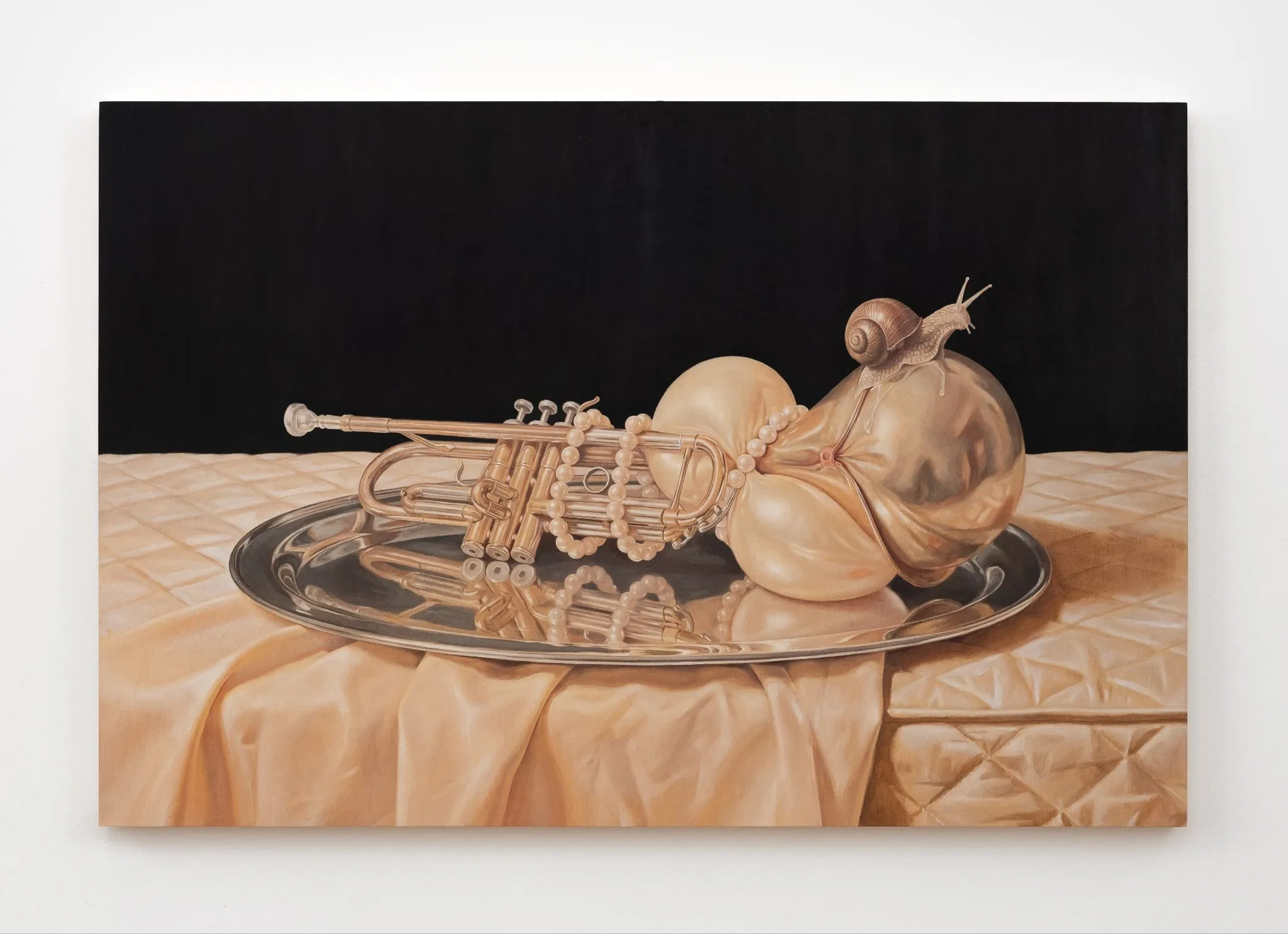
In his exhibition Elizabethan Collar at TEMPLON Gallery, painter David Smalling dissects the social codes that define gender and render its expectations constricting. Smalling’s practice appropriates the visual vernacular of the Dutch Golden Age and mannerism to examine the taboos and cultural hierarchies that construct identity. As such, the exhibition encompasses a series of surreal still-life oil paintings on wood panel featuring distorted instruments, candles, snails, balloons, mattresses, and birds, all warped by pearls and bows. As per the press release, the double meaning within Elizabethan Collar underscores its criticism of gender norms: it invokes the Elizabethan ruff, the stiff decorative collar from 16th- and 17th-century fashion, and its contemporary veterinary counterpart, “the cone of shame,” designed to prevent an animal from tearing its sutures.
Works such as Heimlich Manœuvre (2025) and Party Favor (2026) present trumpets with snails crawling across their surfaces atop silk mattresses. The intensified texture and convex reflections within the polished metal, akin to the mirror in Jan van Eyck’s Arnolfini Portrait (1434), lend the compositions a hallucinatory feel. In both paintings, instruments buckle and balloon under the weight of pearl strands and bows, losing their ability to produce music. This suppression functions as a formal analog to the rigid social constructions femininity imposes, with the pearls and bows serving as its symbols. The aesthetic choice of Dutch Golden Age painting further implicates canonized art history as a vehicle for entrenching gender expectations.
Similarly, Hollow Point (2026), which presents a gun beneath a glass dome, and Fast and Loose (2025), a still life of a gun alongside diamond earrings with snail trail dripping from the barrel, extend this logic: the decorative vocabulary of femininity neutralizes the possibility of violence. Meanwhile, Chandelier (2026) suspends a dead bird by pearls in the form of a chandelier, and Initiation (2025) presents a lifeless pheasant’s stomach literally ballooned and tied with a bow, set upon a wood-grained tablecloth. In both, Smalling’s syntax of stereotypical femininity mutates living creatures into ornaments.
But for all its painstaking craft, Elizabethan Collar remains trapped within the visual language it seeks to critique. Smalling’s distorted instruments, neutered guns, and beribboned birds effectively illustrate how gender norms suffocate art and life—but the artist diagnoses a system the audience already understands, without offering a perspective or formal disruption urgent enough to make that commentary feel earned. Although the result is technically exceptional and compositionally assured, it devolves into an elegant restatement of the familiar—something audiences can more readily grasp watching Kristen Stewart choke on a pearl necklace in Spencer (2021).
Václav Požárek: OOF
15 Orient | 72 Walker Street, 3rd Floor, New York
March 20 – May 1, 2026
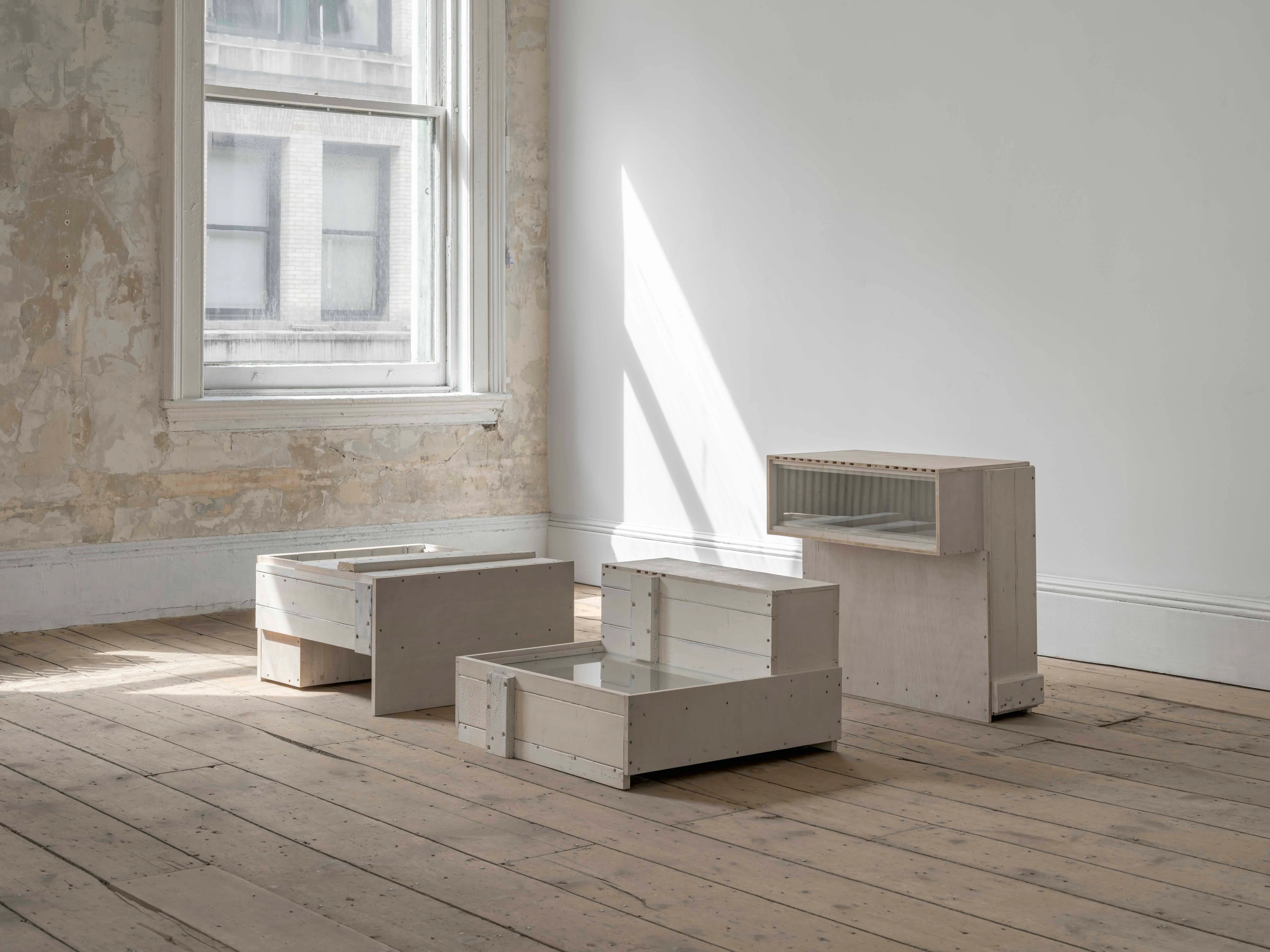
Václav Požárek calls the rods that crisscross the interior of a wooden bow “neons,” though they are in fact wooden dowels. Such deliberate misnaming links Požárek to Dan Flavin and a cadre of minimalist sculptors such as Carl Andre, Donald Judd, and Robert Morris, whose work prompted him in the late ’60s to pursue sculpture after working in trades and studying typography and filmmaking. In the 1984 sculpture Drei Neon, the mislabeling signals an interest in works that hover between model and object. A model—typically an intermediary leading to a final object—is usually subordinated to that object; Požárek deliberately flouts this hierarchy. Across the exhibition, his language games, construction strategies, and material choices complicate minimalism’s orthodoxies and stage a more mutable experience in which nothing is terminal, and primacy is diffuse.
Požárek’s US debut at 15 Orient, titled OOF, is a compact retrospective of roughly thirty works across a fifty-year career, anchored by three large sculptures collectively titled Three of OOF (2023–26). Made expressly for the show and produced in New York (the artist lives in Bern, Switzerland), these sculptures derive directly from a small wooden maquette, Three of OOF (maquette) (2023). The form translates from small to large: an L-shaped configuration composed of two rectangular, open-slat wooden boxes conjoined at the corner. Where the maquette remains raw wood, the larger versions receive a light whitewash. The trio assumes three distinct poses—on the long side of the L, flat and face up, and balanced on two corners—offering a multiplicity that resists expectations of singularity and originality.
The title is an acronym for “one over five,” perhaps referring to five gaps that subdivide the form when seen on its long edge or five runner boards apparent from the short edge. It may also allude to the exhibition’s five “OOFs,” including a drawing, OOF (2025), in which the acronym appears in lozenge-shaped lettering. The sounding out of the title also recalls the French œuf ("egg"). Relations among drawing, model, and the three-times-duplicated sculpture produce an indeterminate economy. It is all eggs, no chickens. They also wink formally at the crate, the structure that ferries artworks from production to display.
A trio of white sculptures that collectively constitute Wändlich (1992), further demonstrates how detailing choices in a single series evade material purity and foster an unsettled sense of provisionality and finality. A periscope-shaped box, where a furniture-grade plywood sheet might elsewhere be pristine, is here a composite panel with an unfinished edge that exposes board-and-batten construction. Taken together, the trio also presents as wall fragments, sliced out of larger structures, capped with glass, and propped up for display. This is also supported by the title, a German neologism that could be approximated as wall-like or wall-y. Open ends—those seams and corners that art often conceals—are instead shown, revealing how parts might meet to form wholes. In an era when studio production standards should be reevaluated, Požárek’s materially vulnerable work feels both timely and generous.
This linguistic sensibility recurs throughout Požárek’s practice: maquette and object, diagram and form, representation and actuality continually shuttle weight between one another. His background as a book designer is evidenced in a well-stocked reading room in which original drawings for cover designs are on view, also sharpening his wit and translation between image and thing. Hinges, too, operate on twin planes: in works such as Offen mit Neon (1995) and Corner Piece (2017), they are sometimes merely suggested, sometimes fully mechanical, underscoring a conceptual suspension that invites consideration about not only what an object is but what it might be becoming.
Embodied Narratives
Kates-Ferri Projects | 561 Grand St, New York
March 6 – April 26, 2026
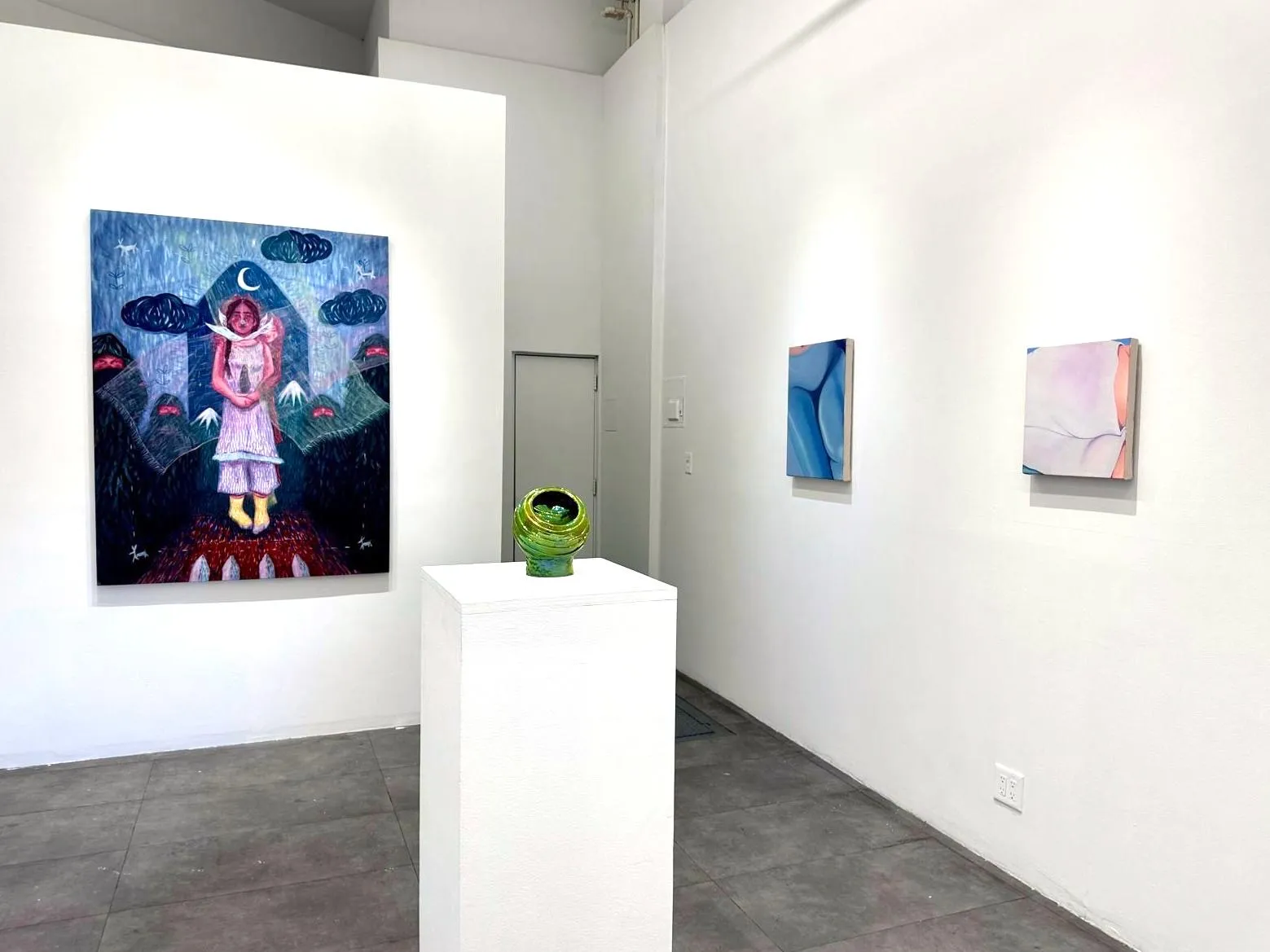
Embodied Narratives at Kates-Ferri Projects, curated by Micaela Giovannotti, ruminates on the human body’s sacred presence and precarious vulnerability. Philosopher Judith Butler writes that we have “a primary vulnerability to others, one that one cannot will away without ceasing to be human”1—that precariousness, vulnerability, and interdependence are constitutive conditions of embodied life. The works in Embodied Narratives pictorially proximate such conditions. Tucked away in the back of the gallery space is Shirin Abedinirad’s single-channel video ALMA (2013), whose title translates to “apple” in her native Azerbaijani tongue. In the work, Abedinirad paints over the reflection of her nude torso, gradually covering her chest, neck, and hair to create a black chador that eventually leaves only her face visible. Abedinirad reaches for what she considers the forbidden, precarious nature of the “apple” by concealing her nude torso with the legally-mandated hijab, conversely uncovering and reclaiming the full presence of her body.
Nearby, Dario Carratta and Krizia Galfo extend the notion of vulnerability into an erotic, dreamlike dimension. Carratta’s trio of small oil paintings depicts a lone nude male idling, contemplating, and reclining in a dark dreamscape, where the teal sky glistens against the terra cotta fortress. His slender body is positioned in voyeuristic openings—between open curtains on a balcony or amidst an open field—precariously exposed, suspended, and gazed upon. Unlike Carratta’s dark and earth-toned palette, Galfo works with a charged, saturated magenta one. In her trio of intimately sized oil paintings, Galfo uses the concealment and sometimes absence of the body to direct our focus to its lingering, erotically charged presence. In Friction (2025), Galfo depicts a close-up of a cluster of metallic purple and silver balloons. The swelling, fleshy, gently creased balloons press against each other as they intertwine, like bodies would in a deep embrace.
In the next room, Turiya Magadlela further amplifies such corporeal tension by stretching and sewing pantyhose across the canvas. In What happened to Lumka? (2023), flesh-toned pantyhose are cropped right below the hip, then sewn into rows, with the white canvas exposed through openings between the bases of thighs. The openings serve as visceral reminders of the female genitalia, which are subject to being stretched, being prodded, and being carved open. Magadlela’s works quietly nod to Senga Nengudi’s sculptures from the R.S.V. P series (1976–), which use sand-filled pantyhose to reflect the tensile resilience of the Black female body. In her series of four small paintings, Adelisa Selimbašić presents bodies as plush, malleable, and within reach. Evasively denying full views of the body, Selimbašić paints close-ups of bare abdomens, leggings-hugged thighs, and buttocks peeking through shorts. In Delfina (2025), the stretched abdomen with its slightly deformed belly button echoes Magadlela’s distorted pantyhose shown on the opposite wall.
Works in Embodied Narratives do not dramatize vulnerability—they quietly insist on it as what renders us human. Bodies here are rendered on the threshold, between concealment and exposure, suspension and distortion, violence and caress, and it is precisely within that tension that the human body’s sacred presence and precarious vulnerability reside.
Ayano Elson: Control
The Chocolate Factory Theater | 38-33 24th Street, Long Island City
April 23 – April 25, 2026
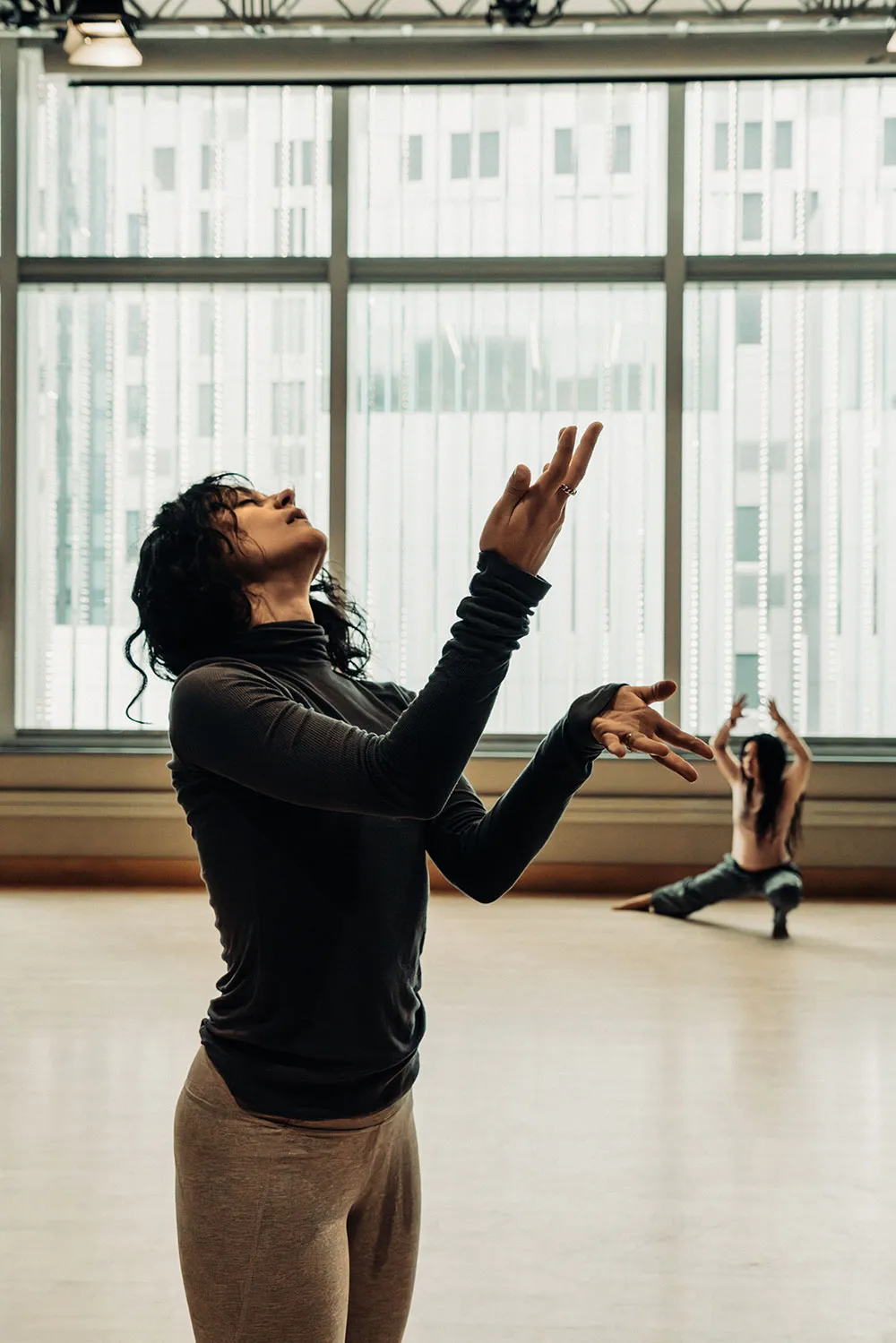
In Ayano Elson’s Control, a minimal exterior scaffolds a sensuous core. The four dancers (Cayleen Del Rosario, Amelia Heintzelman, Owen Prum, and evan ray suzuki) cycle through repeated movements that are simple, often minute, and restrained. We, the audience, can feel a psychic intensity in each sequence—an impulse, ticking beneath the dancing body’s surface, that intuits and responds to its co-presence with performance space and performing peers.
Commissioned by The Chocolate Factory Theater in Queens, Control is a performance that asks us to linger; to stay with its four performers and understand what they create in their interactions, however subtle. An entirely engrossing work, Control activates an aesthetic formalism to stake an intellectual grip on its audience. The dancers mostly perform as individuals, exploring abstract postures or ordinary actions like crawling, lunging, hopping on two feet, reclining seated, and lying sideways on the floor. But when we stay with each performer, we begin to see their uniqueness. They become characters that, through Elson’s perceptive arrangement, physicalize their own histories and desires, shared intimately (although often ambiguously) with others.
The dance begins with Del Rosario and Heintzelman almost nose-to-nose, as Heintzelman lifts Del Rosario’s arm towards the ceiling. This brief physical touch disperses into the comings and goings of all four dancers, who explore space and time as compressed and dilated. They travel far onto the concrete surrounding the stage floor, with pacing varied yet continuously disciplined. Throughout, each dancer holds a gaze that prompts intrigue, as though the object of their sight remains permanently out of the audience’s view. When athleticism builds, and bodies begin to distort the typical organization of their movement, we can sense that a clear logic still informs how the dancers relate. Live music, composed by Matt Evans and performed by Evans, isa crespo pardo, and David Leon, is a vital collaborator in this world.
A major feat in Elson’s work is her ability to formally distill the complex research for Control, which she identifies as “American postmodern dance, postwar slow cinema from East Asia, and Okinawan performance lineages.” Unexpected intimacies of aesthetic and imperial histories unfold in these references. Elson complicates the “neutral” postmodern dance body previously associated with a separation of “dancer” from systems of power, a blank canvas scrubbed of race and sexuality, for example. Instead, this dancer becomes deeply specific. Turning to Okinawa, where Elson was born, also puts these later-twentieth-century dance histories into broader conversation with parallel timelines of US militarism and the afterlives of war. Research sources like photography books by Keizo Kitajima and Mao Ishikawa depict scenes of differing intimacies between the Okinawans and US soldiers who exist on the archipelago, invoking an understanding of intimacy as necessarily entangled with asymmetries of nation, race, gender, and desire. In Control, we surface a similar sensation: a presence and co-presence of bodies skimming towards collision.
Anthony Torrano: Concrete Spirit
White Columns | 91 Horatio St, New York
March 13 – April 25, 2026
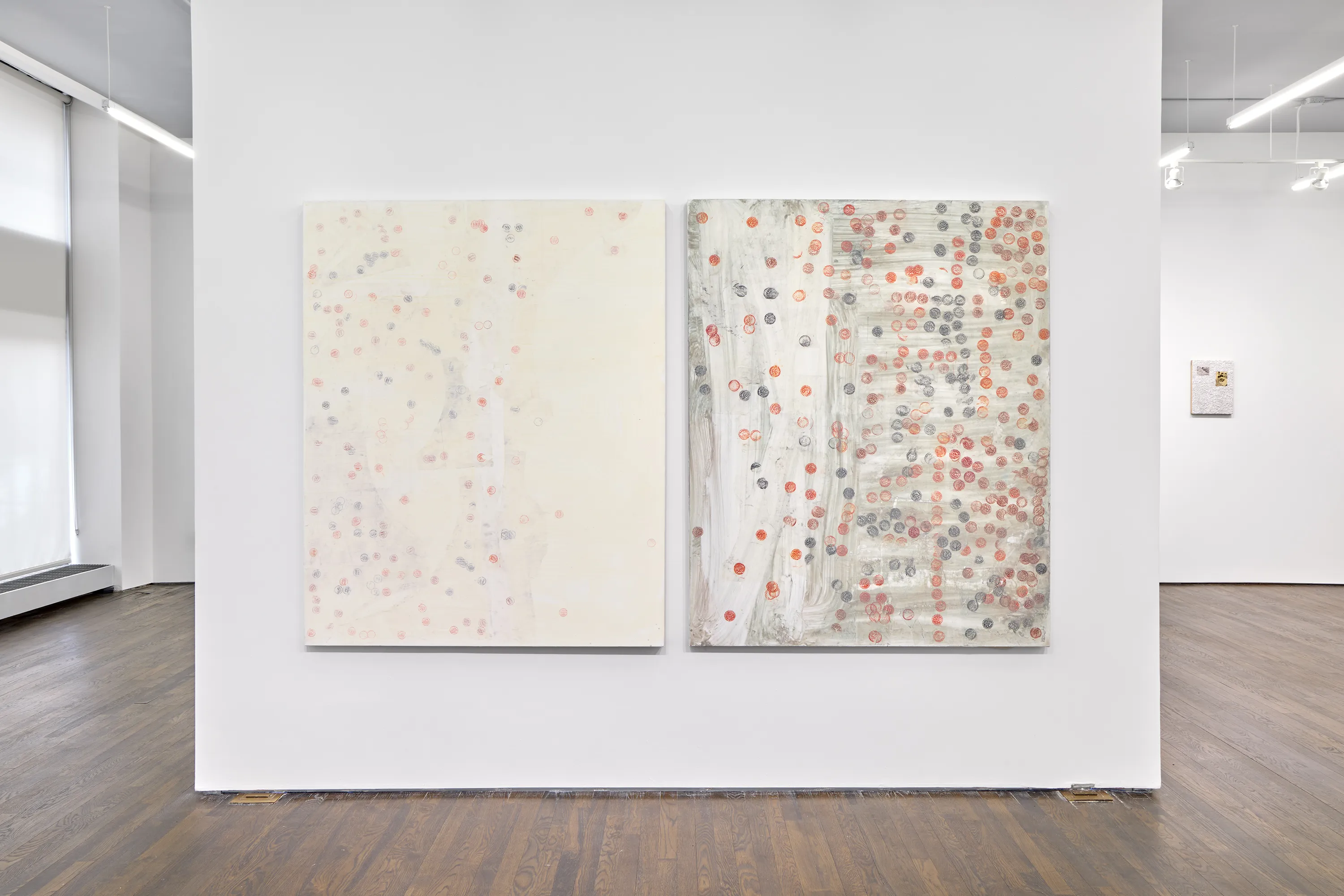
Using frottage, a technique that involves rubbing paper over an object or incised texture with a marking agent, Anthony Torrano has developed a body of paintings that veer between abstraction and specificity, threaded with scattered bits of personal and social narratives. In Concrete Spirit, his debut exhibition at White Columns, Torrano repeats and layers the imprints of objects drawn from both public and private spheres—“SF toilet” stamps, manhole covers, his family’s wooden mooncake molds. In the eponymous Concrete Spirit (2026), a rubbing of a street plaque from San Francisco’s Chinatown is washed with a rusty yellow. Some of the Chinese and English letters are smudged into illegibility or completely lost, and the gray tones of charcoal imbue the plaque with a hazy, weathered quality, reminding us that the past is clouded and inaccessible.
The method of frottage is a highly mediated process; one encounters the object through a sheet of paper, without knowing which details will be picked up or lost. When Torrano transfers the rubbings onto the canvas, a second translation occurs. The ending result is a ghostly index, marked by distortion, loss, and fuzziness. There is a parallel between this process and the attempt to understand and represent a distant past. No matter how carefully one searches, histories—whether of a city or of one’s own roots—are always mediated through layered and unstable memories that may never point to a single truth. This tension is evident in Translator (2026), where an illustration of a cityscape is paired with a cartoon depicting three Chinese American schoolchildren gathered around a record player.
The images are taken from Torrano’s mother’s notebook from the 1960s, when she attended Chinese School in San Francisco, which was later passed down to the artist and became part of his personal collection. Suspended within a field of blank yet textured silver leaf, these images open a space for the artist and viewer to fill in what is unspoken. While the memory of the city in the 1960s can never be fully retrieved from these relics, the artist’s archive is reanimated here through recontextualization. Similarly, the imprints on Torrano’s paintings—never able to fully reproduce their originals or contain the entirety of their histories—are not mere remnants of a lost place or time. Made through rubbings often undertaken on the street with his brother, they become new accumulations of familial memory and intimate experience with the city.
The tears and smears on the frottage paper are retained on the canvas, where unevenly rubbed marks—each bearing a distinct texture—drift and interact both within individual works and across the exhibition space. These “imperfect” impressions add another layer to the histories of the city and his family, forming part of the artist’s process of world-making through painting and printing.
Typoe Gran: Anatomy of a Practice
Boca Raton Museum of Art | 501 Plaza Real, Boca Raton
March 25 – October 11, 2026

Typoe Gran’s art reads as playful on the surface—he doesn’t shy away from that. Look closer into the mind of the artist. Linger.
Gran begins each day in his studio with a couple of hours’ worth of free association drawing. What comes out are shapes and forms, reminiscent of the familiar, but not always exactly identifiable. Recurring objects include toys like children’s building blocks: the Jewish-Cuban artist has long held an interest in early child psychology, in how playing with blocks and shapes helps children develop abstract thinking. Flowers. The floral void inside the Louis Vuitton logo. Raven. Bones. Memento Mori. Gran accumulates a variety of these forms on single pages reminiscent of a da Vinci sketchbook, drawings of human figures, and would-be inventions.
For his first solo museum show, Anatomy of a Practice at the Boca Raton Museum of Art, Gran has expanded from the page to fill a wall—a full 25-feet-across—with his idea-stage charcoal drawn objects and shapes. Curator Keffie Feldman positioned the mural, his largest drawing to date, to face the notebook page-sized artworks it evolved from.
The mural’s title, The World as I See It, takes its name from a quote by 20th-century French author Anaïs Nin: “We don’t see things as they are, we see things as we are.” Indeed, Gran’s drawings build worlds as he sees them around him. His colorful Eden (2025), a bracing departure from the black-and-white charcoal drawings, appears as a playful, hopeful, unpopulated, geometric update of the first two panels from Bosch’s The Garden of Earthly Delights (c. 1490–1510).
Gran further extends the objects from his drawings into large sculptures, some several feet in height. These are displayed in the exhibition as well, positioned down the center of a gallery, creating a visual scavenger hunt encouraging visitors to match the sculptural forms standing before them with shapes on the wall. Most artworks on view were created specifically for the exhibition and have not been seen before.
1 Judith Butler, preface to Precarious Life: The Powers of Mourning and Violence (Verso, 2004), xiv.