Tim Breuer at Champ Lacombe and TRAMPS
Review
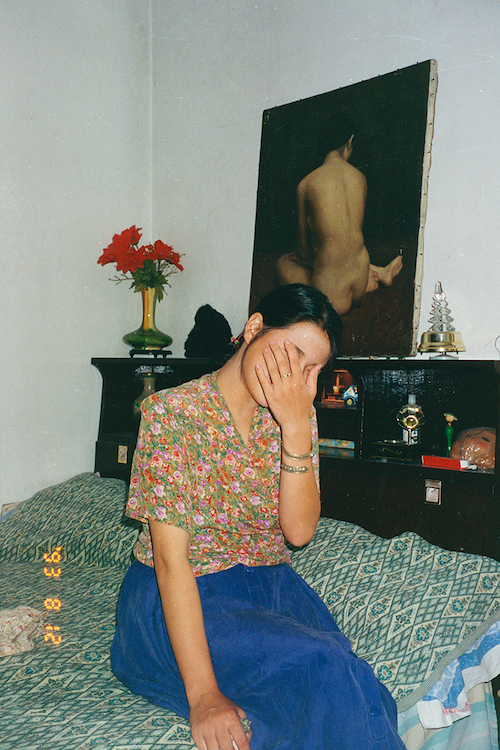
Paris- and Beijing-based artist Thomas Sauvin’s project Beijing Silvermine began in 2009, following his encounter with Xiao Ma, a recycler of silver-bearing waste on the outskirts of Beijing. At the recycling facility, workers routinely dissolved discarded materials containing silver compounds, including film negatives, to extract residual value. Sauvin began purchasing 35mm film negatives by the kilogram, gradually assembling an archive that now comprises over one million images. Most of these photographs date from the mid-1980s to the early 2000s, a period marked by the flourishing of vernacular photography in China prior to the rapid shift to digital formats around 2005.
Working with anonymous photographic negatives otherwise dismissed as visual debris, Sauvin reactivates discarded personal images, foregrounding questions of memory and authorship. Archives—a recent exhibition that paired Sauvin’s prints with the sculptures and drawings of Liu Shiming (1926–2010)—unsettled distinctions between document and artwork, fiction and truth. In these encounters, visual echoes emerge across media, suggesting a form of “family resemblance” between disparate practices shaped by a shared historical moment in China.
Renee Yu Jin: Could you speak about how your recent collaboration with the Liu Shiming Art Foundation came about, and what drew you to this dialogue?
Thomas Sauvin: The collaboration emerged through the Liu Shiming Art Foundation’s ongoing curatorial practice of presenting Liu’s work alongside that of other contemporary artists, through which Beijing Silvermine was brought into dialogue with Liu’s sculptures and drawings. Reviewing archival images of Liu Shiming’s sculptures quickly revealed the potential for a compelling juxtaposition: encountering a sculpture would often call to mind a specific photograph from the archive of Beijing Silvermine.
Beijing Silvermine is deliberately disordered, without keywords, which makes retrieval time-consuming but also generative. Searching for a single image often involves going through thousands of photographs, during which unexpected visual patterns begin to surface. At times, this process takes on a rhythm, one day focused entirely on a particular motif, the next on tracing connections across different images. In this sense, the dialogue between the archive and Liu Shiming’s work emerged as much through intuition as through process. At the same time, it was not without difficulty. Liu’s sculptures are deeply rooted in rural life in China, a subject matter that is only sparsely represented in Beijing Silvermine. This raised initial doubts about whether the two bodies of work could sustain a meaningful exchange.
Working with a large archive often allows for many possible combinations, but here it became clear that the strength of the dialogue lay not in quantity but in precision. Rather than producing many pairings, the exhibition developed around a limited number of photographs, each forming a particularly strong and focused connection with the sculptural works.
RYJ: The exhibition produces moments where photography and sculpture appear to converge, despite being produced in isolation from each other. How do you understand this constructed synchronicity, and what role does fiction play in enabling such connections?
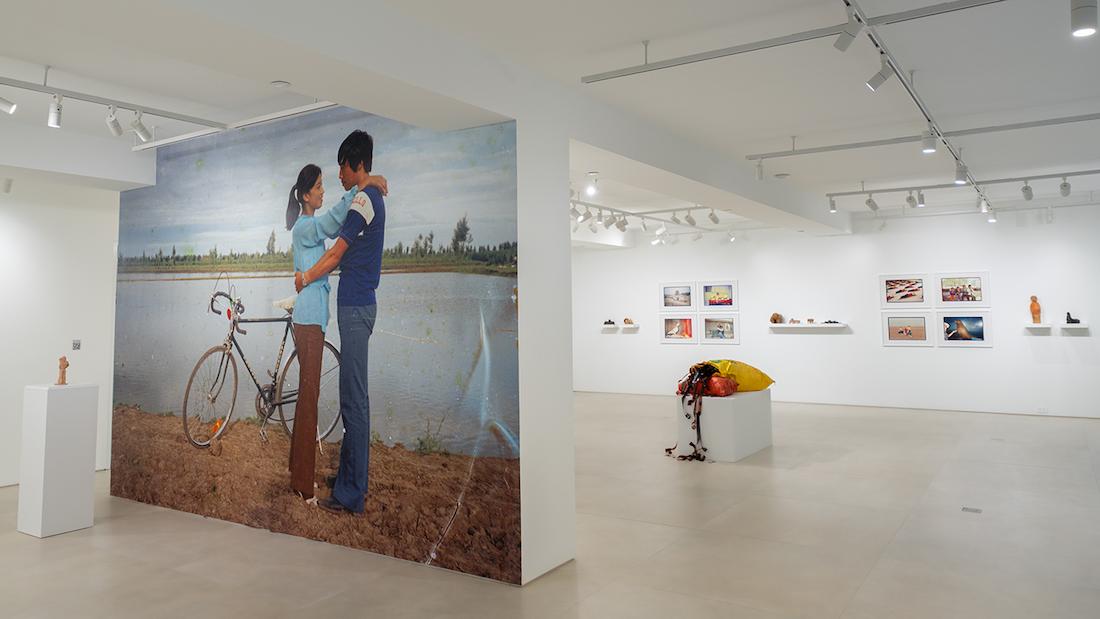
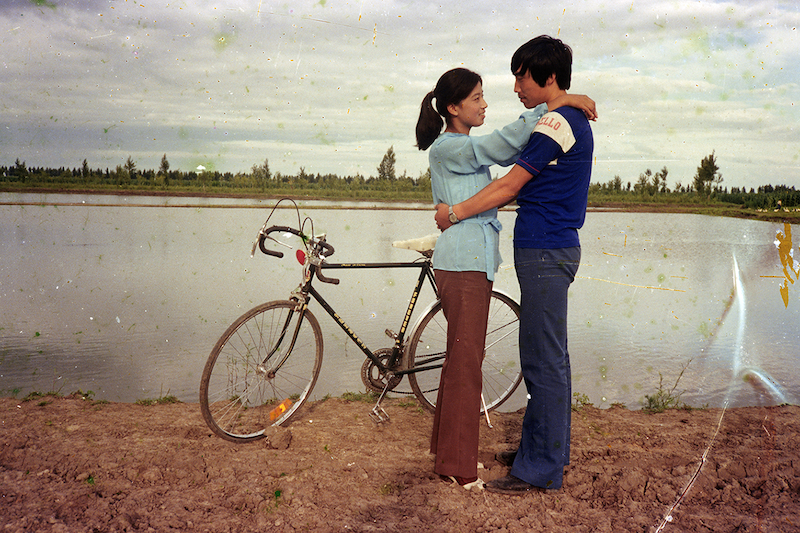
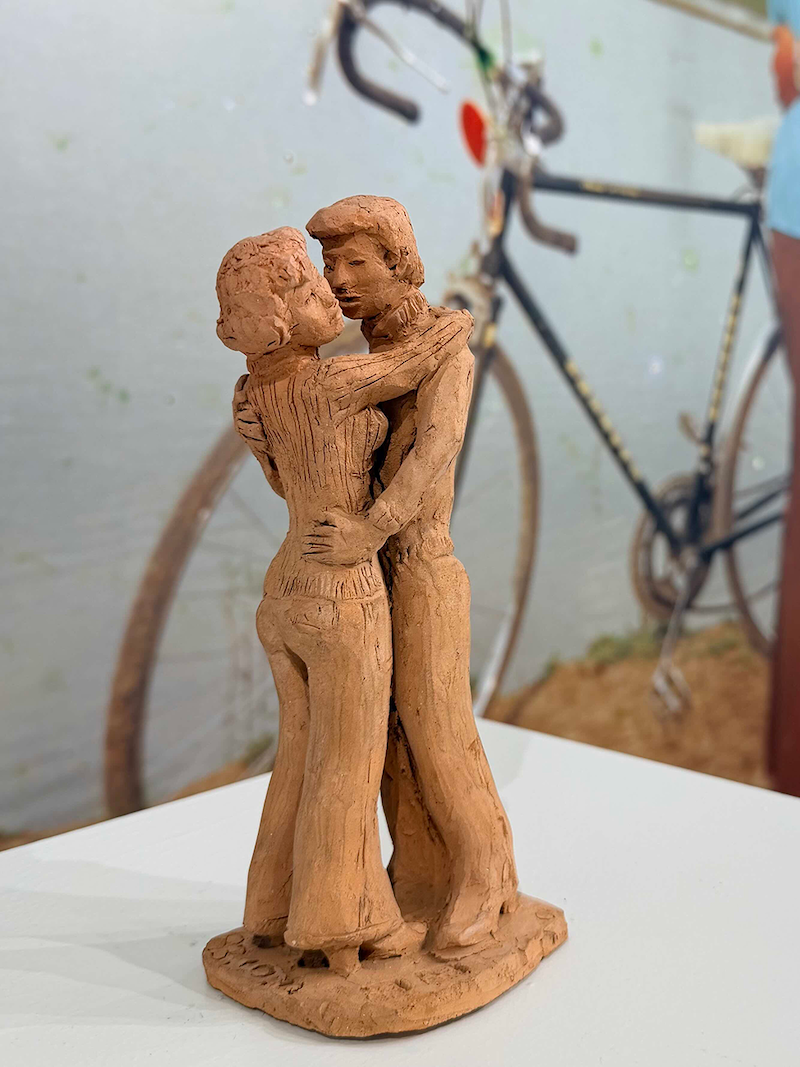
TS: One of the most compelling pairings in the exhibition is the “hugging couple,” appearing both in the photographic wallpaper and in a clay sculpture. There is something almost uncanny in the way the figures stand, hold each other, even in details such as the shape of their clothes. It creates the impression that the photographer and the sculptor were sitting shoulder to shoulder, witnessing the same event at the same moment, both moved by it and compelled to capture it.
At the same time, this impression is clearly a fiction, a construction of the mind. The photograph itself points to a much more specific situation. It was most likely taken using a tripod and timer, which is quite unusual, and became evident when I looked at the other images from the same roll of film. This couple appears repeatedly, always photographing each other, with no third person present. In fact, the consistency across the images suggests a mutual staging, him photographing her, or her photographing him, across multiple scenes.
In this context, while the pairing in the exhibition creates the impression that the photograph and the sculpture are witnessing the same event, the photograph itself belongs to a very different, situated moment. The apparent synchronicity is constructed rather than real. Beijing Silvermine is not driven by a concern for historical accuracy, but by the stories that can be produced through these images, materials collected from the recycling stream and reactivated through new forms of association.
RYJ: When did you begin working with the “hugging couple” at a larger scale, and what changed when you enlarged it?
TS: I first came across these images at the very beginning of Beijing Silvermine, around 2010. I was immediately drawn to them and used them in books and exhibitions over the years. It was only much later that I began working with them at a larger scale, using them as wallpaper.
When I enlarged the image, I noticed that the word “forever” (yongjiu in Mandarin) was written on the bicycle, something I had not seen before. What interests me is this moment of rediscovery: you think you know an image, and then, when you scale it up, details that had remained unseen begin to emerge.
RYJ: The exhibition is titled Archives. How do you understand the idea of archiving ordinary life in relation to your work?
TS: “Archiving ordinary life” may be a way to describe the Beijing Silvermine today, but it was not the initial intention. The project emerged from a long period spent in China and was shaped by my work collecting contemporary Chinese photography for a private collection based in London.
The encounter with these negatives happened almost by accident, while searching for new material. At first, they appeared banal, even uninteresting, and there was little expectation that they would lead to a sustained body of work. What sustained the process was precisely this simplicity: the images felt very close to everyday experience in Beijing, yet far removed from what circulated in magazines, television, or art exhibitions.
RYJ: In the exhibition, the images are presented as enlarged photographic prints rather than as original negatives. Could you speak about this shift, and how the material qualities of the print relate to questions of time in your work?
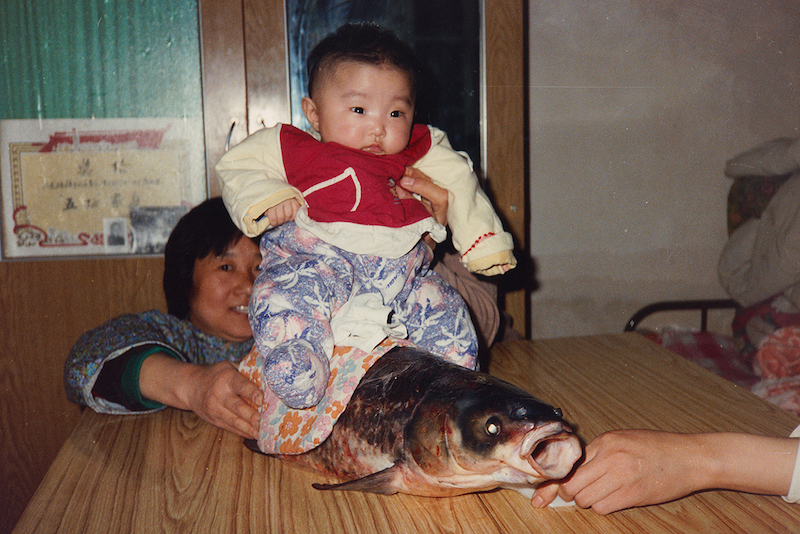
TS: There are essentially two kinds of dates involved. One refers to the production of the print, while the other, when available, corresponds to the moment the photograph was originally taken. In many cases, however, the latter remains undetermined, as the negatives themselves do not always carry a visible date. Only when a date is inscribed on the film, through the technology of analog photography, can it be identified with certainty.
In terms of production, the prints shown in the exhibition are C-type handprints made directly from the original negatives. Today, a more common approach would be to scan the negative, convert it into a positive digitally, and print it using an inkjet printer. By contrast, the analog process involves enlarging the negative directly onto photographic paper, without any intermediate digital step. The image is produced through the transmission of light and shadow onto a light-sensitive surface, effectively re-inscribing the photograph through a second chemical process.
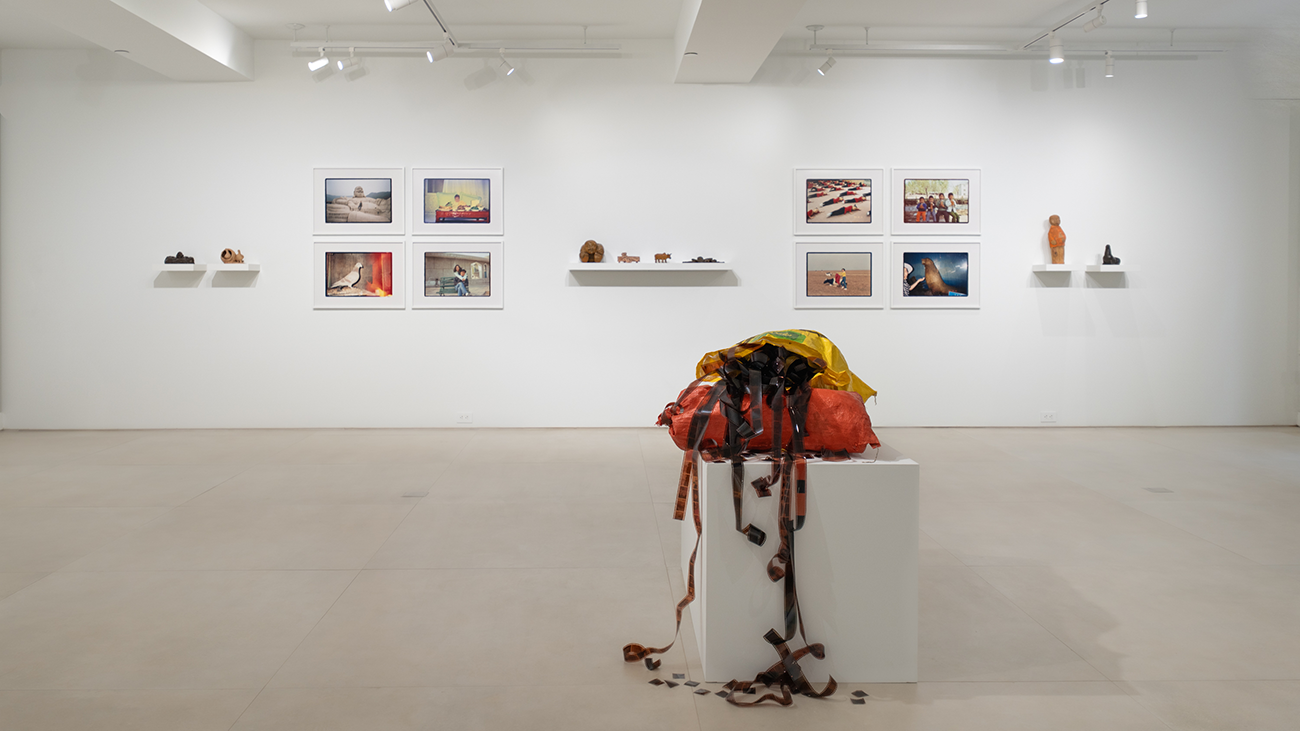
While certain adjustments remain possible in the darkroom, such as exposure or color balance, the image cannot be fundamentally altered. In this respect, the print remains closely tied to the original negative. This relationship is further emphasized by the presence of black borders, which correspond to the edges of the negative itself. These borders signal that the image has not been cropped or recomposed, but is presented as it exists on the film. In the context of the exhibition, the visible frame, with its edges and limits, foregrounds the image as a material trace, rather than a fully composed picture. This differs from other contexts, such as photobooks, where images are often presented full-frame and without such markers.
RYJ: Thinking of the archive as a material resource, how do you approach the anonymity of the people depicted, and the questions of authorship it raises?
TS: These images often capture intimate moments that were never intended to be seen by others, and in this sense, anonymous photography renders its subjects particularly vulnerable. This requires a careful approach, one that remains attentive to the humor and lightness of everyday snapshots, without slipping into mockery. It is a delicate balance, and not always an easy one to maintain.
The question of authorship is more complex. While the photographs themselves are not authored here, the work lies in their assemblage, in collecting, recontextualizing, and bringing them into relation within a larger project. This suggests that authorship resides less in the making of images than in the act of bringing them together.
RYJ: You’ve been quite active in art book fairs in recent years. How do you see these spaces in relation to the circulation of your archive?
TS: Photobooks have always been central to the project, though it took some time to understand why. They are not simply an outcome, but a way of archiving. The process begins with collecting and organizing material, often over many months or years, until a particular direction or narrative emerges. When it feels sufficiently resolved, it takes the form of a photobook.
Once published, usually in editions of several hundred or a thousand copies, the work enters circulation. At that point, there is a sense of release, as the material is no longer confined to a single physical archive, but distributed across multiple sites and readers. In this sense, the photobook functions as a form of preservation through dissemination.
By contrast, the physical archive, with its negatives and prints, remains inherently fragile. Despite careful preservation, it is always subject to contingency, loss, or dispersal. Photobooks offer a different temporal horizon: once in circulation, the work persists across contexts, allowing these images to continue to exist in another form.
Archives was on view at the Liu Shiming Art Gallery from February 24 to May 17, 2026. Maëlle Ebelle served as the gallery director and project manager for the exhibition.
This interview was edited for clarity and length.