Retail Therapy at the Affordable Art Fair
Voice
The title of the Institute of Contemporary Arts London group show, Genuine Fake Premium Economy, marries opposites: “genuine” and “fake,” “premium” and “economy,” mass-produced and exclusive, kitschy and high-end, counterfeit and authentic. This oxymoronic title can refer to a copy, an appropriation, or a fiction of some sort, establishing the context in which Jenna Bliss, Jasmine Gregory, and Buck Ellison probe notions of authenticity.
Curator Nicola Leong opens the exhibition text with the biographies of the artists: all three were born in the United States in the mid-1980s, entering the workforce in the wake of the 2008 market crash. Across the exhibition, a lexicon of dissent forms around three main institutions—finance, family, and art. It is apparent that their practices were shaped by a milieu defined by ongoing aspiration and antagonism.
.jpg)
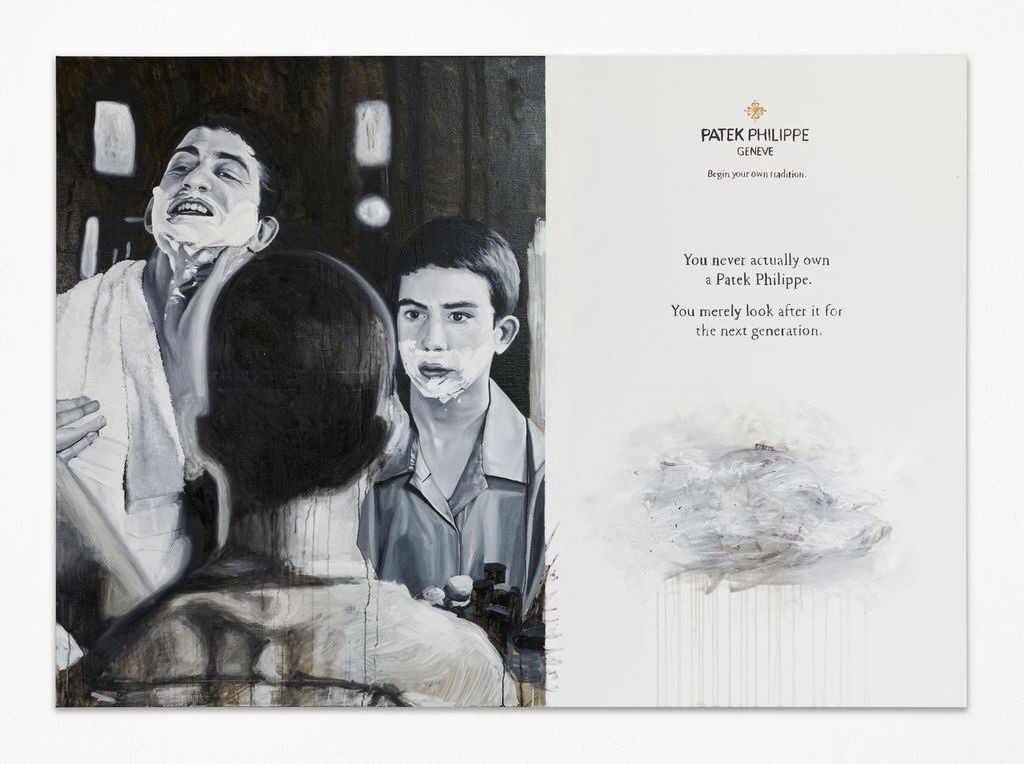
In the main gallery, Gregory presents two new paintings from her Investment Piece series. Both appropriate the visual language and rhetorical devices of luxury watch brand Patek Philippe’s “Generations” campaign introduced in 1996. Characterized by glossy black-and-white photography and a signature tagline signaling virtues of stewardship, the advertisements feature idealized father-son relationships. Here, the artist examines inheritance as a financial and affective infrastructure through which class reproduces itself across generations.
Gregory negotiates the condition of visibility, one of simultaneous representation and exclusion, through a material intervention. In Investment Piece no. 11 (2026), the watch is deliberately obscured—muddied with painterly brushstrokes and scattered with glitter and dust. This gesture unsettles the myth of permanence within patrimony, asking what kind of values become institutionalized, and how art can contest them.
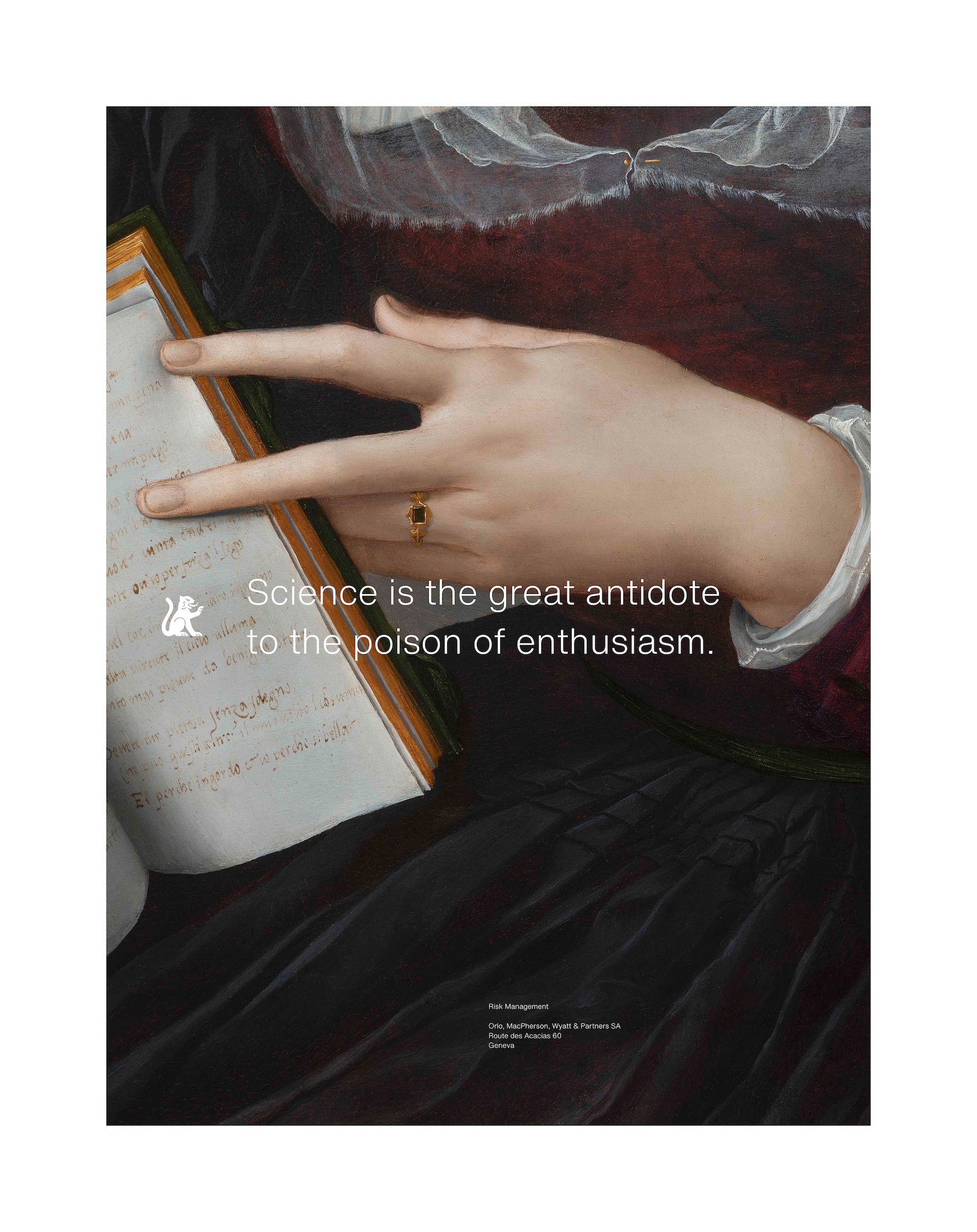
Ellison’s method of appropriation is more oblique. For this show, he created a fictional private bank, Orlo & Co., and a meticulous world around it. In Jack’s Office (2026), the artist assembles a profile of Jack, an 18-year-old imagined as a 30-year-old American man working in Orlo & Co.’s London office. Through a selection of found and fabricated ephemera—receipts, books, and other personal effects—in a glass cabinet, Jack appears as a megalomaniac drawn towards the rhetoric of enlightenment, self-optimization, and warfare. Opposite, three lightbox pastiches of paintings by John Singleton Copley, Bronzino, and Édouard Manet are framed as marketing materials for the bank, overlaid with sterile taglines such as Adam Smith’s “Science is the great antidote to the poison of enthusiasm.”
For Ellison, pictorial appropriation is an indexical process of researching, studying, and citing the visual codes through which power legitimizes itself. What makes Jack legible is a kind of private exchange with viewers, one that thrives on empirical precision. While the fictional protagonist might seem disembodied and peculiar to some, he is immediately recognizable by those from the same socioeconomic class. Attesting to Bourdieu’s idea of habitus—a set of internalized, often classed dispositions of a lifeworld—these visual codes can reveal a lifestyle, a belief system, and in this case, the gap between one social world and another.
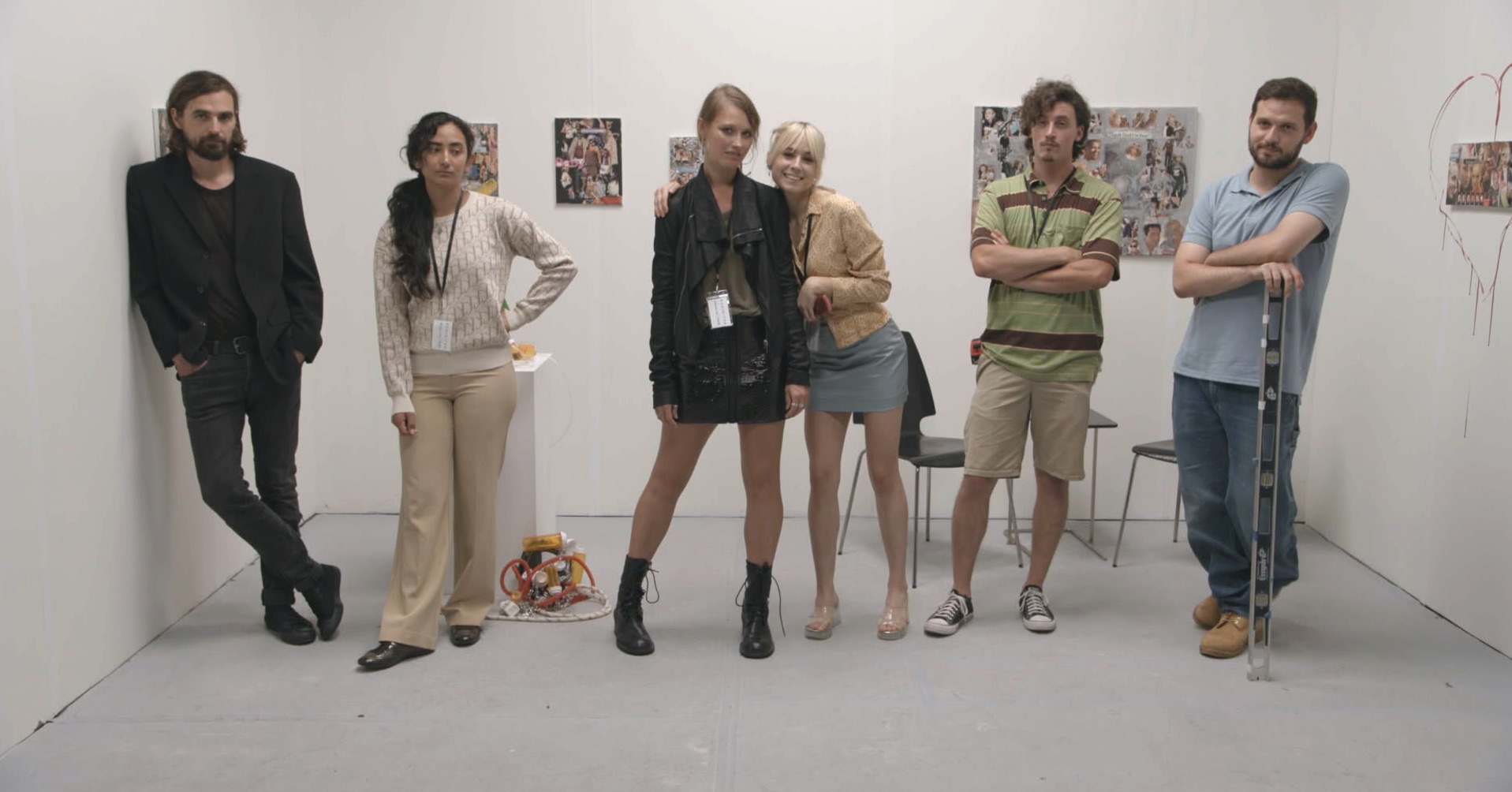
The exhibition closes with Jenna Bliss’s True Entertainment (2023–24), a video work posing as a reality TV show about a fictional art fair billed as “the most prestigious art fair.” Borrowing its visual style from The Hills (2006), this satirical piece toys with the dynamics between art-world archetypes: the neurotic artist, the sanctimonious gallerist, the nepo-baby gallery assistant, the critical theory aesthetes, each toeing the line of social performance to fulfill their own aspirations.
Fictions, when informed by lived experience, expose economies of value, labor, and exchange. The fictional systems throughout the exhibition—a fake art fair booth, a simulated advertising imagery, an imaginary private bank—are not merely frivolous satire. They come from a historical continuum of artistic subversion. Recall Andrea Fraser’s museum tours in the late 1980s, or Carey Young’s call center in the early 2000s: both staged fictional situations with performative scripts operating as an exposé of institutional bureaucracy.
At a time when race, gender, and trauma remain popular organizing principles of group shows at major institutions, this grouping of artists offers a refreshing invitation to think about financial infrastructure—the material conditions that shape artists’ practices and lives. Read this way, Genuine Fake Premium Economy participates in a broader reorientation in contemporary art history: a shift from institutional critique to infrastructural critique. Where institutional critique took the museum as a site of dissent, infrastructural critique, coined by the late theorist Marina Vishmidt, holds that criticism must attend to the infrastructure that surrounds the production of institutions—labor market, philanthropy, corporate power, real estate—and how they perpetuate the structural violence of capitalism and its racist, patriarchal foundations.
To exit the show, visitors must walk past a vitrine of artist-made exhibition merchandise for sale. For artists, when the real world is rife with the capital they criticize and the exhaustion they endure, the question persists of how effective it is to aestheticize one’s own struggle. Genuine Fake Premium Economy is a smart group show to see for those wondering what style can look like when precarity continues to govern lives across locales. It is a play on access, taste, glamour, and the class that produces them. It is also a self-referential joke by the artists, on the delusion of aspiration, and most of all, on their limits against a collapsing world.
Genuine Fake Premium Economy is on view at the ICA London through July 5, 2026.