
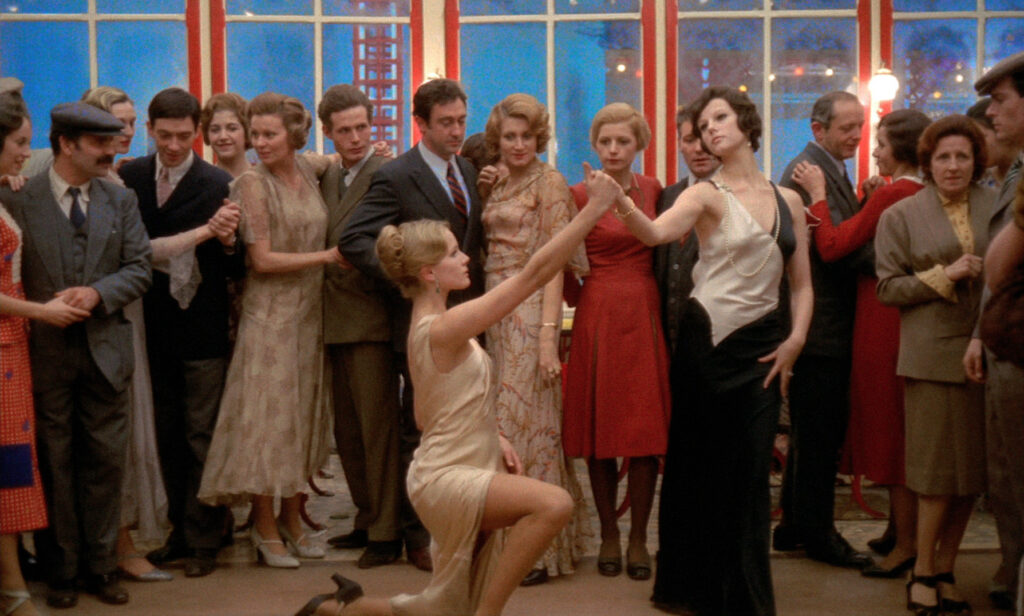
"The Conformist" by Bernardo Bertolucci
Review
This year is the 100th anniversary of Marilyn Monroe’s birth, and the world couldn’t pass up the opportunity to celebrate. There are Marilyn tea sets for sale, and Marilyn caviar sets too; Marilyn kissy socks from Brooks Brothers, a Marilyn vacuum cleaner from SharkNinja. In the Academy Museum of Motion Pictures’ consumeristically-named Rolex Gallery, there will be an exhibition intended to highlight Monroe’s agency in how she navigated the studio system and crafted her own image within it. Yet perhaps the best celebration of Monroe would be to watch her lesser-known 1952 psychological thriller, Don’t Bother to Knock. In one of her first starring roles, she delivers an unnervingly internal performance, one that pushes against the post-World War II mass market society and stands in contrast to the ways she’d soon be commodified and exploited.
Don’t Bother to Knock, sensitively directed by Roy Ward Baker, opens in a Manhattan hotel that wants to be an all-stop shop for its guests: it has an actual shop and a lounge singer, and there’s a detective on staff. The elevator operator will even recommend a babysitter, which is where Monroe’s Nell comes in, the operator’s niece. Nell, an inexperienced babysitter, threatens the easy, efficient facade of the hotel after she’s charged with the care of a well-off couple’s child. What could go wrong? The couple’s just downstairs in the banquet hall. After putting the child to bed, Nell begins dreaming of a different life, a cozy life. She dresses herself in the mother’s negligee, earrings, and lipstick, and then she invites over a man she sees through the window on the other side of the courtyard.
.%2020th%20Century%20Fox.webp)
In a sense, Monroe is tasked with playing an antagonist to capitalism, a woman who can’t and doesn’t deliver the on-demand care she’s paid to give. In a simpler noir, she might be nothing more than that. Yet here, Monroe has created such a feeling, singular character that the film slows and warps around her. Her performance prevents her character, a woman recently released from the mental institution in which she was placed after the death of her boyfriend in World War II, from serving the typical noir structure.
In large part because of Monroe’s performance, Don’t Bother to Knock feels distinct from movies like Psycho (1960) and Leave Her to Heaven (1945). In those, mental illness fits relatively cleanly into the film’s arc and symbolizes various threats to an ideal and safe American way of life, while Baker and Monroe resist portraying Nell’s increasing disorientation as part of a symbolic narrative. Instead, they seem more interested in preserving the sense that who’s most affected by Nell’s confusion is herself. Baker lets the camera roll when Monroe comes on screen, tossing aside the classic cinematic pace of the hotel and falling into Nell’s personal rhythm. Monroe never loses sight of Nell’s psychology, juggling her desires and hopes, her exhaustion and fear, her rage and desperation. She has several masterful moments where she seems to couple Nell’s growing confusion both with a partial awareness of that confusion and with a panic that she won’t be able to make her confusion stop. And all of this is filtered through Monroe’s constantly searching, evaluating, painfully open gaze.
.%2020th%20Century%20Fox.webp)
While Nell could be a simple villain or a stand-in for irreparable World War II trauma, Monroe unsettles the noir genre by making Nell first and foremost an individual. This itself is an anti-commercial feat. Unsurprisingly, the film was not a hit, neither critically nor at the box office. Yet what The New York Times reviewer Bosley Crowther called a confused, “not quite certain” approach to the role of Nell could probably better be described as one ahead of its time.
Interestingly, Monroe’s performance also feels out of time with the rest of the movie. To Ned (Richard Widmark), the man from across the courtyard, Nell is just a detour from a more conventional relationship with the lounge singer played by Anne Bancroft. There’s a quintessential busybody across the courtyard, too, with her quintessential subservient husband. Nell’s uncle, the elevator operator, is run-of-the-mill and eager-to-please, wanting nothing more than to do a stand-up job. Throughout the film, these straightforward characters are challenged in trying to deal with this unusual person whom they can’t quite figure out. From this angle, Don’t Bother to Knock feels like a sad premonition of the future for Monroe and her career. Soon, she’ll be stuck in roles very much of their time, roles like Bancroft’s attractive lounge singer, ones that neatly serve the purpose and pace of their film and thus the box office.
.%2020th%20Century%20Fox.webp)
Yet even when Baker steers the film to a relatively clean end, Monroe blocks her character from blending into an easy narrative. She is tasked with speaking what sounds like the first halves of maxims without endings, which she does with precise and personal interiority. It’s clear that Nell knows what she means, but doesn’t have either the energy or the words to communicate it. When the film asks Monroe to contribute to its hopeful, routine message, she ultimately preserves Nell’s complexity. In Don’t Bother to Knock, Monroe cements herself as a master of emotion and psychology, an artist who values the humanity of the individual over the superficial and harsh system of commodity.
On April 11, The Museum of the Moving Image will screen Don’t Bother to Knock as part of its series Marilyn Monroe in New York. The film was also recently shown as part of the MoMA program Marilyn Monroe: Celluloid Dream.